Get the report: How to Achieve CIO-CEO Alignment in the Era of AI
RAKUS Co., Ltd., the company behind popular cloud services such as the expense management system “Rakuraku Seisan,” continues its rapid ascent in Japan’s SaaS industry. With a long-term vision of becoming one of Japan’s leading enterprises, Rakus is aggressively expanding its workforce and opening new offices nationwide. To support this fast-paced growth, the company needed a secure environment where employees could work from anywhere. Their solution: the cloud-native security platform Netskope.
Rakus adopted a Zero Trust approach to ensure secure and flexible work, enabling efficient operations amid rapid expansion. Compared to other solutions, Netskope stood out for its robust Security Service Edge (SSE) capabilities, ease of operation, and ability to combat shadow IT.
In a shrinking labor market, Rakus aims to help companies grow and improve employee wellbeing through its IT services. Since its founding in 2000, the company has grown rapidly by offering the “Rakuraku Cloud” suite, including expense, sales, and attendance management tools. Under its medium-term management plan (FY2021–FY2025), Rakus has set a goal of reaching ¥10 billion in net income and ¥20 billion in net assets by March 2026.
With hundreds of new hires annually and multiple new offices opening across Japan, Rakus needed a fast, flexible, and secure digital work environment. The company’s former remote work setup relied on remote desktops to access in-office PCs, which created several issues: poor performance, VPN complexity, increased cyber risk to VPN appliances, and the need to provide two PCs per employee, raising both cost and administrative burden. Although they explored VDI (Virtual Desktop Infrastructure) as a solution, it was ultimately deemed too costly.
This prompted Rakus to adopt a Zero Trust model. “Zero Trust allows us to operate securely with just one PC per employee—no VPN needed. This helps reduce the cost and complexity of PC operations as our headcount grows. It also ensures both security and convenience across all work locations, while accelerating the secure launch of new offices using only a PC and internet connection,” explains Keisuke Inoue, Manager, Osaka Information Systems Section, Information Systems Department, Technology Headquarters at Rakus.
Other vendors had separate management interfaces for each function, which we found cumbersome. Netskope’s single-pane-of-glass interface was a major plus
Initially, Rakus explored other Zero Trust solutions but had concerns from a security standpoint. “Our employees actively use various cloud services to enhance productivity. When implementing Zero Trust, having a CASB (Cloud Access Security Broker) to visualize cloud usage was critical,” recalls Inoue.
To strengthen shadow IT countermeasures, Rakus compared Netskope to competing platforms. They found that Netskope provided superior visibility into cloud usage at the operational level. This, combined with a secure, user-friendly Zero Trust experience, tipped the scales. Netskope also fit within the budget when considering the costs of the previous remote desktop setup. “Other vendors had separate management interfaces for each function, which we found cumbersome. Netskope’s single-pane-of-glass interface was a major plus,” adds Inoue.
Our primary goals were to gain visibility into internet-bound traffic and ensure secure cloud service usage within our on-premises environment
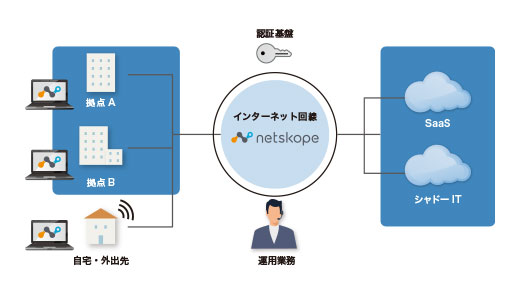
Rakus adopted Netskope in July 2023 and began a Proof of Concept (PoC). “Our primary goals were to gain visibility into internet-bound traffic and ensure secure cloud service usage within our on-premises environment,” says Kazuyoshi Fujiki of the Osaka Information Systems Section, Information Systems Department, Technology Headquarters. “All traffic routes through Netskope, which can disrupt compatibility with certain applications. We started small and worked with each department to identify potential issues. For apps that initially became unusable, we adjusted Netskope’s permission policies to resolve them.”
Following successful PoC validation, Rakus began a company-wide Zero Trust rollout with Netskope in July 2024. The initial phase prioritized new hires, employees due for PC replacements, and departments with frequent business travel. Equipped PCs with Netskope clients and necessary apps were distributed, with full deployment expected by the end of FY2025.
Rakus’s implementation of Netskope was supported by Tokyo Electron Device (TED), a Netskope partner known for delivering advanced IT solutions. “The Japanese-language manuals were easy to understand, and the best practices provided were very helpful. When we were still unfamiliar with Netskope, TED hosted briefing sessions that made a big difference. They also hold regular meetings where we can share our requests and receive updates. Their responses to our operational questions are always quick and accurate,” says Tomonori Nakamura, Osaka Information Systems Section, Information Systems Department, Technology Headquarters at Rakus, praising TED’s support.
Netskope not only boosted performance but eliminated the hassle of VPN connections, which users appreciated. Users don’t even realize security is being enforced behind the scenes, which benefits both operations and user experience
“Netskope not only boosted performance but eliminated the hassle of VPN connections, which users appreciated. Users don’t even realize security is being enforced behind the scenes, which benefits both operations and user experience,” says Nakamura. “VPN disconnections used to compromise our security posture. With Zero Trust, we now maintain consistent security regardless of location. Also, because access control is managed per user—not per IP—organizational or personnel changes are easier to handle,” adds Fujiki.
One notable operational benefit was firewall optimization. “We’ve minimized the number of perimeter firewalls thanks to Zero Trust, reducing both costs and management overhead. When launching new offices, we no longer need to purchase additional firewalls, which accelerates deployment and curbs investment.” As for shadow IT, Netskope enables Rakus to track who is using which application, under which account, and what actions they’re taking. “We regulate the use of generative AI, and being able to visualize usage of such emerging services via Netskope is extremely valuable,” says Fujiki.
Next steps are enforcing rules while balancing usability. “There are still many Netskope features we’ve yet to fully utilize. Next, we plan to test and validate cloud services that are technically prohibited under our current policy. With Netskope, we aim to enforce rules more strictly while maintaining a balance between security and usability,” concludes Inoue.
With Netskope, Rakus continues to provide an environment where employees can perform at their best—securely and efficiently—fueling its impressive growth trajectory.