As governments and organizations take steps to prevent the further spread of COVID-19, we at Netskope Threat Labs have been tracking the effects of these measures. We have seen an exponential growth in the number of remote workers over the past two weeks as “social distancing” measures have been enacted throughout North America. This blog post provides an analysis of the last six months of use of our platform from North America.
Remote work trends
Organizations, governments, and communities around the world are increasingly enacting social distancing measures to control the spread of COVID-19 (Netskope included). The net effect of these measures is that the number of people working remotely and directly accessing the Internet and cloud apps and services is increasing exponentially.
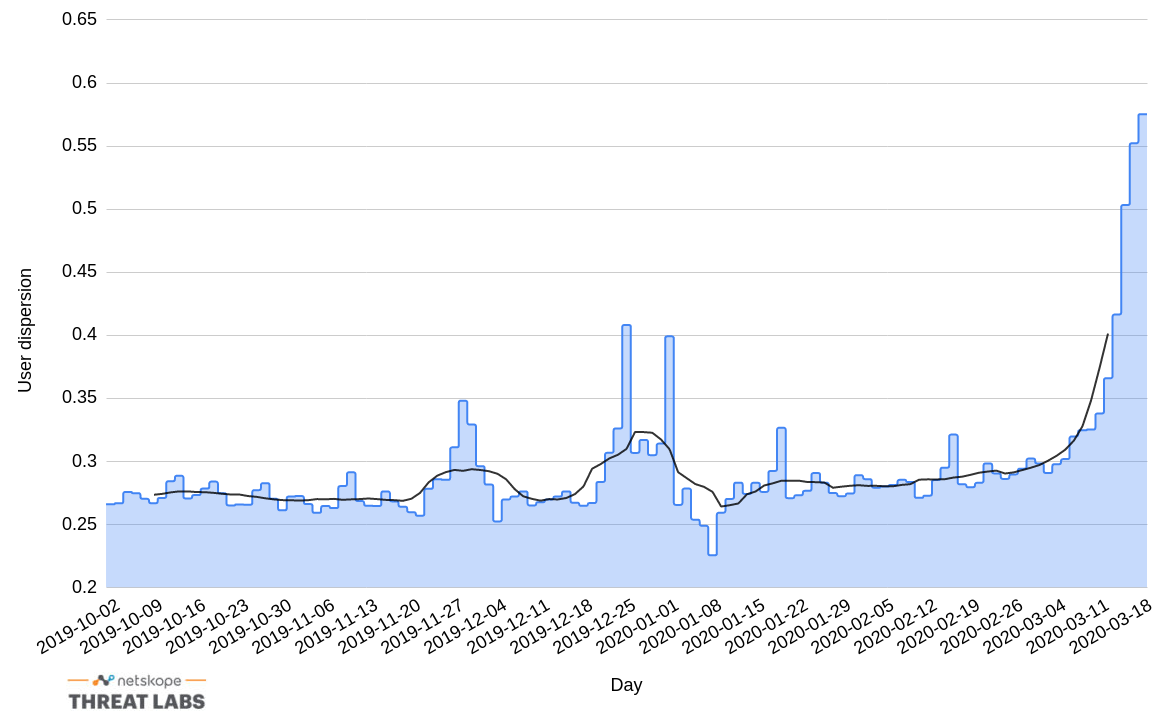
We approximate the percentage of remote workers using a measure we refer to as user dispersion: the ratio of the number of distinct globally routable IP addresses from which users are working to the total number of users. If all users are on the same network (e.g., they are in the same office or or connected to the same VPN), this ratio approaches zero. If all users work remotely from different locations and don’t use a VPN, this ratio approaches 1. Below, we show the trend of this ratio over the past six months, excluding weekends. The average remote work percentage on weekends has held steady at 43% for the past six months.
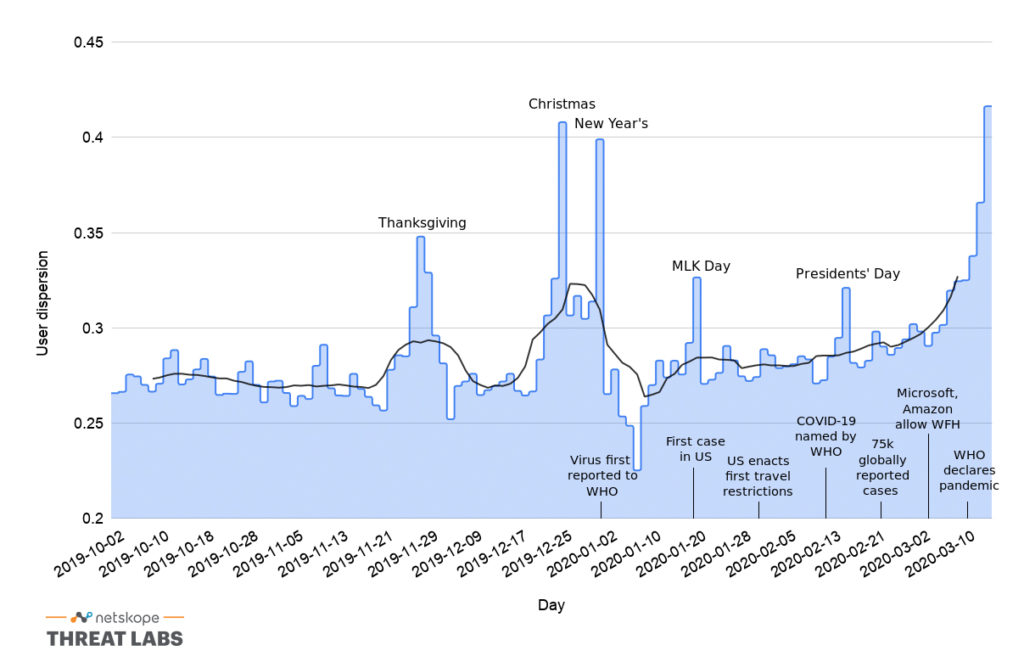
The chart shows that remote work increased gradually for the first 8 weeks of 2020 after the virus was first reported. It has been increasing at an exponential rate in the past two weeks, as companies, beginning with Amazon and Microsoft, have been explicitly encouraging employees to work from home, an important social distancing measure.
The chart also shows a few earlier spikes, which correspond to major US holidays:
- Thanksgiving
- Christmas
- New Year’s Day
- Martin Luther King, Jr. Day
- Presidents’ Day
Prior to the COVID-19 outbreak, 27% of users worked remotely on the average weekday. For the week ending on March 6, the average was 30%, with a Friday peak at 32%. For the week ending on March 13, the average increased to 35%, with a Friday peak at 42%. In other words, the percentage of users working remotely has increased by 15 percentage points since the beginning of the COVID-19 outbreak.
Friday’s peak of 42% is just 1 percentage point behind the average weekend remote work percentage, and higher than any of the holidays in the past six months. Additionally, the total number of remote workers is the highest we have ever observed. On weekends and holidays, the total number of active users is approximately ⅓ that of an average weekday. This means that on Friday, we saw three-times as many remote workers as we typically see on a weekend or holiday.
Update 3/17
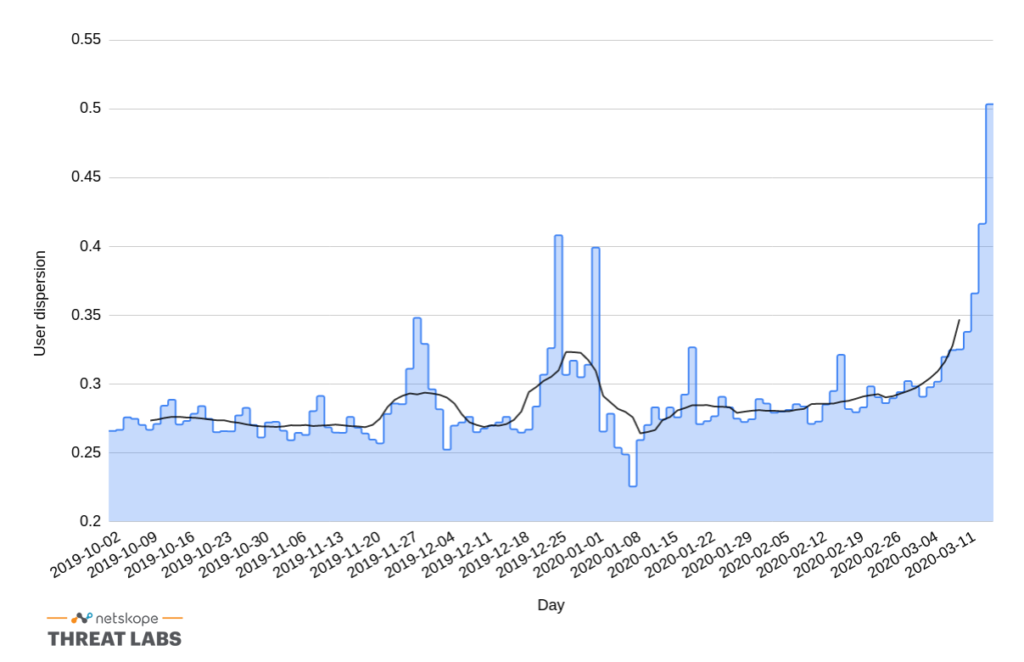
Remote work continues to increase. On Monday, March 16, more than half of all users worked remotely, an increase of more than 8 percentage points since Friday, March. 13.
Update 3/18
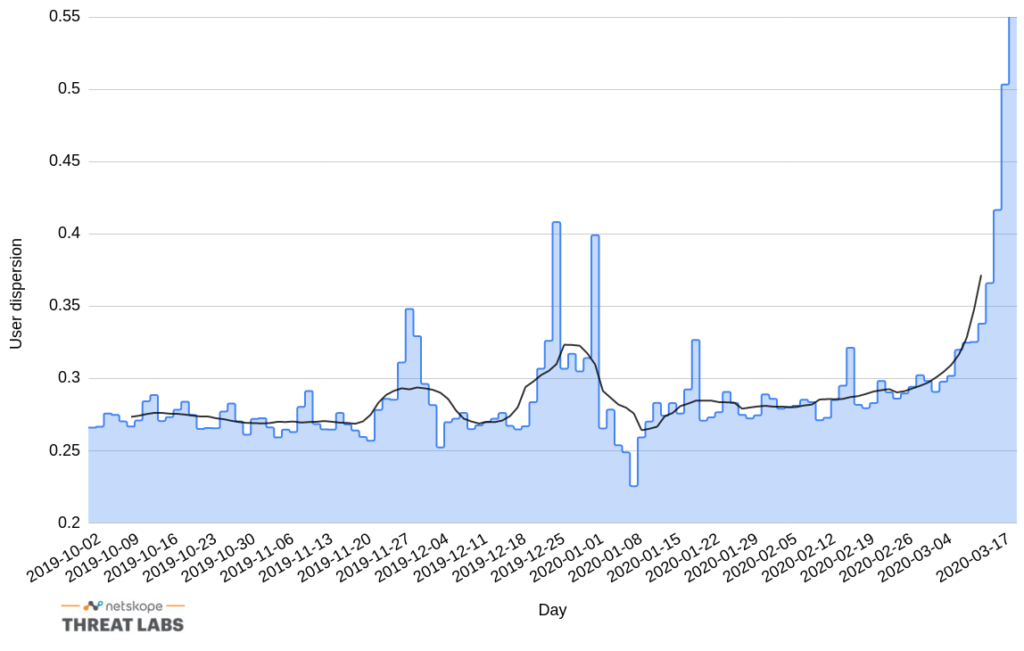
On Tuesday, March 17, remote work went up another 5 percentage points to 55%.
Update 3/19
On Wednesday, March 18, remote work went up another 3 percentage points to 58%. We expect remote work to level out around 60% for the week. Currently, more than twice as many people are working remotely in North America compared to last year’s average. As the rate of growth slows, so too will our updates to this post. We will continue to monitor the situation and provide updates if we see any significant changes.
Update 3/24
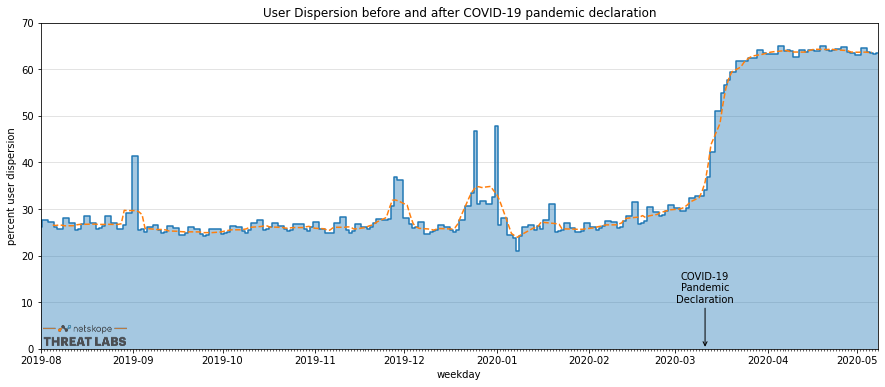
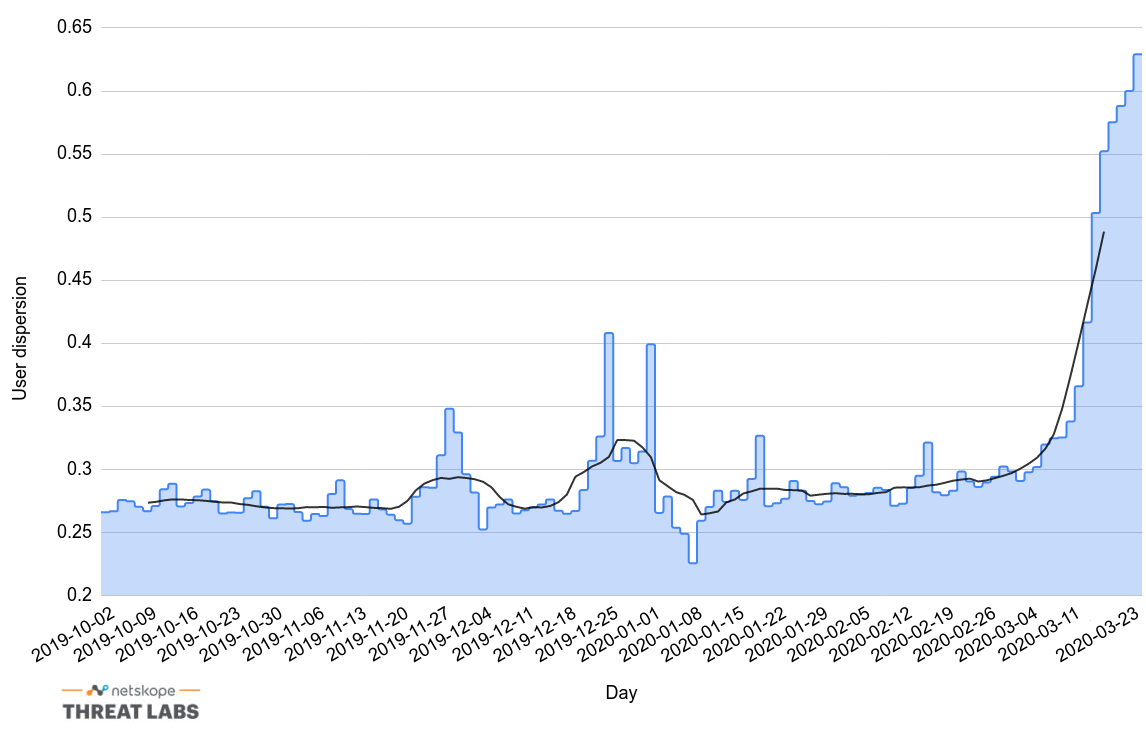
The remote work percentage maxed out last week on Friday, March 20, just above 60%, as projected. Monday, March 23, saw a 3 point jump as more social distancing measures went into effect over the weekend. Given recent trends, we project that remote work will increase this week to around 66%.
Update 3/31
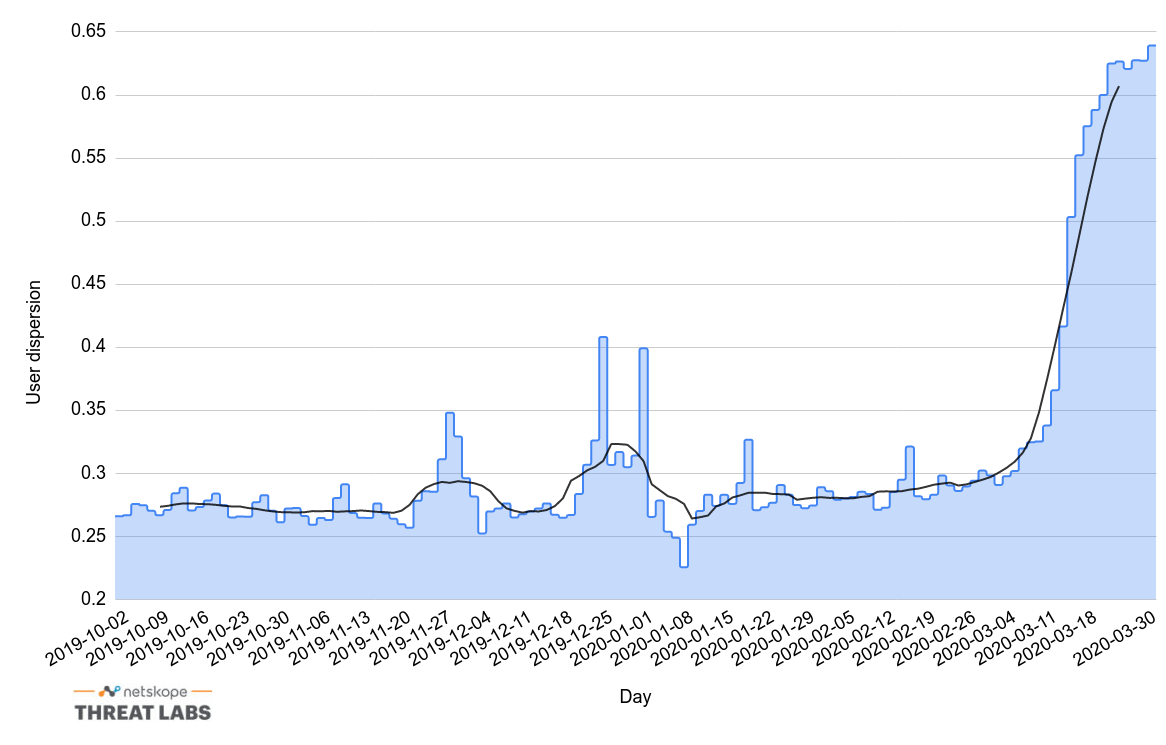
Throughout the week ending on Friday, March 27, the remote work percentage remained unchanged. Wednesday, March 25 was the first day since February 25 that we did not observe a day-over-day increase in remote work. Monday, March 30 saw a 1.4 point increase from the previous week’s average. We expect remote work to continue to remain around ⅔ throughout the month of April.
Netskope Threat Labs will continue to monitor these trends in how user’s work patterns change as even more social distancing measures go into effect this week. Stay tuned.
Update 5/12
Since the beginning of April, the percentage of users working remotely has held constant, with approximately two-thirds of users in North America working remotely. Stay tuned for updates in how this number changes as some regions begin to relax their social distancing measures.