In December 2019, I wrote a blog recommending CIOs and CISOs review their annual budgets in 2020 and continue to reduce their spend on legacy appliance-based network and security controls with a move to a scalable and future-proof cloud-based architecture.
In the past few months since then, the world has changed. Budgets are now further under the spotlight with non-essential projects being postponed, emergency budgets for pandemic response to maintain BAU and support a remote workforce applied (and is some cases budget “borrowed” from 2021), and budgets for 2021 being mandated to accelerate digital transformation (and to cover a potential budget deficit) and support growth in new digital services. This change has prompted me to write an update to the blog, a “Part 2,” to cover how organisations will have to adapt to support their current and future workforce changes and potential budgets in 2020 onwards.
Scaling a remote workforce
Most conversations I have with CIOs and CISOs predict that the remote workforce will continue to rise in numbers, with an additional 20%+ of the workforce working remotely beyond the pandemic. For organisations, this is a tipping point whereby it’s envisaged that 50%+ of the organisation’s workforce could be considered remote workers. As CIOs and CISOs ensure they can fully support this rising number of remote workers, they are also tasked to manage unpredictable costs including the big spend CAPEX items that hit their budget plans every year. These CAPEX costs are usually offset over a three to five year budgeting period, however for the organisation, the spend is paid up front. Difficulty in predicting and planning for how the organisation will scale in the next three to five years usually results in larger appliances being purchased to meet a potential growth of the organisation which further pushes up the spend.
As the same organisations continue to embrace the cloud, to harness both reduced costs and the continuously updated and enhanced features cloud services offer, it’s critical to start assigning a value to this transformation from both a business benefit perspective and a cost savings perspective.
Transformation Savings
The big-ticket items for most security budgets are the appliance spend and the ongoing maintenance of these appliances over their short lifetime. Monthly updates with new features, patching newly found vulnerabilities, and the racking and stacking of appliances as the traffic throughput increases are costly especially when change maintenance windows may only be possible overnight or on weekends. To use an analogy, it’s similar to buying a new car outright every three years and depreciating the full cost over that time with no residual value remaining. The car is serviced every month paying the service centre a double-time hourly rate for a service that doesn’t always work the first time When buying a car at least, we get a trade-in price for 30-50% of the value after the three years. However for appliances, the majority are sent to a secure scrapyard and recycled after that period no matter how well maintained they are. Not only does this not make financial sense, but it’s also not the best approach to support a happy and fulfilled workforce with evenings and weekends lost to this maintenance requirement. Plus, the constant production, shipping, and recycling of appliances is not supportive of the environment.
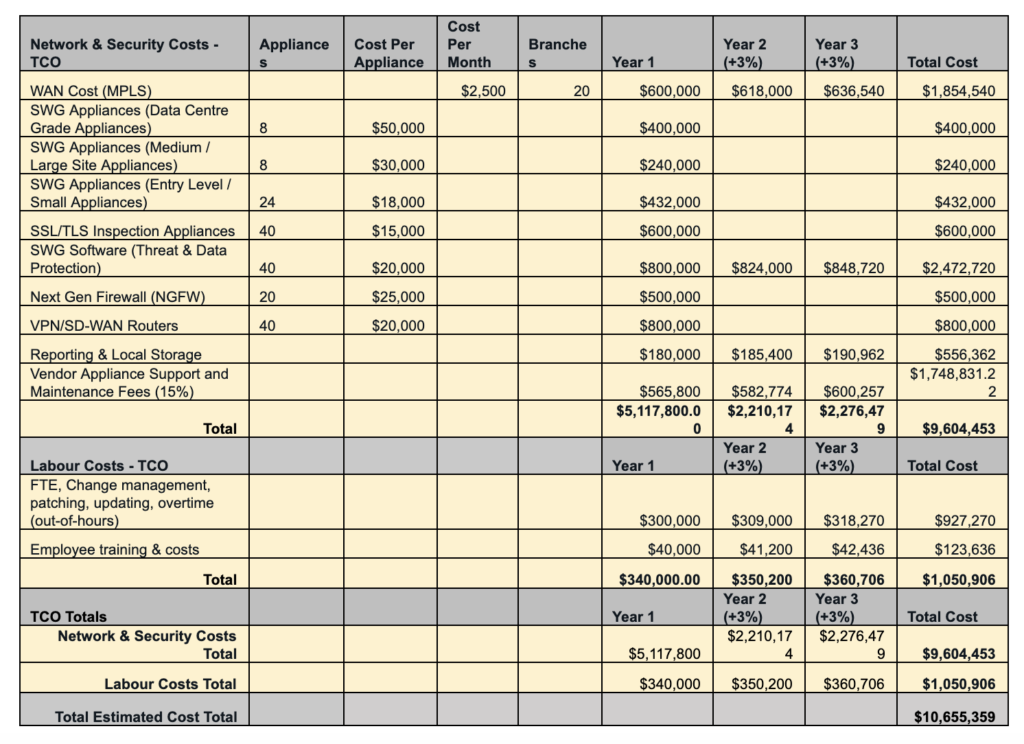
The key issue however is the cost. The following is an example of an organisation with 20 offices across the globe and their spend on fundamental network and security appliances and technology. With the total spend above $10m+ over three years for MPLS, SWG, TLS, NGFW, and VPN/SD-WAN appliances, not including all the local storage needed for reporting and the maintenance fees, it’s a costly business to run this organisation’s network and security infrastructure.
With a 50%+ remote workforce, why would an organisation continue to steer network traffic through to a data centre where these appliances reside, increasing latency, reducing quality of service, and adding cost? If we consider cutting the cost of the three to five year appliance expenditure, a significant cost saving can be made. In this same example, the appliance costs are the primary expense across all categories of spend.
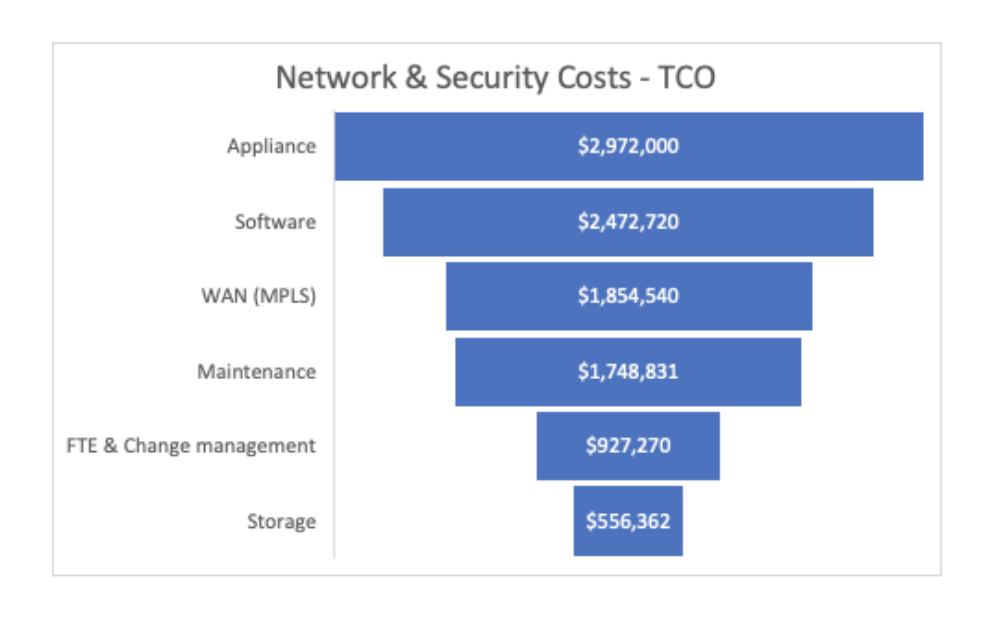
These cost savings can also extend to reduced expenditure for MPLS lines. With a move to cloud, this organisation may no longer need expensive MPLS lines for every site. With a direct-to-net/cloud approach, the organisation could make a significant saving on WAN costs reducing these costs further.
The FTEs assigned to keeping the appliance lights on can be repurposed to focus on the Security Operations side of maximising the investment in the security control and technologies (writing new policies, tuning, and reporting) which would offset part of the maintenance expenditure.
Finally, storage costs can be reduced. As we know, cloud storage costs are significantly less expensive than on-premise storage costs and include multiple benefits including active backup and DR recovery.
Business Outcomes
To conclude, this approach may not work for all organisations. A percentage of organisations may continue to be reliant on legacy appliances and a traditional corporate network, however, the majority of organisations will have started or already be moving to this new approach. An organisation’s workforce is a driving force to dictate the strategy of the organisation. With a workforce that needs the flexibility of working remotely, with the consumption of cloud-based infrastructure and SaaS becoming the normal, and with the cost calculations and cost reductions organisations need to consider, now is the right time to architect a future-proof cloud-based architecture that works for everyone.
In part 3 of this series, I will look at the cost savings over the full three to five year lifecycle and explain how further cost savings can be made.