Enterprises no longer need to be convinced that 5G is real. The debate is over. The harder question now is practical: How do you actually operationalize 5G across distributed enterprise branches— and make it work as a true WAN, rather than just as a contingency link that sits idle until your primary fails?
For years, 4G/LTE kept wireless firmly in backup-only territory. Real-world latency, jitter under load, and capacity limits made it a poor fit for enterprise voice and video. 5G changes that equation. The performance is there. The question is how best to deploy it.
The momentum reflects this shift. Gartner forecasts enterprise IoT spending on 5G communications services will reach $7.3 billion by 2028 (a 55% compound annual growth rate from 2023). Manufacturing is the sector leading adoption at 43% of identified deployments, followed by transportation and logistics at 17% and healthcare at 10%.
For enterprises building or scaling a SASE architecture, the branch is where strategy meets reality, and where most deployments fall short.
The gap between 5G potential and WAN reality
Most enterprises attempting to add 5G to their WAN hit the same wall, and it isn’t one of performance. 5G provides multi-gigabit throughput, ultra-low latency, and massive device density. The problem is a lack of integration in how 5G gets added. Most deployments rely on a separate device bolted onto existing branch infrastructure: another box, another vendor, another layer of complexity at every site.
And it compounds from there:
- Physical SIM cards lock branches to a single carrier until someone travels on-site to swap hardware, an operational burden that scales badly across hundreds of sites.
- Signal reliability suffers in warehouses, manufacturing floors, and medical facilities, where consumer-grade antennas were never built for real-world RF challenges.
- IoT sensors, HD cameras, and cloud workflows compete for bandwidth with no intelligent prioritization to protect critical applications.
- 5G runs through a separate management plane so visibility is fragmented, troubleshooting is manual, and every incident becomes a multi-console exercise.
So with 5G the connectivity improves, but the operational complexity doesn’t.
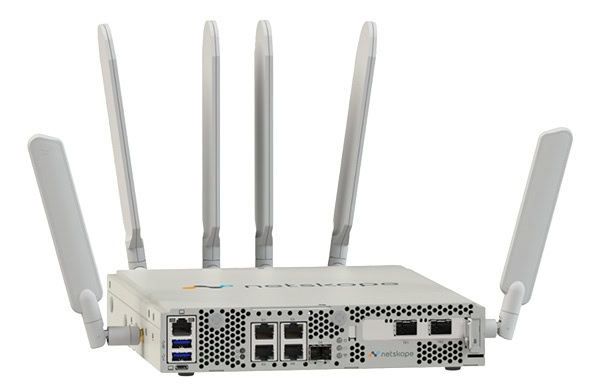
The Netskope One Gateway: Native 5G for your SASE architecture
The NSG-2108CW is a version of the Netskope One Gateway with embedded 5G, consolidating 5G, SD-WAN, on-prem security, and edge compute into a single platform, running Netskope, partner, and custom applications with app-store simplicity and industry-best performance. Carrier-certified by AT&T, Verizon, T-Mobile, and the PCS Type Certification Review Board (PTCRB), NSG-2108 is purpose- built to make 5G a native transport, not an afterthought.
Under the hood, that translates to:
- Sub-second failover and up to 5Gbps throughput. 5G operates as a first-class SD-WAN transport, with the same QoS policies and intelligent path steering as any wired link, automatically switching between 5G and broadband based on real-time conditions.
- Faster time to service. 5G SA and eSIM enables new links to go live from any carrier in minutes, eliminating broadband provisioning delays and accelerating new site rollouts.
- Carrier freedom. With eSIM and LPAd, switch carriers remotely from a central console, no physical SIM swap, no site visit, and no renegotiating contracts from a position of dependency.
- External antenna support for signal reliability. Purpose-built for the RF challenges of warehouses, healthcare facilities, and logistics hubs where internal antenna designs fall short.
The NSG-2108CW is designed around the operational realities of distributed enterprise environments:
- WAN failover and business continuity. 5G runs as a primary path alongside broadband, or as standby failover, eliminating downtime for business-critical sites
- Retail and pop-up branches. Deploy in minutes, not weeks, with no ISP provisioning delays: perfect for seasonal pop-ups, new store openings, and distributed retail networks.
- Hybrid security — Runs the same application firewall and IPS/IDS on the gateway that we run in the cloud to secure east-west and outbound traffic across all ports and protocols
- Secure IoT without a separate stack. Netskope One Device Intelligence secures vulnerable branch devices through context-driven classification, risk assessment, micro-segmentation, and access control.
Because Netskope One gateways are built on the Netskope One platform, one-click security services edge (SSE) integration extends firewall (NGFW), zero trust network access (ZTNA), secure web gateway (NGSWG), cloud access security broker (CASB), data loss prevention (DLP), and AI security to any enterprise location. A single console unifies management of 5G, SD-WAN, and SSE across every site and remote user, further simplifying operations.
The NSG-2108CW is the on-ramp. Netskope One SASE is the highway.
The Bottom Line:
The NSG-2108CW with integrated 5G extends Netskope One SASE to the branch, but it goes much further than that. Adding 5G has always meant another vendor, another device, another console, and another contract, but the NSG-2108CW makes 5G a native transport inside the platform you already run. No added complexity. No operational fragmentation. Just a unified SASE architecture that gets simpler as it scales. Every branch, regardless of size or geography, becomes a fully capable and secure SASE Branch, converged, secured, optimized and operational from day one.
That is why 5G belongs at the center of your SASE strategy.
Stop bolting 5G on. See how the NSG-2108CW makes it native. Explore Netskope Wireless WAN solutions.