Netskope One AgentSkope is an intelligent operational layer of the Netskope One platform, forming the architectural foundation that allows organizations to easily deploy Netskope AI agents. In today’s companion blog, I discussed AgentSkope generally, and focused on the security operations agents that had launched today.
To catch you up: Netskope One AgentSkope provides a shared operational framework which serves as the foundation on which to run purpose-built agents, enforcing security and compliance requirements, removing the burden on you. AgentSkope enables a whole new range of capabilities that depend upon integrated insights (coming from the Netskope environment as well as integrated third‑party data sources) and joined-up actions. AgentSkope agents enable faster administration, quicker incident response, reduced reporting overhead, and measurable operational efficiency, allowing organizations to get more value from the teams and platforms they already rely on.
Now in this blog I want to turn to look in a little more detail at the agents that are available for network operations teams.
Agentic operational support for policy management
According to Microsoft, 90% of identities are over-privileged, using less than 5% of their granted permissions. The common problem of permission creep often happens because teams focus on the urgency of provisioning access, and rarely have time to give the same emphasis to de-permissioning unused access, or access that is no longer relevant. Over privileged accounts are a prime target for attackers, who use them to move around the network and get to sensitive data. While you could manually check and update policies, that approach is time consuming and repetitive, making it the perfect task to automate with an agent.
One of the new agents is just such a policy recommendation agent. Netskope Private Access AIOps Agent recognizes that the shift from broad network access to fine-grained, identity-based controls—that implementing zero trust network access (ZTNA) requires—depends upon accurate application discovery, segmentation, and policy definition. This work is often manual and scales poorly, leading to errors as environments grow and change through cloud expansion or M&A. It also often proves to be too slow to enable appropriate access to new AI tools, slowing down adoption and creating hurdles to the productivity advantages that AI might bring. Without continuous visibility into application usage, policies become stale and least‑privilege weakens.
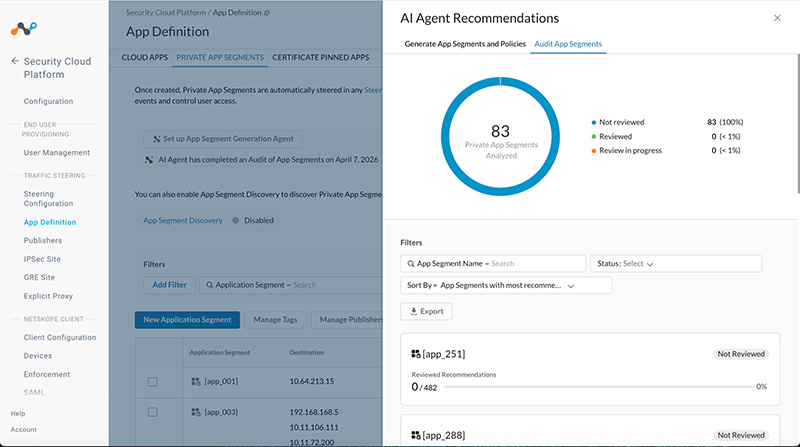
The Netskope Private Access AIOps Agent was built to fix the operational gap that appears once ZTNA is live. After deployment, teams are left managing broad access rules, manual exceptions, and policies that no longer match how applications are actually used. The agent takes much of this burden from the team, reviewing traffic to identify where access is wider than necessary and showing which privileges can be tightened or removed. The agent keeps ZTNA policies accurate, manageable, and aligned with least‑privilege as environments expand.
The Netskope Private Access AISecOps Agent is a separately licensable component, please contact your account team for more information.
Digital experience monitoring and troubleshooting
Poor user connectivity or application performance is seldom tied to a single data point, and teams generally find themselves having to diagnose a broad set of underlying conditions (manually combing through large volumes of telemetry) to identify the specific cause of any issue. This data overload slows down mean-time-to-detection (MTTD) and mean-time-to-resolution (MTTR), creating bottlenecks in support teams and growing backlogs of unresolved tickets that directly impact user productivity.
Today, unplanned downtime costs a mid size business $14,056 per minute on average, and large enterprises lose nearly double this amount. -With this cost context, it’s easy to understand why every second matters in digital experience management.
By making use of AI agents to automate triage and investigation, a root cause analysis (RCA) report can be sitting ready for a network operations analyst to immediately commence remediation, without the potential of hours of delays caused by manual investigation.
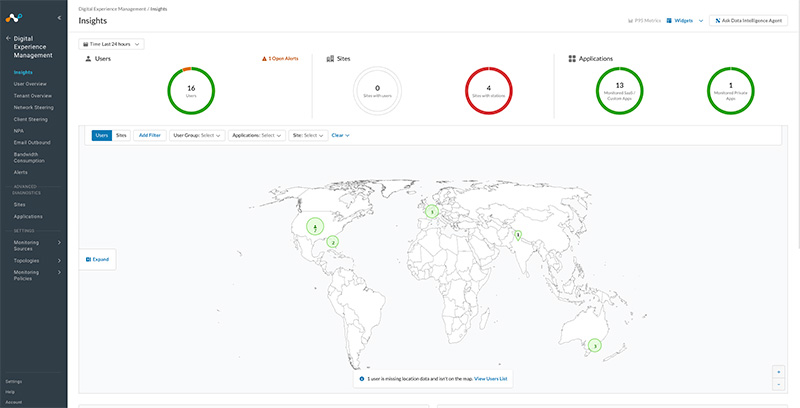
As a companion tool to Netskope One Digital Experience Management (DEM), the Netskope DEM Data Intelligence Agent shortens this cycle by turning experience data into immediate operational insight. It analyzes telemetry to identify the specific drivers of performance degradation and guides teams directly to the data that explains why an issue is occurring. The agent accelerates root cause analysis, supports faster and more accurate ticket triage, and helps lower resolution times by reducing manual discovery requirements. Analysts can interact with the system using plain English, making deep diagnostic data accessible without complex query languages.
The Netskope DEM Data Intelligence Agent is a separately licensable component for DEM Level 3 and 4 customers, please contact your account team for more information.
There’s more that agents can help with in DEM too, which is why we launched a second DEM agentic today.
- The Netskope DEM Data Intelligence Agent is a powerful partner that correlates granular telemetry signals and summarizes them via a natural language interface, enabling rapid remediation of complex, intermittent issues.
- The Netskope DEM Insights Agent is a macro-intelligence engine that distills millions of data points into a narrative-driven incident discovery view. It identifies the reasons behind performance degradation.
The Netskope DEM Insights Agent turns millions of telemetry data points into a clear, narrative‑driven view of incidents. Acting as an automated analyst, it surfaces critical performance issues and explains the root causes behind degradation. It highlights systemic, high‑impact problems affecting large parts of the organization enabling more strategic prioritization. The agent delivers an executive‑level view of digital experience and performance, reducing mean-time-to-understanding (MTTU), a lesser used but critically valuable metric to track. This agent tracks performance issues across ISPs, regions, device health, or application latency, helping teams identify and demonstrate the extent to which issues impact the workforce.
This intelligence helps organizations identify how everyday digital slowdowns are impacting productivity and even potential revenue, making it easier to justify IT investments as profit recovery rather than technical clean up.
The Netskope DEM Insights Agent is included with all DEM Level 3 and 4 subscriptions, please contact your account team for more information.
Watch Netskope One AgentSkope in action
Aware that there’s a lot being released today, the team has produced short demo videos for each of the add-on agents. These are available to view in our Agent Library.
Information on the other three new agents—those that will most interest security and SecOps teams (Netskope DLP AISecOps Agent, Netskope Insider Threat AISecOps Agent and Netskope CCI Insights Agent)—can be found in part one of this two part blog series.