In my last blog, we discussed how the Secure Access Service Edge (SASE) is the optimized “middle mile” that delivers networking and security services at the edge of the internet. This introduces several concepts that many architects have not previously considered. Instead of building out and managing a network and security stack in the locations where it’s needed, SASE changes the model by leveraging a security private cloud and service-delivery approach that the customer manages in a shared responsibility with the vendor.
This is a dramatic transformation, but also an incredible opportunity. Customers are now better positioned to be nimble and respond to an organization’s expansion plans or critical business objectives without having to own and operate network or security infrastructure. This can be particularly challenging when it comes to deploying effective data protection and security, while trying to do it at scale, providing global coverage and addressing the unique requirements of remote sites or teleworkers.
In a discussion about the Netskope NewEdge network, one of the first topics that often comes up is coverage and I can understand why. It’s difficult to wrap your head around the concept of a security private cloud. A discussion about the locations where service points are located provides a tangible way to gain confidence and achieve a better understanding of the solution. I feel like there are many positive things that come out of a discussion of coverage, but there’s also a lot of confusion in the market.
In this blog, I want to clarify a few points and put a proverbial magnifying glass on this topic of coverage. The goal is to dispel some of the confusion that exists in the market and ultimately help you become a “smarter shopper” as you evaluate what’s needed to select the right cloud to protect and secure your business.

Focus on regions & services, not data centers
Would it be surprising to learn the number of data centers doesn’t provide an accurate picture of coverage? When you hear a vendor recite the number of data centers they have, it’s imperative to double-click to determine what this means to you. For example, where are the data centers located? If there are multiple data centers in the same region, does that provide any benefit to you, as a customer? The surprising answer is that the second (or third, or fourth) data center in a region is most often not for redundancy, but rather because of architectural, scaling, or colocation vendor limitations in densely populated areas. This becomes apparent when some regions have multiple data centers and others do not.
Another question to ask is how many of the data centers can you actually use? In many cases, vendors divide up their data centers into coverage zones accessible only to a subset of customers in a region or requiring additional fees and contracts to gain access. In other cases, while a vendor may promote a large number of data centers, in reality, some of these locations are dedicated only for use by strategic partners, such as a managed service provider. One vendor, for example, has more than half of its data centers globally dedicated in this fashion, and accordingly off-limits to other customers! The reality is if you’re only able to use a small fraction of the total universe of data centers, then what’s the tangible benefit of that “larger number of data centers”?
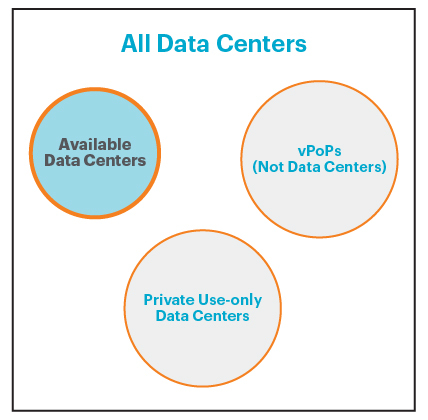
This is because the fundamental goal of coverage is to minimize the latency by reducing the dependence on the public internet in the connection between the user and the SASE edge location. If the second or third data center in the same region cannot be used by the customer, and it’s not used for redundancy, then it doesn’t provide any coverage or reliability benefit to the customer. In short, it ends up looking like just a numbers game when it comes to counting data centers.
The situation can get even more dire when you probe on what services are available in each data center? Some vendors have different versions of their technology running in different data centers, so while the total data center may appear adequate, only a small number of data centers may have the services you require available. As you can see, digging into these questions gets you closer to really understanding coverage. This way you can be clear on the data centers available for your use, with the right security capabilities enabled, so you have access where and when you need them.
With NewEdge, we’re delivering on our commitment to provide customers with the world’s largest, highest-performing security private cloud network powered by data centers in 40 regions, with aggressive plans to continue expansion in the months ahead. Is 40 a good number, especially when you hear claims of more than 100 data centers from other vendors? Yes, because only with NewEdge is every data center across all regions accessible to all of our customers with the entire Netskope suite of security services available. No regional surcharges and no surprises.
Identify where traffic gets processed
Another important dimension of fully understanding coverage is to explore where compute is happening or, in other words, where traffic gets processed? Different vendors take different approaches with many not putting compute at the SASE edge, namely the ingress to their network. The main driver for this is cost containment. It’s expensive to deploy compute in multiple locations and often easier (and cheaper) to create many network “on-ramps” that steer traffic to just a few compute locations. These are generically called virtual points of presence (or vPoPs), given that they appear to be a PoP, but the reality is traffic must be hairpinned to another location to actually get processed. The following diagram walks through an example of a typical vPOP:
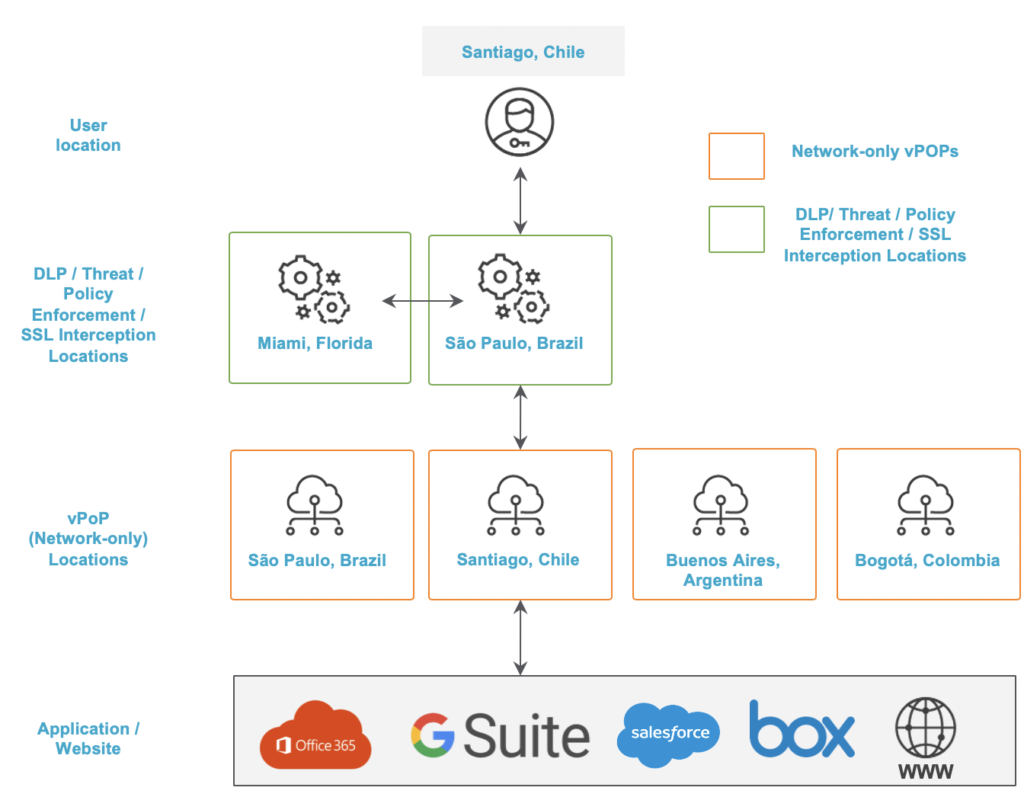
There are two fundamental flaws with the vPoP model:
- Since inline processing is latency-sensitive, with hairpin routing of traffic to the compute location latency is inevitably going to be added. Accordingly, a user that’s located in a location where the vPoP and the compute are in the same region will have a very different experience than the user that enters via a vPoP in a distant, remote region. This could translate into poor application response times or slowness of file uploads or downloads.
- Since all traffic has to ultimately go through the compute location to get processed, then does this diagram represent three data centers in three different regions (namely Johannesburg, Frankfurt, and Tel Aviv), or is it really one data center shared between three regions? And theoretically, if three more vPoPs were added to link up with the same, single compute location in Frankfurt, would it then count as six data centers? One can quickly see that the data center number alone becomes misleading, as clarity is needed between where compute is happening versus where traffic is on-ramping to the network.
Clearly, the concept of vPoPs ends up serving the vendor more than the customer. Not only does it lead to some far-fetched marketing claims, but it quietly helps the vendor scale their network and their services, as well as boost their margins. It also gives a false perception of coverage and service quality, when it’s in fact quite the opposite. With the vPoP approach, customers suffer from increased latency which likely translates into an inconsistent and unsatisfactory user experience.
With the NewEdge network, we’re not taking any shortcuts to deliver the security services of the Netskope Security Cloud Platform. We don’t use vPoPs today and every data center offers full, local compute for real-time, in-line traffic processing. This allows us to inspect and enforce security policies without having to send the traffic halfway around the globe. All Netskope security services – including Next-Generation Secure Web Gateway (NG-SWG), Cloud Access Security Broker (CASB), Data Loss Prevention (DLP), and Zero Trust Network Access (ZTNA) – take advantage of this architectural approach.NewEdge is unique when compared to the approaches used by other vendors in the market. Not only is the architecture of NewEdge a significant technical differentiator, but it’s the right thing to do for our customers since we know latency matters and milliseconds count. We’re tremendously proud of the work we’ve done with NewEdge and excited about what’s ahead for the future. To learn more about Netskope and NewEdge, please visit: https://www.netskope.com/netskope-one/newedge.