Jason Clark:
I think that one, security needs to be built into everything from the beginning. That's the only way to have really good security, and it's to simplify. The enemy of security is complexity, right? I always probably see the aspects of quality and security, that the difference of the cost of building it in right to begin with versus the cost of coming and being reactive, and trying to remediate is significant, so I think security should be in the beginning of that conversation.
Speaker 2:
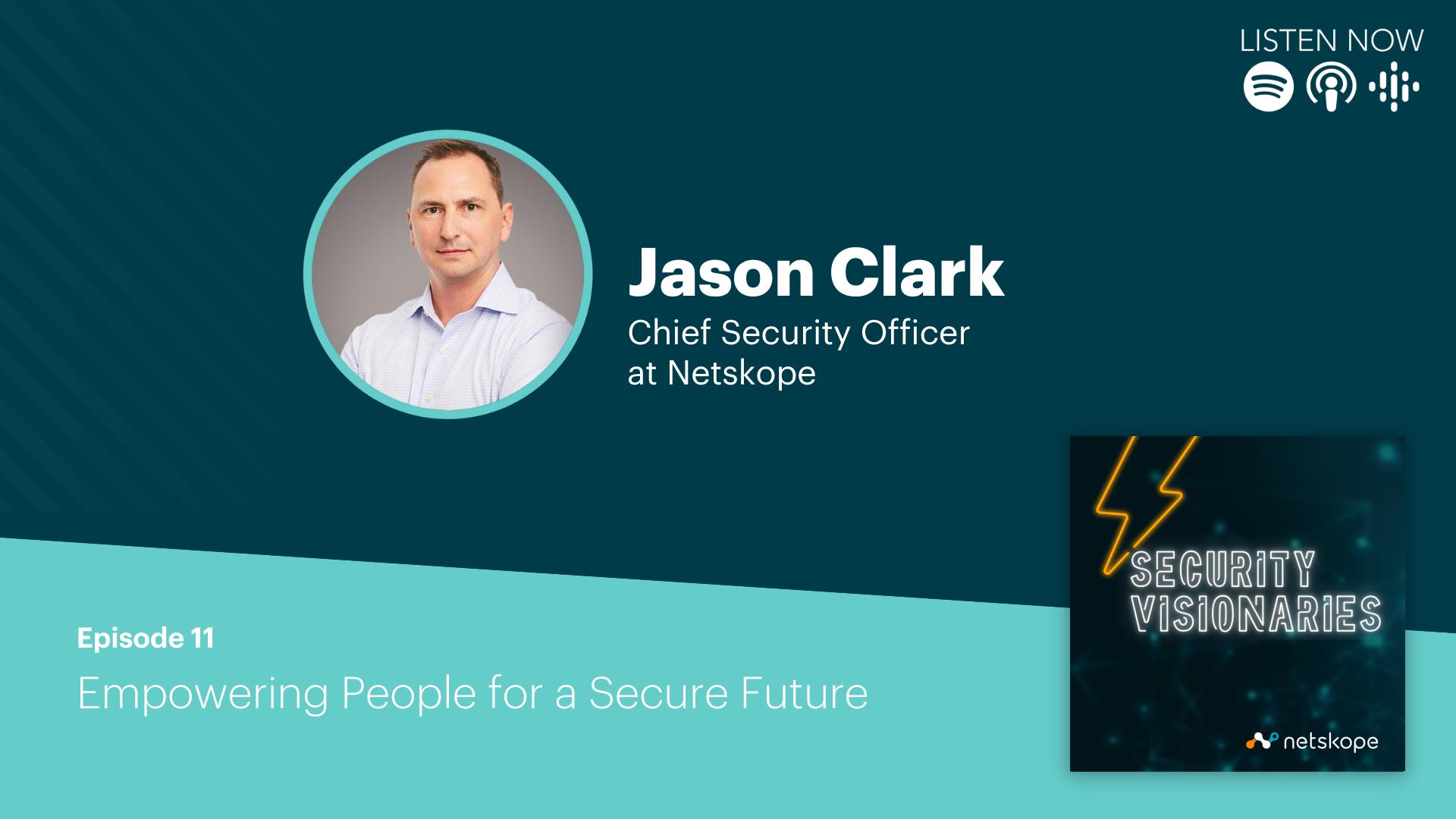
Hello, and welcome to season two of Security Visionaries, hosted by Mike Anderson, CIO at Netskope. You just heard from today's guest, Jason Clark, Chief Strategy, Security, and Marketing Officer at Netskope. Our new host, Mike Anderson, is the chief digital and information officer at Netskope. This season, Mike sits down with industry leaders who are tackling security as a team sport, and empowering their employees to become better digital citizens. This episode features an interview with Jason Clark, Season One Host and Chief Strategy, Security, and Marketing Officer at Netskope. As Jason passes the baton to Mike, they discuss who is responsible for security, the human firewall, and what the future holds. Before we dive into Jason's interview, here's a brief word from our sponsor.
Speaker 3:
The Security Visionaries podcast is powered by the team at Netskope. At Netskope, we are redefining cloud, data, and network security with a platform that provides optimized access and zero trust security for people, devices, and data anywhere they go. To learn more about how Netskope helps customers be ready for anything on their SASE journey, visit N-E-T-S-K-O-P-E.com.
Speaker 2:
Without further ado, please enjoy episode 11 of Security Visionaries with Jason Clark, Chief Strategy, Security, and Marketing Officer at Netskope, and your host, Mike Anderson.
Mike Anderson:
Welcome to season two of the Security Visionaries podcast. I'm Mike Anderson. I'm going to be your host for season two. I'm our chief digital officer and CIO here at Netskope, and this is kind of a passing the baton episode. We have Jason Clark, who's our chief strategy, security, and marketing officer who's joining us, who was our host of season one. Jason, welcome, and maybe help explain, because that's a lot of stuff for one person to be responsible for. Maybe you can talk a little bit about how do those things fit together.
Jason Clark:
I get that question a lot. I started as a security person since I was 17. All my life, I've done nothing but security. And then, kind of after you build security, and I ran infrastructure and networking as well for large companies, and then you kind of... You build it over and over again, and I got my MBA, and I realized I love the strategic side of it, so I joined as a chief strategy officer for a large organization, but also kept the security team, because I knew that. And it was a security company, so I ran strategy thinking about how to build products and where to take the go-to-market strategy at the same time as... I feel like it's on the security side, my job is to wake up every day and know the problem. Know the pain of the community and of the buyer. So that helps me inform strategy, by getting the 3:00 in the morning wake-up calls. But then, then I grew and added marketing into what I do, because it aligns so well with strategy. The best CMOs out there really are driving the strategy, because it's now driving where we're going from a product direction and services direction at the same time as how do we message, and market, and build trust with that community, right? And with those buyers. Again, wrapping down to, well how better to do that than to live it and feel the pain every day, right? So actually to me, all three of those functions go together perfectly, mainly because we're a cybersecurity company.
Mike Anderson:
That makes sense. I just assumed it was when you say, "Hey, I think we should do this" about something, people say, "Why don't you do it?" And then all of a sudden, you take on more things. You always have to be careful also once you say, "Hey, I think we should really be doing this instead of that." Then all of a sudden, you become the person doing that.
Jason Clark:
Yep. I've learned to say less in those meetings, and definitely try to say no more, right? To some of that. I do remember being in a board meeting, where the chairman and the CEO was complaining about something. This was two companies ago. And I raised my hand. I said, "Well, this is how you solve it. Guys, we're spinning around in circles. Just do this, this, and this," and they looked over at me, and they said, "Guess what. It's yours now, Jason," and it was a PNL. They said, "You're now the GM of that business." And I sat there, and the guy who was the GM was also sitting in the room. It was really awkward, so at that point, I said, "Okay, I need to stop doing that."
Mike Anderson:
That was passing the baton in the same room, but he was surprised, but he or she was surprised as well, in that way.
Jason Clark:
Exactly.
Mike Anderson:
One of the things I know we've talked about a lot. I joined obviously a little over a year ago, from Schneider Electric, and you've had a long, storied career as a security leader, strategy leader with some rocket ship type companies as well in your past. One of the things I know we've talked about a lot is this concept of a team sport. Security is a team sport, and thinking about it not just in context of just the CIO/CISO partnership, but thinking more broadly across the organization, across the IT leaders, across the people using the applications. What is your take on that whole concept of security being a team sport?
Jason Clark:
I love the phrase. It's a good mantra. I think security's always been a little bit of a team sport. I mean, to get it done, you've needed everybody. But I would say that it's not been executed well, right? So it hasn't been high-performing teams. They haven't thought about it like a team sport. It's more like, "Hey, you have a responsibility." But in the end, the security teams end up getting held accountable without everybody else necessarily being accountable, right? So I'd say it wasn't exactly fairly set up to have high-performing teams. Now, going forward, to me, it all starts with the relationship with the executives, right? And making sure that you have that support, that alignment, throughout the entire organization, and definitely most important relationship is the CIO. That CIO needs to feel very comfortable with their head of security. Whether they report to them or not, they have to be the best and strongest team. And where I see things in the past gone wrong, as an example, and I see this today, where you have a CIO who doesn't necessarily let the CISO go talk to the CFO or talk to the CEO without them. A part of being a team sport is just kind of leaving egos at the door, right? You've got to enable your other leaders to have and build those one-on-one relationships as well. I think the other part is there's the other peers, but then you have the executives and IT, right? So networking, and infrastructure, and applications are the most important relationships inside of IT for that security team. They need to designate champions inside those teams who are part of that, and who feel like they're also part of security. And I think trust and transparency is one of the most important things in this kind of team sport.
Mike Anderson:
No, I couldn't agree more. If you think about, a lot of security teams originally were born out of the infrastructure team. You had network security and firewalls, and the security team got kind of carved out of that. I would love your take on if you think about budgets, how much does budget go into that team sport concept? You know, who owns the budget, and who owns the decision... A lot of times, decisions follow who owns the budget. What's your take on that from... How are budgets transitioning from that team sport standpoint? How does it influence those relationships?
Jason Clark:
And that budget's kind of like... It's the leverage point, right? The person who has the budget, for the most part, has a significant amount of the power. I would say if you think about all kind of... Let's just take the network security bucket, which is the biggest spend in all of security, that has been heavily controlled by the infrastructure and the networking team. Let's say it was 90-10, 90% kind of control there, you've probably seen it more 70% controlled by the networking team still, and 30% by the security team. But what I see more and more is the security team reaching in and saying, "Hey, look. I'm going to set the requirements in the name of security. Yes, you're spending the money, but you have to match my requirements." So you see a lot more teams are working together. When they don't, I do see the security team in some of the bigger companies reach out and just start saying, "Well then, if we're not going to play nice together..." They end up having a little bit more power at the board level, to just reach over and grab it. So I do see that happening at a... And I did a CISO dinner two nights ago, and 1/3 of the CISOs in the room said that they have recently taken over networking and infrastructure because of that, as an example. Because they had friction, and they couldn't decide on some of the technology decisions or the direction they wanted to go, but also, over time, the network...
It's really just providing access and you need to make sure it's secure, right? And that's the job of security too. And when you live in a hybrid world that we live in right now, half your users are off the network half the time. Some massive percent of your apps are probably in the cloud or moving to the cloud. What is the network anymore? I think IT leaders are asking themselves that same question. I think you start to see that convergence happen.
Mike Anderson:
Ray Wang once, I saw a presentation. He talked about the I in CIO having different meanings around innovation, investment. I wonder if the I in CISO is going to be infrastructure as another dimension in the future, chief infrastructure security officer. Maybe that's the new title.
Jason Clark:
That could be right. I mean, I wish, actually, kind of we centered on... It's all about the data, right? And I know we say information, but kind of the word data really resonates more with the business. We want secure access to data. Get the data to fingertips, right? Make it valuable, and secure it. So I kind of wish it was like something with data in the title. I think further to that, Mike, as we think about kind of the naming of stuff, I think the title matters a lot as what the rest of the leaders in the organization think about this, right? The head of security. Use the example of kind of the chief people officer, the head of legal, the CMO, the CFO. All of them have different perspectives, in every company, on the security team. So the team sport aspect, title matters.
Mike Anderson:
Yeah, absolutely, and you know, it's interesting. You mentioned board. I feel like board is getting into that team sport conversation as well, because obviously, they've got risk, personally, based on the security posture of the organization they're in, so they're definitely part of that team sport, which I think to your point, kind of elevates the CISO to be very important in that board-level conversation. One of our friends and one of our customers had said... The CIO said, "When the CISO sneezes, I feel it." That one's stuck in my head as a pretty interesting comment, when you think about the team sport and how you have to be partnered at the hip on everything you do.
Jason Clark:
On the board front, there's actually a movement, though, of a number of CISOs at big companies, where there's discussions around having... They have a comp committee and an audit committee. Having a security and resilience committee, just focused on this topic, which would be interesting.
Mike Anderson:
You're in a unique position inside Netskope, because you have security not just for internal, but also product security. And it's interesting, because when I talk to a lot of CIOs that are thinking about a CISO role, they're always like, "Where should the CISO live? Because it owns not just the internal security controls, but also what we build into our products." How does that kind of play into that whole team sport concept? Because there's a lot of people, CIOs and security leaders, that work in companies that build products that get sold to end customers, where security in the product is also important. What is your thoughts on that one?
Jason Clark:
I think that's a lot to do with the company, right? Because does the CIO own building products for the business, or are they more supporting the back office infrastructure and the main systems like ERP? So you see some companies where they have a CTO and a CIO, and the CTO is building new, or you see the divisions have their own CTOs, and they're just getting the support from the CIO. I think that all really depends on what's the organization design for technology, and how really important is innovation, and who are they giving that task to. And then, I think the security team that needs to fit into that, depending, right? With the CIO owns all of it, then it just fits naturally with that CIO, but if you have a CTO and a CIO, which I see in a lot of companies, then all of a sudden, having the CISO report into the CIO, who isn't the CIO that owns the building of the new, I don't think that works well. Especially if it's a cybersecurity company. At that point, I would tell every CEO of a cybersecurity company, the head of security should report into the CEO. The CEO should be that close.
Mike Anderson:
Yeah, that makes a lot of sense to me. The two questions I get the most from people is... One is, "Where should the CISO report?" Is one, but the one I get more often than not now is, "How do we know we're doing enough?" Which is probably a conversation for a different episode, but you know, this is going to be a super exciting season on Security Visionaries season two, as we talk about security as a team sport, you know, with all the different great guests we're going to have this year. I want to pivot now, and as we think about tech stacks, and we think about the tech stack from security, what role should security play when it comes to determining the tech stack that the CIO and the IT leaders are implementing? You touched on it a little bit, but I'd love for you to dig in more and tell me kind of what is your perspective on how should security play a role in the tech stack decisions that are made, and how far should that go?
Jason Clark:
I think that one, security needs to be built into everything from the beginning, right? You build security in. That's still probably a challenge a lot of places, but that's the only way to have really good security, and it's to simplify. The enemy of security is complexity, right? I always probably see the aspects of quality and security, that the difference of the cost of building it in right to begin with versus the cost of coming and being reactive, and trying to remediate is significant, so I think security should be in the beginning of that conversation. I think that security is in a unique spot, because think about what other IT leader other than the CIO spends as much time with the board, and regulators, right? Their job is to really understand the entire aspect of the business on every angle, whereas the infrastructure teams aren't... They're not tasked the same, right? And the app teams are kind of, a lot of times, spending time on their specific apps, and not necessarily the SaaS apps, as an example, which might be half the apps and that the business is operating on.
Whereas security and CIO, and I would say enterprise architecture, all three of those, they should be doing it together. I feel like the CISO and head of enterprise architecture should be the right- and left-hand leaders to the CIO, and the three of them look at the whole picture together, and make that decision. Security has a lot of roles in it. It just really depends on the strength of the CISO. You know, really strong, business-led, business leader CISOs are very much in that conversation from the beginning, before they even decide to build something. "Hey, we're going to enter this new market," right? "We're looking at doing this acquisition. We're going to enter and do business in China," right? Or, "We're going to build this new innovation." The strong security leaders are in those conversations with the CIO, with the CTO, but then you still have a significant amount of kind of IT, or let's say infrastructure born and never really left infrastructure security people, that they're not getting invited to those conversations because they have less value to add. They're not going to talk about how, as you enter that market, how to maximize the acquisition of customers, the retention of customers in that space, and how to create trust in the market and function.
Mike Anderson:
You made a point earlier where you talked about understanding the business, right? I think the first thing you have to do is definitely be a student of the business you're in. That's the key thing of any business leader. I've always told my teams, "You can't change what you don't first take time to understand," so a lot of times, people come in with their playbook saying, "I did this at this other company, so I'm going to do the same thing here, and it's going to work." And a lot of times, you have to take time to understand, which is why when you go through any MBA program, they say your first 90 days on any new job is you take time to understand the business you're in, and learn, and ask a lot of questions, and don't try to form a lot of decisions. You may have some opinions that are forming, but make sure you ask a lot of questions and get perspectives from different angles. One of the comments that comes up a lot too is around this whole zero-day exploit. You talked about application teams. Today, as I build apps for cloud, I'm going and I'm pulling data or pulling applications from git repositories. I'm pulling out data or applications from public cloud, which is a lot of open source technology. And then what's happening today is people are concerned if there's a zero-day exploit like Log4J, how do I go identify all the places I'm using these bits of code within my applications that I'm building, right? So as I think about tech stack, what are some thoughts you have on... What can security leaders, and IT leaders, and app leaders do around making sure that they can identify that? If you think about this whole software bill of materials, right? That's been a new topic as well. How does all that come together when you think about from a tech stack standpoint and zero-day exploits?
Jason Clark:
This is a big one, because it's really about doing asset management really, really well, right? And that gets a lot harder in a world where you have probably 100X more providers in a cloud world than you ever had, or you don't own that infrastructure, right? And you don't even know what other tools that they're using, so you have third-party, fourth-party, fifth-party, sixth-party technologies that are all playing a part in this. I think that just... Third-party risk just got almost impossible in today's environment, so that is something I think the industry needs to solve, number one. So you can talk about it for your own products, or stuff sitting in your data center, but as soon as you start expanding out to everything SaaS, or platform as a service, I think that just change. Now, security can do a lot. In Netskope, we spend a lot of time on this topic with our customers, and even internally ourselves, understanding just all the apps, and then having some type of app at the station to know what the nth-party applications are, and whether those do good security or not. A simple example, where let's say our HR team decides that they want to use an app that's got 28 employees sitting in Atlanta with an app hosted in AWS, but they don't have a single security person on the team. But they're not compromised, right? But how much data do we want to give this organization? We should be in the middle of that conversation as a security and technology organization, with that business unit. I think a lot of people look at that as shadow IT, but that's really business IT, and we want to enable it, but enable it safely. So that's the third-party part of the conversation, but then I think it translates all the way down to when I say asset management, I think it's people. All your users, what do they have access to? And you can't just look at Active Directory anymore and know, right? Because you've got all the business IT SaaS apps, that might have two-factor authentication, but those business admins in the marketing department or in the HR department are the ones defining the access, and it's not consistent. So we need to be in a world where we can know every user, everything they're using, all the access to the data they have, how their behavior has changed and how that's different from their peers, correlated to how risky is that app. We should have a real time risk dashboard by user, by app, and by data. That doesn't exist today. I mean, you have to do it manually using technologies, right? We play a role in that, but there isn't like this one uber way to solve, I'd say, the asset management problem. So I kind of took it a level above more zero days.
Mike Anderson:
You know, when I think about tech stacks, if I look at the market we're in today, a lot of people would say we're already in a recession or we're heading towards a recession, right? We were talking around the business value, right? It's the reducing risk. It's reducing cost. It's improving my organizational agility. You know, when we think about that, obviously that cost becomes front and center. So does risk, right? When we're in a tough environment, whether we look at COVID, the bad actors try to take advantage of those environments. And at the same time, there's a lot more pressure and sensitivity on cost. It's interesting. When I talk to a lot of leaders, there's these acquisition of a lot of tools, right? Best-of-breed everything, and I always say, it's kind of like Baskin-Robbins, right? You wake up one day and you've got 31 flavors of ice cream in your tech stack. So now it's kind of like how do I get... Maybe it's not best-of-breed, but it's best-of-suite. What are your thoughts on that, and how will that play into some of the security decision-making going forward? As CISOs, and CIOs for that matter, are looking at investments in their security stack, how is the economic climate going to impact some of that decision-making when they think about the number of vendors they work with and where consolidation may occur?
Jason Clark:
There's a couple of parts to that. One, the unfortunate or the hard thing about security is that you have an active adversary, who is constantly trying to break in, right? So they're innovating, and then you've got this very fast-growing attack surface of cloud, cloud apps, mobile devices, people working from home, and APIs, which I think APIs are probably even the fastest-growing attack surface, that people aren't doing a whole lot to protect right now. And so you just say, "Okay, I've got this really fast-growing attack surface, and I've got this innovating bad guy. That's what's resulted in this proliferation of a lot of security technologies." Now, their good news is, on certain parts, certain elements, the platforms are there. They're one complete platform. I think SASE and Security Service Edge is a perfect example of where you're keeping up with the bad guy through feeds, right? And as long as you follow your data and you follow your user, and you're basically just taking legacy stuff on the perimeter and moving your new network security into the cloud, and making it data smart. So the innovation is that all of a sudden, what used to have to happen with 10 boxes, and not even efficiently, you're now moving that to the cloud and making it one brain. So the way, I think, you get ahead is you can... The platform has to think as one brain of your data security, and then that nervous system is the traffic that goes through it. Once you do that, you can all of a sudden get ahead of the bad guy, and you can start to reduce that attack surface again. The issue is, where you can't get access to the traffic, such as stuff that's just sitting in a cloud environment, where you're worried about that infrastructure, and it's not the traffic. Now how do you insert yourself on every single type of use case or attack surface, right? So there isn't a platform that can solve that yet, but SASE will help the secure access part of it, which is significant.
Mike Anderson:
So I want to switch gears a little bit and go back to a comment you made earlier, about people, right? When we think about the team sport and teaming up on security, one of the things is our people, like what role our people play in that whole security as a team sport. I was really excited this last year when I was in our St. Louis office, and I was handed my human firewall t-shirt, because I thought that was super cool. I'm part of the team, you know? So what are your thoughts around how do we enable our people through security, and what role do our people across our organization play on teaming up, and getting ahead of the bad actors, and being part of the solution?
Jason Clark:
That's the most important element. It's the people. That's where most of the accidents happen, right? It's a misconfiguration of something, or it's an accidentally sending out, right? Most stuff's not malicious, but also, it is people involved in insider threat. That is also malicious, right? So it's the people element that has the most amount of opportunity to solve. Any program, and any technology that's engaging with the user in the conversation, right? So kind of moving from an on-off, yes-no, where kind of security has always got this bad rap of being the office of no. You know, there's many security leaders I'll talk about, they walk down the hall and other people in the other parts of the organization will turn around, because they don't want to run into the head of security, right? Versus really being known as just being this very collaborative person. A lot of times, people will say, "We need to reduce risk and we need to reduce friction." Actually, friction's an okay thing. You want to be able to pump the brakes. It's just let's not slam on the brakes, right? For every little thing. A couple examples that we do is one, we have champions and warriors kind of out in the business, especially on the engineering team as an example, and where there's MBOs aligned to helping make sure that we have good, quality code, that people are getting bonused on 100% of the stuff that they write goes through the security pipeline review process, right? Versus skipping it. So people get incentivized for that kind of stuff. People get incentivized in the company for catching bad guys, even though it's not defined as their job, but because this is back to the team sport, we're creating a culture where daily, we get something, "Hey, I got this weird text message that acts like it's from our CEO. Asked me to send a gift card," and we get these notifications and alerts all coming through the SOC. Every month, we have awards for that. Taking that further, the other aspect is our technology. We want to build it into the Netskope technology, right? That obviously, we're a massive consumer of. It's one of the most important pillars of our own security program, but for our customers, one of their favorite things, especially the CIOs we talk to, is where a popup comes up and says, "Hey look, I know you're trying to upload this thing, but can you type the one business sentence reason why? Just tell us why, and we'll let you go." 98% of people back out. So that's just a fun way to engage. Or just-in-time train them, saying, "Hey, look. You're sharing this file outside the company, and you've assigned and said it never goes away. I'm allowing this person to have access forever," and it makes a suggestion that says, "Well, why don't you just maybe give them access for 48 hours and start with that, versus forever?" Just little nudges and training to people, kind of have a system that engages with them, where you're not just saying no. You're saying, "I'll let you go. Just tell me why." And then you find people self-select out. That's, to me, how you start to create this culture, and that's a human firewall, where you're allowing them to make the decision. You're empowering them.
Mike Anderson:
You know, so Jason, one of the things we've talked about a lot is we want to create better digital citizens, not just within Netskope, but within our customers as well. Because at the end of the day, what we really want is our people to not click on the links they shouldn't click on, not buy applications without working through IT and security, right? Really, we want to create better digital citizens. As we think about that, I want to pivot a little bit. You made a comment at the very beginning of our conversation, around HR. And it's interesting. I'd sat down with Marilyn, our chief people officer, but she was talking about… She came from a customer, you know? She came from Anaplan. They were a customer of ours, and she talked about how she partnered with the CIO on rolling out Netskope, because obviously we sit between users and all the applications and things they access. We have all internet traffic running through us. What are some ways you feel like... and maybe some examples of where you've worked with HR leaders in the past, as you've rolled out security programs, or even some CISOs you've worked with? What are some examples of where HR's played a pivotal role in the security program at large?
Jason Clark:
I think that it's one of the most important relationships that a security team can have. From the beginning of security, HR has probably generally been a pretty close partner. Sometimes in the beginning, it was for the wrong reasons. It was, "I want to know about this employee's behavior," right? And they'd become a user of your web security gateway because they'd want to make sure employees are not doing bad things, they're doing their work, right? But that relationship has been built over time, starting there. Then it kind of merged into the, "Let's have a process around background checks, and making sure that people should have access, and what they should have access to, and how much do we trust them?" Now, as we kind of think about just the new world, of people working from everywhere, and this hybrid environment, and we talk about security from a culture standpoint, HR is... And this is where I see people having the strongest conversations. It is around culture. It is around how do we create a security culture? And the chief people officer generally is the custodian of that, right? The CEO sets the tone. The leadership team sets the tone. But HR are the real custodian, and they're also a good balance of like how far should we allow them to make a decision, or how far should we put the brakes on things and control? What's the process that we do when somebody isn't being a good digital citizen, kind of as you said, right? How do we manage that, and coach the security team on the most appropriate way not to necessarily go slap somebody's hand, right? But to maybe go work with leadership and give them coaching like, "Hey, next time, this is kind of how we should do this," you know? But what happens if they just say, "No. I'm just going to keep doing what I'm doing"? They need that guidance from HR, from a cultural standpoint, on what's the best way to kind of approach that. And I think again, just making HR part of the education process for security awareness, and as you start thinking about privacy, right? Again, you start bringing in legal, and I mentioned the CMO earlier. I mean, the security team has a hard job to do of marketing their program, internally, and inspiring people to want to be part of it, that marketing can help. So I'd say when I think about the top partners, other than the IT organization, it is the chief people officer and the chief marketing officer.
Mike Anderson: L'unica costante nella vita è il cambiamento, ma la cosa più difficile è il cambiamento, giusto? Come adattiamo le persone al cambiamento? E quando mettiamo... Parole come attacco superficiale non significano nulla per qualcuno che lavora in contabilità o per chi è in prima linea della nostra organizzazione, ma significano tutto se ci pensiamo dal punto di vista della sicurezza. Quindi penso che aiutare le persone a capire che la superficie d'attacco sia esplosa con questo modo ibrido di lavorare, giusto? Quindi dobbiamo cambiare il modo in cui interagiamo, e deve essere... La sicurezza deve essere radicata nella cultura. Sono d'accordo con te. Avere marketing e fare marketing intorno al change management è un'ottima idea. Penso che molte persone possano, se non lo usano, è qualcosa che dovrebbero assolutamente fare. Voglio cambiare argomento, giusto? So che quando abbiamo fatto la prima stagione del podcast Security Visionaries, abbiamo parlato di trasformazione della sicurezza, del manuale di gioco, dove sta andando il mercato? Ci sono state molte conversazioni sul futuro, quindi ora voglio fare un salto al 2030, giusto? Mentre pensiamo a come evolveranno le cose... Sai, lo zero trust è un tema importante che abbiamo oggi. Come si rifletterà questo nel futuro? La zero fiducia sarà ancora un argomento di cui parleremo nel 2030?
Jason Clark: Il mio primo pensiero è che vorrei fosse un nome migliore. È bloccato, e sta diventando integrato nella regolamentazione, e voglio dire, sta diventando una cosa importante. Anche se non è un nome ben definito, il concetto è perfetto. Non credo che tutti comprendano bene il concetto completo, quindi lo spiegherò un attimo, perché questa è la parte più importante. Non è tutto zero trust. L'opposto è la piena fiducia, e la gente pensa al mondo come a un on-off, come se fosse binario. Se entri in casa mia, non significa che mi fidi di te per fare tutto quello che vuoi in casa, giusto? Ho ancora il controllo su "No, puoi entrare nel mio soggiorno", giusto? Non puoi prendere tutto quello che vuoi dal mio frigorifero. Ci sono i controlli, e la questione è quanto accesso ti do? Quindi penso che tu non abbia alcuna fiducia, mentre io non mi fido nulla... Forse non mi fido più del tuo dispositivo, ma potrei comunque fidarmi di te come persona, giusto? Come utente, altrimenti potrei non fidarmi completamente di quell'app. Quindi, non puoi andarci. Ma ci sono livelli di fiducia, e io lo vedo come una scala da zero a cinque, cinque è completa, fiducia assoluta, perché hai sei agenti diversi, e sei seduto accanto a... Uso l'analogia del medico. Sei seduto accanto a un paziente morente su un dispositivo medico, e hai bisogno di quell'accesso in tempo reale, puoi fare qualsiasi cosa con quei dati, mentre quel medico va dall'altra parte della strada in un ospedale concorrente, e il medico è sull'iPad, e ha comunque bisogno di accedere al paziente, ma non può scaricare, Quindi è visualizzare, modificare online solo le informazioni del paziente. E poi quel medico è a casa, e ora stessa cosa, stesso scenario, tranne che sappiamo che quel dispositivo e quella rete della casa del medico sono compromessi. C'è un cattivo sopra, quindi si passa a zero trust, ma poi si rivolge a questo buon cittadino digitale e si chiede: "È un'emergenza? Se sì, accettiamo il rischio. Devi guardare questi dati per aiutare questo paziente," giusto? Ecco perché è un concetto brillante, purché le persone capiscano che non è on-off, e che deve essere integrato in tutta la nostra architettura, in tutte le nostre applicazioni, e che non esiste zero trust, che io sono l'azienda zero trust, giusto? Questa è un'altra cosa di cui dobbiamo stare attenti. È davvero un'architettura.
Mike Anderson: Quando ho sentito per la prima volta zero trust, ho pensato ai budget a base zero. Abbiamo sempre dei budget. Li costruiamo semplicemente da zero. Si parte da zero, ma costruisci e ti adatti in base a ciò che capisci e al contesto, quindi penso che sia un ottimo punto. Sai, molte volte parliamo del futuro. Ho sentito molte persone dire negli ultimi anni, e soprattutto durante la pandemia, che si sentiva sempre dire: "La mia sfera di cristallo si è rotta. Davvero non riesco a vedere il futuro. Non riesco a prevedere le cose." Arrivando al 2030, dovevamo parlare con leader IT e responsabili della sicurezza, CISO, CIO, e chiedere: quale cosa o due avrebbero voluto poter investire di più oggi, che li avrebbero preparati meglio per il successo di domani? Cosa sarebbe?
Jason Clark: Inizierei dalle persone, prima di tutto. Voglio dire, tutti noi abbiamo un... C'è un divario di talento, e penso che questo divario stia aumentando. Molto è perché le persone che fanno questo da tanto tempo come noi, Mike, probabilmente a volte si lasciano prendere dal modo in cui fanno le cose, e dopo 25 anni non ho davvero voglia di imparare qualcosa New. Mi piace semplicemente lavorare sui server del mio data center e sulla mia infrastruttura di rete. E man mano che queste cose se ne vanno, come investiamo nel far crescere New le persone, o nel far crescere quelle persone per la transizione, per diventare più persone DevOps, aiutarle su quella strada e mostrare loro il perché, perché è importante per il loro futuro. Abbiamo un enorme problema di divario di talento nella sicurezza, e vedo tutti parlarne. Ci sono molti ragazzi che si diplomano in cybersecurity e non riescono a trovare un lavoro nel settore della cybersecurity, eppure siamo milioni di persone, milioni di posti aperti. Solo nella mia città, credo che qui a St. Louis, ci siano 3.000 ruoli aperti nella sicurezza in questo momento. Conosco sei o sette ragazzi che hanno appena preso una laurea e non riescono a trovare lavoro, perché tutti vogliono qualcuno già qualificato e con esperienza. Quindi penso che ogni leader IT debba dire, "Sai una cosa? Assumeremo persone appena uscite dalla scuola, che sia al liceo o all'università," e anche rendersi conto che non deve essere per forza l'università, giusto? "E assumeremo persone inesperte che hanno le qualità giuste, che possiamo crescere molto rapidamente." Sento che sarebbe [inaudibile 00:33:58] impegnarsi a farlo, e penso che per me sia una cosa importante, sia investire nel futuro. Questo è il lato delle persone. Il secondo è che, dal punto di vista della sicurezza, abbiamo bisogno di un solo cervello. Non c'è un unico cervello di sicurezza. Abbiamo una sorta di memoria, che è una simulazione. Questo dopo i fatti. Quello che abbiamo è che abbiamo tutti questi sistemi disparati. Ho una soluzione per VPN, una per il traffico web, una per le mie cose cloud e una soluzione per, "Oh, è traffico FTP telnet che passa attraverso un firewall." È solo un utente che va a un'app, giusto? Quindi penso che chi non si è reso conto di "Ho bisogno di un cervello della mia soluzione di protezione dei dati" sarà una svolta enorme per loro. Penso che molte persone, quelle che non l'hanno fatto entro il 2030, lo faranno... Saranno molto indietro, e avranno diverse complicazioni a causa di questo.
Mike Anderson: Ho adorato il tuo punto, il primo, quando parlavi delle persone. Credo fermamente nell'assumere per le soft skills. Quali sono le soft skills di cui le persone hanno bisogno e quali sono alcune competenze di base di cui hanno bisogno? Se hai la giusta fame e le giuste soft skills, puoi insegnare qualsiasi cosa, giusto? E penso che sia proprio questo che spesso trascuriamo. La realtà è che quelle persone non sono ancora radicate nelle loro abitudini. Perché molte volte, quando hai 10 anni di esperienza, si pensa a un solo modo di fare le cose, e spesso è più difficile cambiare la persona che prendere qualcuno che è una nuova argilla e poi modellarla come vuoi con le competenze di cui ha bisogno oggi. Quindi penso che sia una... L'aggiornamento delle competenze è sicuramente un argomento chiave. Vi farò alcune domande a raffica, poi voglio che ci diate risposte, e poi concluderemo la nostra sessione di oggi. La prima, qual è il miglior consiglio di leadership che tu abbia mai ricevuto?
Jason Clark: Quello che ha avuto l'impatto più significativo su di me è stato di non aver paura di mettere a rischio il tuo lavoro. Era un vero accordo di fusioni e acquisizioni, in cui stavamo acquisendo un'organizzazione molto grande, e il modo in cui volevano che ci ritagliassimo questa organizzazione ci metteva a rischio significativo, e il responsabile delle fusioni e acquisizioni ha praticamente detto: "Ehi, porteremo questo al tuo CEO. Non sarà contento che tu rallenti questo accordo. Ci costerà un sacco di soldi." E mi sono un po' agitato, giusto? E l'ho portata al mio capo, e lui ha detto: "No. Non stai facendo il tuo lavoro a meno che tu non lo metta in gioco. Non aver paura."
Mike Anderson: Ottimo consiglio. Poi, quale sarà il tuo ultimo pasto?
Jason Clark: Vorrei stare seduto nel Mediterraneo, probabilmente con tre cose diverse. L'antipasto sarebbe una zuppa di gazpacho, una fantastica, piccante e fantastica pasta con salsa rossa, e poi, in terzo luogo, qualche tipo di frutti di mare straordinari dal Mediterraneo.
Mike Anderson: Sembra fantastico. Qual è la tua canzone preferita, e cosa mi dice di te?
Jason Clark: Sono solo cose con cui sono cresciuto, che nutrono la mia anima, che sento, come quando sentivo da bambino. Sarebbero stati i Beatles, o... La mia canzone preferita, probabilmente, è tipo Grateful Dead, Friend of the Devil. Cosa ti dice? Non lo so. Penso di essere probabilmente un po' più un'anima più matura. Non lo so.
Mike Anderson: Bene, qual è stato l'ultimo libro che hai letto, e qual è stata la cosa chiave, o cosa ti è piaciuto di più di quel libro?
Jason Clark: L'ultimo libro che ho letto è stato The Gray Man. Mi piacciono i thriller militari.
Mike Anderson: Bene, ultima domanda. Chi ammiri di più e perché?
Jason Clark: Ci sono così tante persone che ammiro. Non so se ho una persona che ammiro di più. Probabilmente ci sono persone nel corso della storia, molti dei nostri presidenti originali, giusto? O Benjamin Franklin, eccetera. Ma ti dirò a qualcuno, e questo è un po' controverso, per le persone, ammiro la genialità di Elon Musk. E anche se ci sono molte cose su cui le persone potrebbero mettersi in discussione o dissentire, penso che l'innovazione che ha fatto come una sola persona, e come ha cambiato le nostre vite, e continua a concentrarsi sul cambiare le nostre vite, che una sola persona faccia così tanta innovazione sia... Voglio dire, è davvero incredibile.
Mike Anderson: Sì, ha sicuramente fatto cose straordinarie. Quindi Jason, è stato fantastico, e sono super entusiasta di essere il conduttore della seconda stagione e prendere il testimone, e apprezzo davvero che tu abbia gettato le basi per questo podcast. So che l'anno scorso abbiamo avuto molti ascoltatori. Spero di poter rendere giustizia, proprio come hai fatto tu l'anno scorso, e spero che ti riporteremo presto nella seconda stagione, quindi grazie mille.
Jason Clark: Non vedo l'ora di ascoltarli tutti, quindi sarà divertente.
Mike Anderson: Grazie per aver seguito l'episodio di oggi del podcast Security Visionaries con Jason Clark. Voglio solo lasciarti con qualche consiglio da portare via. Sai, le tre conclusioni che traggo dalla mia conversazione di oggi con Jason, prima di tutto, la sicurezza è uno sport di squadra, e tutto inizia dai dirigenti. Dobbiamo assicurarci di avere allineamento, non solo all'interno del CIO e della loro organizzazione, ma anche a livello del team esecutivo. E questo significa anche arrivare alla scacchiera. La seconda lezione è che è fondamentale che CIO e CISO collaborino con il loro responsabile HR, perché devono contribuire a instaurare la sicurezza della fiducia in tutta l'organizzazione. Devono assicurarsi di avere i processi giusti, per assicurarci che la sicurezza come uno sport di squadra sia integrata nella fibra e nella cultura dell'organizzazione. L'ultima conclusione è che CIO e CISO dovrebbero investire nelle persone, perché le persone sono l'anello più debole quando si tratta di cybersecurity. Quindi dobbiamo assicurarci di migliorare le competenze delle persone, di dare loro la giusta formazione, e l'ultima cosa che ho sentito da Adam Grant è che dobbiamo ripetere alle persone 22 volte perché possano effettivamente trattenere le cose. Quindi è importante investire nelle nostre persone e comunicare loro l'importanza della sicurezza. Spero quindi che il podcast di oggi con Jason Clark vi sia piaciuto, e restate sintonizzati per i prossimi episodi.
Speaker 3: Il podcast Security Visionaries è gestito dal team di Netskope. Veloce e facile da usare, la piattaforma Netskope offre accesso ottimizzato e sicurezza zero trust per persone, dispositivi e dati, ovunque vadano, aiutando i clienti a ridurre i rischi, accelerare le prestazioni e ottenere una visibilità senza pari su qualsiasi attività cloud, web o applicazione privata. Per saperne di più su come Netskope aiuta i clienti a essere pronti a tutto nel loro percorso verso la SASE, visita N-E-T-S-K-O-P-E.com.
Relatore 2: Grazie per aver ascoltato Security Visionaries. Prenditi un momento per valutare e recensire lo show e condividerlo con qualcuno che conosci e che potrebbe apprezzarlo. Restate sintonizzati per gli episodi che usciranno ogni due settimane, e ci vediamo nel prossimo.















)