Marilyn Miller: We talk about security as a team sport and a shared responsibility and accountability. I think the more that you can drive it from it's instilled in your culture and your values, you have less of a dependency then on the policing and the policy requirements of it. You still need to have those things in place. But I believe a lot in how do we educate, how do we enroll, how do we talk about the importance? How do we make it part of the fabric and culture of the company? And everybody understands their responsibility around data security and the protection of it.
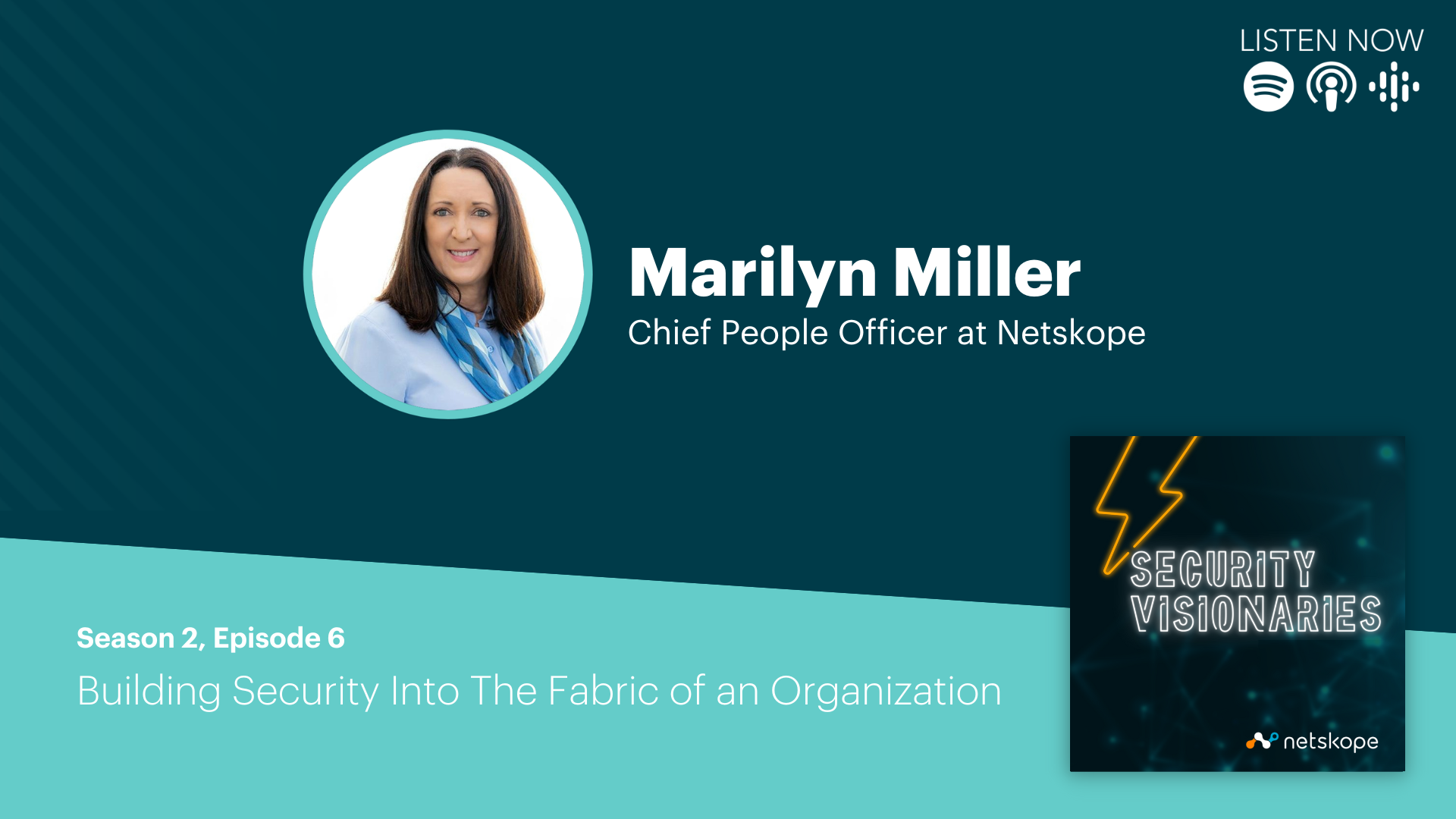
Speaker: Hello and welcome to Security Visionaries. You just heard from today's guest, Marilyn Miller, chief People Officer at Netskope. Establishing security as a team sport is more than just implementing policy requirements. It starts with weaving it into your culture and values. From hiring to onboarding to employment, people need to be educated on the critical responsibilities they hold in keeping their organization safe. Before we dive into Marilyn's interview, here's a brief word from our sponsor.
Sponsor: The Security Visionaries podcast is powered by the team at Netskope. At Netskope, we are redefining cloud, data and network security with a platform that provides optimized access and zero trust security for people, devices, and data anywhere they go. To learn more about how Netskope helps customers be ready for anything on their SASE journey, visit N-E-T-S-K-O-P-E.com.
Speaker: Without further ado, please enjoy episode 16 of Security Visionaries with Marilyn Miller, chief People Officer at Netskope, and your host Mike Anderson.
Mike Anderson: I want to welcome everyone to today's episode of our Security Visionaries podcast. I'm Mike Anderson. I'm the Chief Digital and Information Officer at Netskope. I'm excited today to be joined by our Chief People Officer, Marilyn Miller. What's interesting about this is when Marilyn first joined, she was on a town hall and she was introducing herself and she talked about how she had partnered with the CIOs in her past companies as they thought about security policies and how those impacted the organization and how they could work together on that change. And it was at that moment when we thought about our theme for this year has been security as a team sport, I said, "All right, Marilyn is coming down on the podcast. We're going to talk about this." So Marilyn, welcome. Why don't you tell the audience a little bit about yourself and maybe your journey to Netskope and maybe your journey as a Chief People Officer?
Marilyn Miller: First of all, thank you so much for having me. I was very excited to be able to have this conversation with you today. So yeah, I've spent my entire career in human resources. I've been a chief people officer for probably the last decade. I grew up as an HR business partner, but I think when you get to the chief people officer side of it, you get to see all aspects of the function. When I think about what my role as chief people officer, I'd probably talk about it today in two different contexts. The first one being, ultimate responsibility, can we attract and retain the necessary talent for our stage and size and growth, the business models and how we execute the business strategy? So that's one big piece of it.
But I think the other side of it is setting the policies and the procedures as well as the culture of the company. And I think it's that culture piece, blending the talent, attraction and retention as well as the policy side of it that I think is going to be most interesting for today's conversation is how do you craft a company culture that's inclusive of all the responsibilities that each of our employees have?
Mike Anderson: I totally agree, and it was interesting when I was at Schneider Electric before this, we'd always start every meeting with a safety briefing where we talk about where is the exit, how do you get out of the building, what are all the things you need to be mindful of, especially in a manufacturing environment? And always had this ambition. I'm like, "I want to have cybersecurity be part of that safety briefing. How do we be safe at this meeting?" Remember when we're at a hotel where the exits are but also remember, put your laptop in your safe. That's one of the things I want in the safety briefing. I'm really interested in your perspective as we get more on this topic.
So you brought up a good point right there around talent. And I know that today if we look in cybersecurity IT across all positions, we have a workforce challenge trying to find the right talent, how do we retain the people we have? How do we up-skill them? How do we attract talent? Talk to me a little bit about when you're partnering up with CIOs and security leaders around recruiting talent, how are you helping them think about that problem in bringing those people on?
Marilyn Miller: Yeah, and you mentioned it at the very beginning. My own journey with Netskope started with the partnership that I had at my previous organization with the CIO. We were getting ready to roll out a whole new set of security technology inclusive of Netskope. And when the CIO came to me and said, "Hey listen, we're going to get a lot of questions around, particularly from our engineering teams of, 'Gosh, how much visibility are we going to have into their own traffic if they were using any of the company devices to check the movie schedules or online shopping?'" And so one of the things we talked about was, "Listen, what's our responsibility as an organization? Our customers expect that we keep their data secure. Our employees expect we keep their data secure. And so this whole culture of security started to reveal itself and we had to talk about it and put it in the context of the culture for the organization.
One, it's everybody's responsibility. We have a duty of care and a duty of responsibility to a number of these different constituents. How do we enroll them in being part of the solution and the decisions and the requirement and the understanding and how it does fit into who we are as a company and the kind of employer that we want to be? And so I think that's what's really shaped the way that I think about the partnerships. We talk about security as a team sport and a shared responsibility and accountability. I think the more that you can drive it from it's instilled in your culture and your values, you have less of a dependency than on the policing and the policy requirements of it. You still need to have those things in place. But I believe a lot in how do we educate, how do we enroll, how do we talk about the importance, how do we make it part of the fabric and culture of the company? And everybody understands their responsibility around data security and the protection of it.
Mike Anderson: Yeah, that's a good point. I think about tech companies, especially in the Valley area. We've got a lot of companies that are pre-IPO tech companies. The source code is the most sensitive data they want to protect. And I think about developers and if that developer that's across from me decides to leave, do I really want them taking our source code and going to a competitor or someone else, because that then impacts the value I have as a shareholder, which is part of the reason I probably came to the startup is I'm hoping there's an exit at some point, whether it's an IPO or an acquisition. When you've had those conversations with developers, has that ever been something that's come up around protecting their own, the value of what they have as a company?
Marilyn Miller: Yeah. And I think it comes from people want to be part of a values-based, mission-driven, high culture company. At the heart of that is the trust, the transparency, the accountability that comes with it, and the software developers that they want the work that they do to add value to the customers, to add value to their own career goals and enhancements. And they expect that the company is keeping that protected. It's very rare that I'm involved with the security team in the pace of the bad actors, if you will, people trying to steal our data or download company confidential, whether that's customer data, intellectual property source code, or any of that. That's such the rare exceptions. But like I said, you want to make sure you have everything in place in the event that does happen.
I think the majority of our software developers and the people that work on our intellectual property, they're doing it to not just make us, but our customers obviously more secure, the pride that they have in that work and then the trust that they have in us as an organization to be able to protect that work and put it to the highest use and greatest value.
Mike Anderson: No, 100%. I mean, I think, you hit the nail on that. I think I always say 99% of people are well-intended every day when they come in the office. There's that small 1% that have some mal-intent for whatever reason. But generally, most people wake up every day and they go, "I want to do a great job at work." Most people don't walk up and say, "You know what? I want to do a crappy job at work today," which always becomes, it's not the intentional person. We have lots of ways to find them. It's the unintentional person that just happens to make mistakes because they don't know better or they didn't retain 100% of what they heard in that 30-minute training. What is the stat? I think it's like hear something 22 times before you remember it. I think it's just that it doesn't become brainstem until 22 times. And we're not going to make people do security awareness training 22 times in a year. They probably have a different set of words back for us. So I think it's that unintentional person that concerns me the most.
Marilyn Miller: Yeah, and I think you said it really well, Mike, but we try to start with how do we be proactive on the front end? And so as employees are joining Netskope, we talk about what we do, why we do it, the difference that it makes, that's kind of that mission driven culture, values-based organization. We reinforce that in the onboarding process, like the accountability and responsibility of each and every one of employees, we have the business leaders come in and talk about the solutions that we provide to the marketplace, who our biggest customers are, why they buy from us? We continue to reinforce that through the ongoing training that we provide to employees. And again, we have a backstop there as well where we've got actual written policies around security and data protection.
So we try to build this into the fabric of the organization and I think that's where the strong partnership across the organization, what are we trying to protect? What are we to get in terms of outcomes? How do we have the shared accountability around that? How are we clear about our expectations as well as what the consequences are in the event that we would have someone who intentionally was trying to take data or download things that they shouldn't be. And I think that complete framework is really the place where the chief people officers, along with the CIOs and the chief security officers as well as the business leaders, come together to say, "We each have a role and responsibility to play in protecting our data, protecting our customers, protecting our employees."
Mike Anderson: Yeah, absolutely. I'm so glad you're doing that because as a cybersecurity company, the worst thing could ever happen is a breach, right, because the reputational harm it can cause for a cyber company as we've seen from some of the other people in the industry that have had that happen is really bad. Question I have for you. In your journey as a chief people officer, have you seen cybersecurity become part of one of the values of any other companies you've worked with?
Marilyn Miller: I think it's embedded in there. So Mike, I've been at this for so long. When I started in HR, most of what we talked about was physical security. Everybody came to an office. You had these giant campuses, you had such an emphasis on the physical security. At that time, employees weren't working as much remotely. In a lot of cases they weren't even taking the company assets and devices outside of the workplace. Then you sort of evolved to the, "Hey, these global organizations. People are on the move. They want to be working from home evenings, weekends, on occasion. They want to have their own devices." You still have to have, obviously, concern about the physical security, but on a relative basis that's so de-emphasized relative to the data security piece of this. If you think about what's happened in the last two years where overnight you might have went from a small percentage of your employee base working distributively to now in a period of time 100% of your employees, unless you are an essential worker on their own devices from lots of different locations.
So that whole aspect of, "Oh my gosh, how do we protect our data and our information?" I've seen that whole transition and then building that into, as I talked about earlier, the culture and the values and the shared accountability around it. And so I do think a lot of companies are rethinking and if it's not explicitly written in their values, it's assumed and it's communicated as I talked about what we're doing in the onboarding, in the ongoing training, written in their policies on the front end of the communication that they have with their workforce about help keep us safe, help keep our data protected. You've got a lot of global GDPR requirements, lots of things to think about as well as your globally context, which most companies that, or big data companies have a global footprint as well.
Mike Anderson: Yeah, 100%. It's interesting, you brought back going back in the old buildings, I remember when I first started as a software developer, you didn't have web mail. Was using GroupWise to take us back in the time machine and we all were forwarding our emails to our Yahoo mail because we wanted to access it from home so we could work on our home PCs and write code. So I totally remember those days. I would've been that developer probably doing a bad thing if it was in today's world, just because I was trying to get things done in my computer at home. I didn't want to sit in the office until one o'clock in the morning.
Marilyn Miller: Yes, right. I mean, how the world's changed, I remember I had the little fob where the number kept updating every 30 seconds or minute if you were going to come in through your VPN. And that wasn't distributed across the entire organization. It was sort of only assumed a certain kind of role or a certain talent was working remotely and distributively and how the world has changed in a very short period of time. And I love the way that even when you hear Sanjay talk about data is the new sort of oil, if you will, data's what drives the economy. And for enterprises to be able to protect that data and think about it from all aspects at the network level, at the device level, in a highly global and distributed environment, the complexity of it is enormous.
And so I think that I shared, again, kind of shared accountability between who's the employer that we want to be, what do we value, and then how do we actually deliver and execute against that sort of talks about that intersection between the CIOs, the CISOs, the chief people officers having to come together and really craft these kinds of solutions for their organizations.
Mike Anderson: No, 100%. I've always had such a close partnership with the HR organization because some people... HRs who I escalate problems to or HRs who I work with when I need to rethink my talent strategy in my organization, which are obviously two things that are key. But a lot of times it's HR people are so good around the psychology of change and how do you get people to absorb things and right, wrong or indifferent, a lot of people in IT tend to write these encyclopedias of policies that no one ever reads and they just set accept. And so how do you translate that into things people can actually grasp and understand? Maybe you've been doing some of those things even here. How do you take this encyclopedia and take it down to the highlights that people need to care about?
Marilyn Miller: Yeah, and I think it's such a great point, Mike, and again, you need those things. I would encourage companies to have really robust policies and have that included, but it's really the storytelling, the narratives that, what can go wrong, put it into a context, connect with them emotionally and viscerally around why these things are important. And you kind of said it, right. You can probably tell lots of stories of enterprises who had bad things happen and what the outcomes were around that. And employees relate to that kind of storytelling, that kind of narrative, that kind of putting it in context. It gives them that aha moment of one, how serious this is, how big the consequences can be if we don't protect the data or things happen. And you kind of said it too, Netskope itself, we become a bit of a target. If you're on the outside and you're trying to have a data security breach, no better company to do it than to a security company in and of itself.
And so that just raises the requirements for Netskope exponentially because we get targeted. We've got really great data. We've got a super proactive security team. I think one of the first people that, besides you, coming in was spending a lot of time with Lamont Orange and his team really understanding that environment, how they do their jobs, how we can help facilitate that and roll employees around, "Hey, it's not just one team or one group's responsibility. It's the exact number of however many employees we have." If we have 2000 employees, then it's 2000 people's responsibility to keep us safe, keep our data secure and safe. And I think that setting that as a cultural tenant and that shared accountability around it has been super successful for us. And that's getting out and talking to people and like I said, telling the stories and the narratives and the why's and the how's and who our customers are and what they expect from us as well.
Mike Anderson: Now it's interesting, one of the things that I've always felt is really important on security is connect it back to how is it helping you, not just when you're in the office, but personally as well? Because if people's individual security hygiene gets better when they're not in the office, when they're on their home computer dealing with their own financials, their own finances, their own personal information, that then will translate into what we do in the office. How have you seen maybe some good examples here at Netskope beyond where you've seen people help that, how that's played out in a positive way in their organizations?
Marilyn Miller: I think to your point, there's a lot of when you can educate, when you can make people aware, when you can help them understand why these things are important, there is a natural transference then to their personal lives and how they think about securing their own data. Everyone's heard, again, the horror stories, your identity stolen or your bank accounts or credit cards being hacked. And so I think there's a lot of parallels around that. And again, I think that at Netskope what we've done a really good job of is continuing to be out in front of our employees. You kind of said, "Gosh, a lot of times these IT policies and then you have somebody sign something on the way in." It doesn't give them context, it doesn't give them consequences, it doesn't give them accountability when you stay out in front of them and you continue to talk about why it's important.
Again, for me, I go back a lot to think about who our customers are. We have over 2,000 customers, many of them, some of the largest, most complex and/or financial institutions, you want them to be protecting your personal data and we help them protect themselves. It's all in a common ecosystem, if you will, or a connected world that the people we do business with are our customers on a personal basis. I certainly want my personal data with my bank and other institutions to have them be as thoughtful as they can about protecting my data and employees start to really understand how all of these things fit together and why it's so important in terms of not just what we do but how we do it and that we have the deep understanding of the relationships there. And like I said, to me it's building it into your culture, your values, your education, being proactive around that and only using the policy statements as kind of a backstop if something was to go wrong.
Mike Anderson: Yeah, it's kind of like in a commercial relationship, no one ever looks at the contract unless there's a problem. So how do we use that same mindset with our people? It's like we just expect they're not going to read the policy document. So what is it important that we get them to know? What are the highlights that they need to know? We talk about stories, so let me hear a couple stories from you around what are some ways that maybe some good examples and maybe some bad examples or maybe humorous around partnerships with CIOs and CSOs in past organizations. And you don't have to list the name of the company unless it was a positive just to keep people's personal brand intact. But maybe some examples of what good looks like and what bad looks like or maybe something you heard from a peer as a bad example of CIOs and CISOs partnering with their HR and people leaders.
Marilyn Miller: I'll start with some of the good examples and I think that's where we've had leaders and managers come forward and say, "Hey, proactively, how do I make sure that my team understands the environment that we operate in and the expectations that we have?" You mentioned it earlier, people want to come to work and do a good job. They show up every day saying, "Hey, how do I enable the organization? How do I make my best contribution?" And so when I get the stories of managers coming saying especially here at Netskope, how important protecting our data and understanding what we do and how we do it and how we enroll the employees around it. That proactive approach is fantastic. I have had examples at other organizations where I get the phone call of, "Hey, we have an employee who left. We can see all their traffic, everything that they've downloaded and the things that they may be trying to take with them," whether it's a pricing sheet or a customer list or copies of contracts that we have.
And I think for me, my first inclination is to say, "Okay, if I was to give them the benefit of the doubt, let's sit down and ask them, 'Hey, we can see what you've done in the network and the things that you've downloaded or emailed to an outside email address. Help us understand what your intention is and how you plan to use that.'" Most of them know right away "I've been caught." And so then you just start the recovery process as well as to start to talk about what the consequences are of taking any of that data and using it for unintended purposes or from outside of the organization. I would say over the years that's actually gotten less and less because of the education. Most employees now know they can see and they'll know and they can detect because companies have done a great job educating their employees on their security environments.
And what happens if you unintentionally lose a device, we remote wipe it, we can shut it down. All you have to do is report it, make sure that we're aware. And so I think where security used to be limited to the people who had security in their job title, it's now because everybody's responsibility and companies have done a really nice job educating everybody. So the bad actors around this I think are less frequent than what I've seen in the past because of that. They know they're likely going to get caught or someone's going to see what they've done. And even employers who, in the past, maybe an employee came and said, "Oh hey, I can tell you where I came from and the customer list that they have." They're like, "No, absolutely not. We don't even want to know that information. There's bad consequences for us for using data that we shouldn't be."
So you kind of have it coming from both sides of it where employees know better not to take it. Employers absolutely know better not to use data that they know they shouldn't have had access to or it came to them in a way that was less than high integrity.
Mike Anderson: Absolutely. It's interesting, you talk about that story. When I came on, I'd heard a story and it stuck with me. It's the whole, your brain will remember a story but it won't remember the facts and figures you put on a slide. And so someone told me the story about a customer. We were in a proof of value with and we were reviewing the results of the proof of value with a financial services customer. And we said, "Hey look, here's this person right here that just yesterday copied 1,200 files off to a personal dropbox account." And they said, "Whose that user ID and who was the person?" And then we told them. They said, "Wait a second. That person's in an exit interview down the hallway. You're going to have to give me a minute. I want to stop them before they leave the building."
I pivot that today, if I look before the pandemic, we still had remote workers. I've worked. My last company, I was at Schneider. I was traveling to Nashville or Boston every week, but then I'd work from home a day a week. A lot of people did that. And so we still had challenges, but most people were in the office. Now we've went to hybrid work with the pandemic where you said earlier, everyone went to or at work and now some companies have gone to a hybrid policy. Some have gone back to "everyone has to be in the office." I know you came from Anaplan. I know the CI over there. So as I think about that, how did you see that partnership change during the pandemic? What happened during that timeframe? How did it change and then what do you hope stays as we move forward now that we're really on the other side of the pandemic. What things got better and how do you make sure those things stick going forward?
Marilyn Miller: And as you mentioned prior to the pandemic, you probably had a small percentage of your workforce and maybe even every day. It was the overnight, 100% being entirely distributed and then distributed from there. So you weren't even co-located around hubs. People scattered across and I was at Anaplan at that time and I think one of the first things that we did was to pull everybody together. We obviously started with personal safety first and the psychological piece of the pandemic. But then after taking care of those highest priorities, the next thing was around business continuity. How are we going to continue to have the business continuity? Security was a big piece of that conversation and the connectivity, the ways that we could support our employees through that. That was a company that dealt with a lot of large scale customer data. We now had even the customer response around that.
If we had a crisis in the past, everyone come to the office and let's get in a room and solve this and figure this out. And we now had to try and solve these really complex customer problems in this highly distributed way. And so talking about how we were going to work and continue to solve problems, serve the customers, innovate, do that in a highly distributed way, kind of weaved through all that would be the security requirements of that kind of data sharing. Even the remote Zoom and WebEx and Teams environment that we went into. We had to make sure and check that all the security around all of the software, the other technology that we were using, really were going to meet the standards of the new way in which all of us were working. Like, does someone have responsibility for checking everybody who's called in here know that we know to a person who's on some of these calls when we're sharing data, having highly confidential company.
And that hadn't really been part of the pre pandemic set of protocols that you go through. But all of those, what seemingly could sound like small things, were super important in the early days of learning how to work in this new highly distributed, entirely remote environment.
Mike Anderson: So it was the start of a call with, "Please, no one takes screenshots of this information. It's not supposed to be shared." As right as you say that, everyone's taking screenshots and sharing them and then you're playing the hunting game, "Okay, who shared that with who?" And it wasn't even outside the company. It was inside the company. "It's okay, now everyone's an insider. Okay, we're just going to make everyone in the company's going to be an insider now because we don't know who's sharing this where." And all these new challenges that we had.
Marilyn Miller: Exactly. All those little things you had to think through and think about some of the security details or security solutions that we have now. It can detect if somebody takes a screenshot or an iPhone picture of highly sensitive, highly coveted, secure data and think about it. Like lots of those meetings that used to only be able to happen in person, you weren't allowed to come in virtually or remotely, board meetings. They all had to get pushed to the virtual and that became a real concern. So I expect that will be something that will really continue to evolve. I think we have to assume highly distributed hybrid, yes, there will be some companies that will ask employees to come back, but it's highly unlikely that will be five days a week because the workforce is sort of already signaled, "That's not sustainable," and it's not even necessary.
It's not an enhancer to productivity or innovation in some cases even green, like the environmental footprint of not having people commuting five days a week. So yeah, I think you're going to see the evolution of these security products continue to be imagined in a world where at least remote working is going to be the larger percentage of the way people join and stay with organizations.
Mike Anderson: Yeah, it's going to be interesting to see how it plays out because we've seen even big companies like Salesforce saying, "Hey, the facts we're not coming into an office. What's having an impact on our productivity with new employees coming in?" And we went from the great resignation, which some would say, "We're kind of maybe still in it," but at the same time, and I think we're in the force resignation right now a little bit, especially in the tech sector with a lot of the layoffs we're seeing.
That's always one where I feel like there's got to be things leaving the building when there's people feel like, "Oh my gosh, I can't believe I was just impacted with my job." Have you seen that play out in your time where you see more of that data leaving the building when there's these reductions like we're seeing today, because sometimes those are done three months, nine, six months ahead of time because of notice times you have to give in certain industries.
Marilyn Miller: So I think it's a great question. I actually think it's probably a better question for a chief people officer who's not the chief people officer at a data and security company, because again, I think our talent, our employees, our workforce is so much better educated and they're so aware of what our capabilities are that even if they were inclined to think, "Well, maybe I'll just download some of the things that I did," or "take some of this data and information with me," they know the probably absolute probability around that is we're going to be able to detect it. So like I said, it's hard for me to answer because I'm certainly not seeing an increase of that at Netskope. But I do think it's because of who we are, what we do, how much education, how much awareness, how much our employees are in tune with that so they're less likely to try and test the system around that.
Ma penso che sarebbe una domanda molto interessante per altri chief people officer. Ma come ho detto, dall'altra parte, la maggior parte dei datori di lavoro non vuole essere associata o far parte di quell'altro, avendo assunto qualcuno e poi porta qualcosa con sé. Primo, dice un po' chi è quella persona che hanno appena assunto, che si offrivano di portarla. E sanno anche che le conseguenze per loro sono gravi se usassero quei dati ottenuti tramite qualcuno che ha preso dati con cui non avrebbero dovuto andarsene.
Mike Anderson: No, sono totalmente d'accordo. Ovviamente, la tua prospettiva è cambiata da quando sei arrivata in un'azienda di cybersecurity a Netskope e proteggi i dati. Quindi, sapendo quello che sai ora, è passato più di sei mesi ormai, giusto? Credo sia passato più di sei mesi-
Marilyn Miller: Sì, è così-
Mike Anderson: ... si sono unite. Il tempo vola.
Marilyn Miller: Sì, circa 10 mesi.
Mike Anderson: 10 mesi. Sì. No, stavo guardando. Sono passati quasi due anni per me, penso, "Wow, il tempo è volato." È come gli anni del gatto. Come è cambiata la tua prospettiva e quali consigli daresti ai chief people officer di altre organizzazioni? Cosa hai imparato nei 10 mesi che poi diresti: "Se vai a un Summit dei Chief People Officer di Evanta e ti trovi intorno al tavolo, che consiglio daresti loro o che hai imparato da quando sei arrivato a Netskope?"
Marilyn Miller: E penso che sarebbe così, Mike. Ma costruisci quelle partnership e relazioni fin da subito. Capire la responsabilità condivisa. Penso che tu l'abbia detto meglio all'inizio. Questo è uno sport di squadra. Ognuno deve contribuire agli aspetti tecnici, alle soluzioni tecnologiche reali, ai prodotti e azioni per la sicurezza dei dati e al modo in cui li pensano. Ma da chief people officer, il tuo compito è capirlo e poi dargli vita, intrecciarlo nella tua cultura, nei tuoi valori. Tieni tutto sotto pressione all'organizzazione, iniziando da come assumi, come ti integri, come continui a formare ed educare, raccontare storie e narrazioni, il perché è importante, cosa si aspettano i tuoi clienti, perché anche voi come dipendenti volete far parte di tutto questo. E una volta che hai questa proprietà in tutta l'azienda, penso che cambi la tua prospettiva su quanto sia essenziale questa cosa.
Possiamo avere la migliore attrazione e fidelizzazione di talenti, programmi di sviluppo e tutto il resto, ma se danneggia il tuo marchio o la reputazione, molte di queste cose spariscono molto in fretta e sono più difficili da ricostruire. Quindi sii proattivo su questa parte del tuo ruolo e su come contribuisci al successo complessivo dell'organizzazione. E nulla danneggia un'azienda come una violazione dei dati, un problema di sicurezza dei dati o qualsiasi tua proprietà intellettuale o dati dei clienti che esci dalle tue quattro mura. Quindi rendi questo parte di come pensi al tuo valore complessivo e poi di come dai priorità a costruire le tue relazioni intorno alle altre parti dell'organizzazione che sono anch'esse responsabili.
Mike Anderson: È un ottimo consiglio e sono entusiasta che tu possa condividerlo perché così avremo altri fan entusiasti o persone che parleranno di Netskope in altre parti dell'organizzazione e questo porterà più affari per la nostra azienda per aiutare i nostri azionisti. Hai sollevato un buon punto. Una di quelle che hai accennato è il talento. Guardo alla cybersecurity e sono sempre stato nell'IT cercando di portare più diversità nelle mie organizzazioni IT, che sia diversità di genere, diversità etnica o semplicemente diversità di pensiero e background. Quando guardo specificamente alla sfida della diversità di genere che affrontiamo oggi nel cyber, quando guardo ad alcuni ruoli tecnologici, quali idee potresti avere su come portare più diversità? Non vedo tante donne nella nostra organizzazione SE, o, per esempio, in ruoli di sviluppo come vorrei. Quali sono alcune cose a cui pensereste per far interessare più donne a questo tipo di ruoli?
Marilyn Miller: Quindi penso che ci siano un paio di cose che vorrei condividere lì. Primo, penso che dobbiamo iniziare prima. Come possiamo entrare nell'istruzione precoce e parlare dei tipi di carriere, dell'impatto, del lavoro che si può fare, delle aziende per cui si può lavorare, con cui essere associati e iniziare a ispirare fin da piccoli. Quando penso a molti dei programmi STEM e a tutto il lavoro che viene fatto, si inizia a creare quell'interesse e questo può aiutare a plasmare il modo in cui pensano alle loro scelte educative e ai percorsi che percorrono al liceo, dopo il liceo, che porteranno a un bacino di talenti più ampio.
Un'altra domanda a cui penso è: come gestisci la narrazione intorno a tutto questo, la narrazione? Tipo, perché questi lavori sono super interessanti, l'elemento umano e quello umano e assicurarsi che sia ben compreso.
Penso che la sicurezza abbia probabilmente avuto una certa reputazione di lavorare in modi misteriosi. E penso che poter parlare di più dell'impatto, della narrazione, della narrazione, dei modi in cui contribuisce aiuterà anche ad attrarre più talenti nel settore. E poi, una volta che riusciremo a portare più donne in questi ruoli, come possiamo assicurarci che siano preparate per avere successo? Possono vedere un percorso professionale, vedono altre donne, lavori importanti e di grande impatto. Penso che tutte queste cose contribuiranno a spingere più talenti verso queste scelte di carriera davvero fantastiche e straordinarie.
Mike Anderson: Non potrei essere più d'accordo, è un ottimo consiglio. Penso che il racconto di storie in generale sia una delle migliori abilità che si possano avere perché può aiutarti in tanti modi, che si tratti di tradurre un argomento complesso o di far immaginare le persone in quel ruolo. E penso che sia qualcosa in cui le persone vorrebbero aver investito di più quando guarderanno indietro, e alla fine penso che il change management inizierà a giocare un ruolo importante nella sicurezza. È sempre stato nell'IT, ma penso che il change management debba essere una componente fondamentale della sicurezza anche per il futuro.
Marilyn Miller: Sì, dare vita a questi lavori. Voglio dire, nessuno fa un lavoro migliore di Sanjay Berry. È così coinvolgente. La sua narrazione sul perché ciò che facciamo è importante e su come aiutiamo a proteggere il mondo, i dati e tutto ciò che vediamo accadere. Penso che questo attiri tutti i talenti verso questo tipo di opportunità di carriera. E che più riusciamo a farlo, più vedremo un gruppo di talenti più ampio e diversificato che seguirà questi ruoli.
Mike Anderson: Sì, non potrei essere più d'accordo. Beh, è stata una grande conversazione. Mi piace sempre chiudere il nostro podcast con qualche hit veloce. Quindi passeremo rapidamente in rassegna questi aspetti. Quindi tre domande per te. Il primo che ti ho dato, qual è il miglior consiglio di leadership che tu abbia mai ricevuto?
Marilyn Miller: Direi che all'inizio della mia carriera ho avuto un mentore e un campione davvero bravo che mi diceva: "prenditi dei rischi. Il prossimo lavoro potrebbe non essere sempre ovvio, potrebbe non essere sempre lineare, ma se riesci a imparare qualcosa, ti mette alla prova in modi specifici." Sii aperto di mente e fai cose che potrebbero farti uscire dalla tua zona di comfort. Questo mi è stato molto utile durante tutta la mia carriera.
Mike Anderson: Oh, ottimo, consigli di leadership. Prossima domanda, qual è il tuo ultimo pasto?
Marilyn Miller: Beh, ho avuto l'opportunità di trascorrere circa nove giorni a Firenze questo autunno. Quindi direi qualsiasi pasto dall'Italia. Ho esagerato mentre ero lì, ma è stato fantastico.
Mike Anderson: Beh, dovremo parlarne più tardi. Amo l'Italia, quindi amo anche il cibo. Quindi questi sono due buoni argomenti per una conversazione futura. Va bene. Ultima domanda per te: chi ammiri di più e perché?
Marilyn Miller: Oh wow. Questa è una questione difficile. Direi che, essendo stato chief people officer e avendo osservato in questi ultimi anni, ammiro tutti i genitori lavoratori e in particolare le madri lavoratrici. I ruoli e le responsabilità che hanno dovuto assumersi, bilanciare la casa e il professionista, è davvero una grande ammirazione che va a quella popolazione.
Mike Anderson: No, sono totalmente d'accordo. È divertente. Un'amica mi ha raccontato che parlava di suo marito che parlava di alzarsi i bambini la mattina durante tutta questa pandemia e di tutto il resto. Lei dice: "Voglio essere marito quando sarò grande." Quindi ho trovato la cosa piuttosto divertente. Quindi mi è davvero piaciuta la conversazione. Quindi grazie mille. Grazie per aver investito il tempo e ovviamente non vedo l'ora di lavorare con voi ogni giorno, quindi.
Marilyn Miller: Sì, grazie Mike, e grazie mille per avermi invitata. È stato divertente e anche educativo per me, solo la riflessione delle domande mi ha portato a riflettere seriamente su questo. Ed è stato un vero piacere essere qui oggi. Quindi, grazie.
Mike Anderson: Grazie. Beh, spero che vi sia piaciuto l'episodio di oggi del nostro podcast Security Visionaries. È stato fantastico avere Marilyn Miller, la nostra Chief People Officer qui di Netskope, a unirsi a lei. Mi piace molto lavorare con lei ogni giorno e ogni volta che posso ascoltarla, le grandi intuizioni che ci dà sono semplicemente straordinarie. Le tre lezioni chiave che ho tratto dalla nostra conversazione di oggi, prima di tutto, sono che devi integrare la sicurezza nei valori e nel tessuto della tua organizzazione. Secondo, è importante sia dal punto di vista del chief people officer, sia come CIO che CISO , lavorare in modo collaborativo il prima e più spesso possibile per assicurarsi che la Politica diventi reale e qualcosa che sia più di una semplice enciclopedia da leggere, ma qualcosa che diventi più pratico.
E poi il terzo, che è un ottimo consiglio per tutti in ogni ruolo, ovvero la narrazione. Usalo per attrarre talenti, usalo per trasmettere argomenti complessi che sai essere una competenza fondamentale da avere. Spero quindi che questo episodio del podcast Security Visionary vi sia piaciuto. Sono Mike Anderson, sono il vostro conduttore. Sono il CIO e Chief Digital Officer di Netskope.
Sponsor: Il podcast Security Visionaries è alimentato dal team di Netskope in modo rapido e facile da usare; la piattaforma Netskope offre accesso ottimizzato e sicurezza zero trust per persone, dispositivi e dati ovunque si trovino, aiutando i clienti a ridurre i rischi, accelerare le prestazioni e ottenere una visibilità senza pari su qualsiasi attività cloud, web o applicazione privata. Per saperne di più su come Netskope aiuta i clienti a essere pronti a tutto nel loro percorso verso la SASE, visita N-E-T-S-K-O-P-E.com.
Relatore: Grazie per aver ascoltato Security Visionaries. Prenditi un momento per valutare e recensire lo show e condividerlo con qualcuno che conosci e che potrebbe apprezzarlo. Restate sintonizzati per gli episodi che usciranno ogni due settimane, e ci vediamo nel prossimo.























)