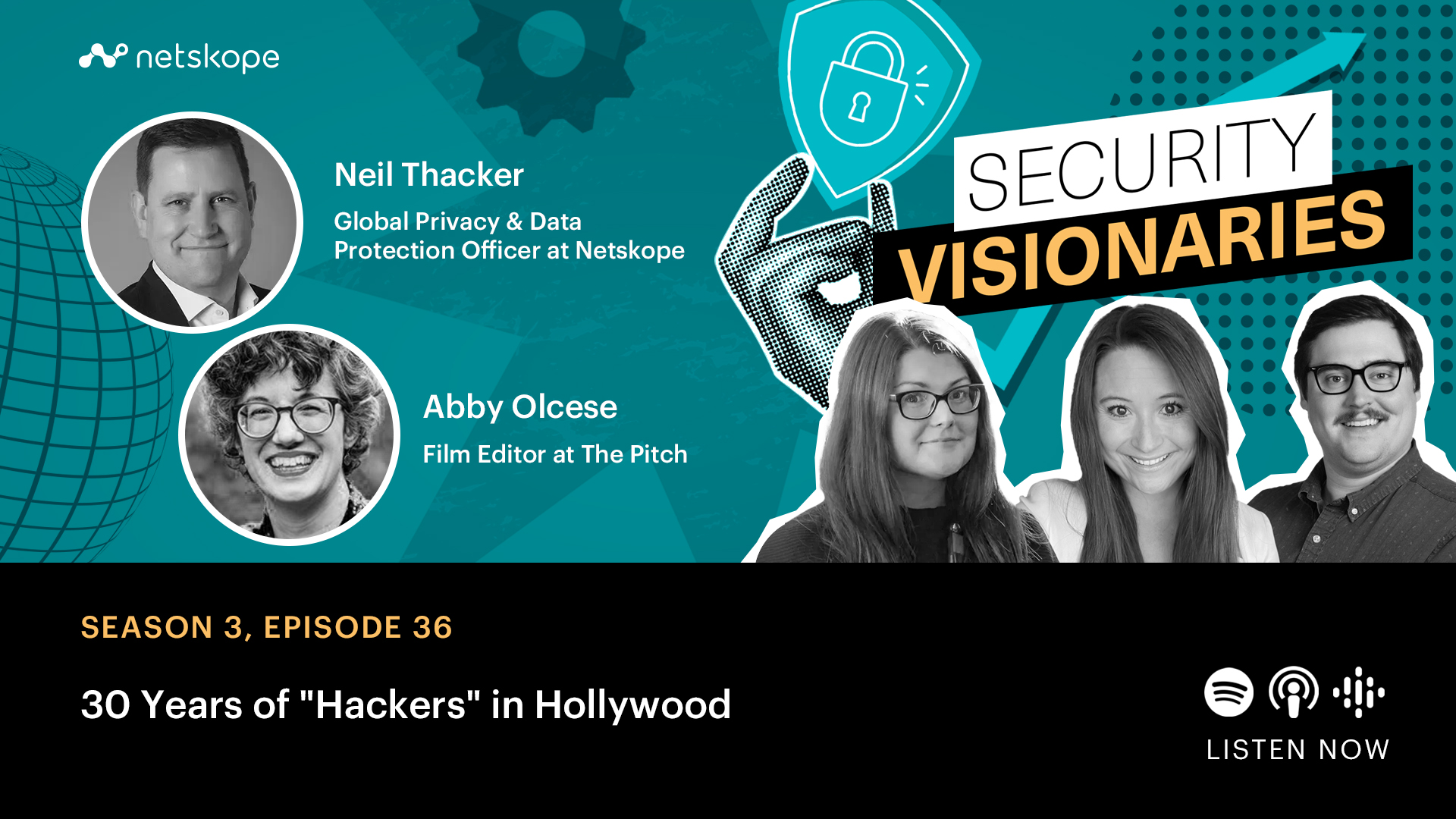
0:00:02.2 Max Havey: Hello and welcome to another edition of Security Visionaries, a podcast all about the world of cyber data and tech infrastructure, bringing together experts from around the world and across domains. But today we're doing something a little bit different. I'm your host Max Havey, and today we're headed to the movies. The 1995 film 'Hackers' is celebrating its 30th anniversary this September and we wanted to take the opportunity to talk about the way Hollywood has depicted cyber crime, cybersecurity, and cyberspace in the intervening three decades, and discuss what impact those depictions have on the industry here. To discuss this, we have two guests. First up we have Neil Thacker, Global Privacy and Data Protection Officer here at Netskope who cites 'Hackers' as a formative influence on his career choices. Welcome back to the podcast, Neil.
0:00:45.3 Neil Thacker: Thanks Max. Thanks for having me again. Looking forward to the discussion today.
0:00:48.8 Max Havey: Absolutely. And second, we have Abby Olcese, Film Editor and Critic for Kansas City's Alt Monthly, The Pitch whose work has been published at Roger Ebert, Paste, SlashFilm and Sojourners among many others. Abby, welcome to the podcast.
0:01:01.4 Abby Olcese: Yeah, thanks for having me.
0:01:03.9 Max Havey: This is the first time we've had like a film critic on the podcast, which in my brain I'm just excited to always talk film with anybody. So this is so exciting.
0:01:11.7 Abby Olcese: Yeah. Absolutely. I'm looking forward to it.
0:01:13.5 Max Havey: So this topic is near and dear to my heart, not only because I spend much of my day to day deep in the world of modern cybersecurity, but like Abby, I also spend much of my free time watching and writing about film and I've always had something sort of related to 'Hackers' percolating in my brain ever since I came on at Netskope in 2019. So it's really exciting to finally be having this specific conversation. I think I've just had written in a notebook somewhere, hackers question mark. And so it's fun to finally see this through. To jump right in here though, can you each tell me about your relationship with the movie 'Hackers' since I already kind of hinted at it here first? Neil, can you go first?
0:01:48.8 Neil Thacker: Yeah, sure. I first watched the movie, I think it was '96. I don't think we got it in the UK straight away. I think there was some debate around it being a depicting cybercrime and things. And five years before they just published the Computer Misuse Act. So there was a delay, I think it was around '96 so we had to wait a year or so until we got it. But it was a perfect time. It was a perfect time. I was just about to select my college course. I was leaving school, moving to college. I was looking at what I wanted to do. I had a focus on computer studies and I watched the movie and of course it depicted this great culture of computer hackers fighting the bad guys in a way. And there's a big story behind that.
0:02:30.7 Max Havey: They were first considered the bad guys, but actually were the good guys at the end. Yeah, it just made everything look so fun, so exciting. And it was again, as I said, the perfect time. I'd seen obviously all the previous movies depicting hacking up war games and weird science and sneakers. That was a great film. 'Hackers' at that point in time was really the kind of the target teenage tech film at the time. It helped me make a choice. It helped me choose computer studies and move into that kind of career. Ultimately, I still remember my first few weeks at college, it was like I was on the set of 'Hackers' because everyone was kind of embracing that subculture that it created. We had people in the, well in roller blades, gliding around the college campus in roller blades. We had a few of them in the goalkeeper jerseys, the football goalkeeper jerseys, which was pretty prevalent in the film as well. And yeah, it felt like I was in that. I quite didn't quite live up to that, that kind of cool subculture as such. But I loved it and it was cool. But it also because the film helps people understand that a little bit more around this approach to computers and elements of cybersecurity, that it could be fun, it could be challenging, a little bit rebellious perhaps. And that kind of also made it exciting.
0:03:42.7 Max Havey: Definitely. And Abby, coming from your side is like a less technical side. What's sort of your relationship to the movie 'Hackers?'
0:03:47.1 Abby Olcese: So I was very young when this movie came out. I think I would have been about seven. So I didn't get to really engage with it until many years later. I think the first time I saw it was in college and it was at the recommendation of a friend who was like, "Yeah, it's kind of goofy, but it's good." And just to kind of place you like where in tech history I am at this point, Facebook was still a fairly new technology. Like I remember the day that we all got our college email addresses, like the.edu email addresses, which you needed to have to sign up for Facebook. And so like we all went down to the IT office to register and the line was like just out the door. It was so long. So that's kind of the space that we're working with. That's like kind of an in-between place from where like, I don't know, the tech of hackers was and where we are now. I, at the time, really didn't care for it. I thought it was kind of goofy. I kind of didn't have the sense of humor and forgiveness about stuff like that that I do now.
0:04:43.0 Abby Olcese: So I kind of have come back around on it overall just because I have a lot of friends who love the movie, who are really close to it. Like aesthetically, you see references to it popping up everywhere online and in person. And so getting to watch it again, I was really excited for the opportunity to kind of re-engage with it and see a little bit more critically what things still work, what things don't and what things I don't care whether or not they work because it's just such a fun and sweet movie.
0:05:06.9 Max Havey: Absolutely. And in that sense, Abby, why do you think 'Hackers' still endures as a cult classic today, 30 years on? Because it really does kind of embody like a specific time and place there. So why do you think that sort of still endures as a cult classic?
0:05:20.1 Abby Olcese: Yeah, I mean, I think there are some folks like the aforementioned friends who like grew up watching it and love it. And it's just become a part of what they thought adulthood might be like. Or at least like teenagerhood, like what we hoped that would be like, where you have like a cool group of friends that you run around New York City with on rollerblades and get to do fun like high tech heists with. So like even if that doesn't necessarily work out in real life, it's still kind of a fun, like some kind of facsimile of it is sort of a thing that people want in their lives. So there's that. There's the extremely specific aesthetic of it that I think is timed to 1995. So this is the year that Johnny Mnemonic also comes out, which like you can see some pretty direct visual parallels between that movie and this movie in the rollerblades in like the club that they all go to. The group of kids where they go to like the hacker club late night in New York, it really feels like you've stepped inside a Johnny Mnemonic scene. It's all like blue electronic lights and people getting their jollies out on the dance floor.
0:06:21.3 Abby Olcese: And I think fashion owes a bit to this as well. This was kind of the ascendancy of the cyberpunk look, which Johnny Lee Miller's character who has the rollerblades and all the pads all over and like the leather jackets and stuff like that all is very. And I think Neil kind of alluded to this as well. Like there are people who dressed like that at the time and continued wanting to because it was such a specific and cool look. So there's a lot of things there. I feel like it's sort of a depiction of tech and film that reached an apotheosis in 1999. Like the Matrix, I think really changed the way a lot of that looked. We moved from sort of the cobbled together community aspect of it to the leather jackets and isolating aspect of it. Pretty quickly after that. But for about five years there, we really had a lot of fun. And I feel like this is a nice inflection point between what we thought the Internet would be like and what it's become.
0:07:14.4 Max Havey: Certainly. And Neil, from your perspective as someone who's been living with this film for the better part of 30 years, what sort of sticks out to you in revisiting it for this conversation?
0:07:22.2 Neil Thacker: Yeah, it was a period of time. At that time, technology was still new. The internet, most people in '95, '96 didn't have access to the internet. So it was new. We had this in previous films where people would do like war dialing and they would use a dial-up modem or their phone to connect. But this kind of felt like it was something that we were on the verge of moving into. So it was a great time. It felt new, a little bit dangerous. Possibilities were there. And a lot of people at that time were experimenting with the Internet. I know, again, going to college, it was a case of the Internet was a privilege. You had to ask and get access to the internet. That was how it was in those days. And I'm now showing my age. But that's kind of how it was. But of course, the first thing people did was like, okay, well, how do I get more access? How do I ensure that I don't have limits in terms of my access? So bizarrely, that's kind of what we did, right? We were a group of computer science students and we worked out how we would get more time on the Internet by cracking passwords and getting access to these kind of things.
0:08:18.4 Neil Thacker: So we leveraged kind of dangerous, that possibilities aspect of this. And we took this into our day to day, really. So that's kind of how it was. We all threw away our black and blue disks, our three and a half-inch floppy disks. And we all got multicolored disks. Everyone's favorite was the yellow disk, again, from 'Hackers.' It was the first time I also saw people with Apple Macs and not Macs at the time, but again, Apple laptops and working through on these devices and basically writing scripts, code. And although it wasn't completely connected to the movie because that was all CGI, it was good to kind of see. And I remember somebody coming in and they'd sprayed their keyboard and so they'd basically set up this laptop from the film. So, yeah, it kind of had this energy, this timeless energy. It was able to also transverse certain generations as well, because even we had lecturers that were quoting quotes for the film and talking about the film as well. So it was great that we had this kind of common theme. And I guess one of the aspects, it's left a lasting legacy because you'll still see famous quotes from the movies at most of the cons today. You'll see We Are Samurai on people's laptops, devices. My Crime Is My Curiosity. And probably the most famous one, Hack the Planet. If you go to DEF CON, you'll see Hack the Planet stickers everywhere. So it's kind of stayed. And I think that's why, as I said, it's a timeless film. Yes, it's not the greatest film in terms of production and acting and all these kind of things, but it's just a fun movie.
0:09:45.5 Max Havey: To steal something that I heard someone say on Twitter years ago, but it's a five star, three star movie. It's a great three star movie. And truly, that's what still makes me want to go back and watch it. Because I came to it later than you all did because I came to it, I think, when I was in college. I'm a little bit younger than Abby. And it's so exciting in that way because it does feel like this fantasy version of technology. But something that really excited me was the fact that they're pulling from a lot of hacker manifestos, like Lloyd Blankenship's Hacker Manifesto is credited in the credits. I wound up looking that up after the facts. I caught that at the end of the credits. And then the Hacker TV show they watch that feels like something out of an anime almost. It feels like Cowboy Bebop. But they say hacking is more than a crime, it's a survival trait. And that's an interesting perspective there. Because what really stuck out to me on this watch was portraying hackers as kind of a counterculture group. And Neil, as someone who's working in cybersecurity, how much of that is still sort of the case? Are hackers still seen as a counterculture group or their own sort of subculture now?
0:10:47.7 Neil Thacker: Yeah, I mean, it depends, right? I used to identify as a hacker, and I would always get very upset when in the media they would write, again, hackers are guilty of doing these kind of things. And it was always the case. Well, yeah, a lot of people are hackers that fight for a good cause and are ethical, and they approach these kind of things. And yeah, we may not all have cool hair and wear bikers' jackets and those kind of things. But yeah, it was something to link this to the energy and excitement around this. I think sometimes it's perhaps not always correctly represented as being like people are cultural misfits or they go to conferences, they're very different conferences to the rest of the world. I think there's a good balance. There are some people who also like to play dress up as in that cultural misfit role, and it's fun and it's exciting. So I think that's where the kind of balance really sits. I think it's interesting that one thing I always talk about, again, in this film, and I watched it again at the weekend with my two sons who also said the same thing, not a great film.
0:11:42.9 Neil Thacker: But yeah, it was interesting. Again, it was highlighting the fact is that the way that it twists, again, were these guys the villains? Actually, no, in the end, they kind of saved the day. And that's something that I think we often miss in terms of cybersecurity. Sometimes there's a lot of play on, okay, well, these organizations have had a breach and they didn't have great cybersecurity or they didn't have these kind of things. Actually, when you look at this, these organizations are fighting cybercrime every day. They're fighting attacks every day. You don't always talk about the positive side of those kind of things. And I think that's really, really important. This movie highlighted that ultimately, people in this role in cybersecurity are also heroes every day.
0:12:18.7 Max Havey: Certainly. And Abby, from your perspective, what kind of stuck out to you either about the way that hackers are portrayed or the way that cyberspace is portrayed? I know you talked a little bit about Johnny Mnemonic as kind of a visual parallel there. I'm curious to get your thoughts as well.
0:12:30.6 Abby Olcese: Yeah. And you mentioned anime or animation, at least. This movie is coming out about a year after the animated TV show Reboot, which was a favorite of mine as a kid. And it was sort of groundbreaking in the way that it used 3D animation, although you look at it now and it feels very dated. But I think the kind of aesthetic of a lot of the movies that came out in '95 and later, it does owe a lot to that show in terms of the bright colors, the metallics, all that stuff. I really appreciated this time around the way that the hackers as a group are really portrayed as a supportive community. They're spending a lot of time out in the world. They are, of course, spending a lot of time in front of a computer screen trying to hack into stuff. But I'd say it's about a 50-50 of them either doing it at home on their own or with other people, like in a room with other people and taking shifts. And you see them hanging out at the club together and sharing manifestos, sharing code books. It feels very connected socially.
0:13:27.0 Abby Olcese: And there's a lot of friend group stuff going on that I feel like you don't really get in a lot of other tech movies either at the time and especially after, where it really feels like it's these kids against the world, which I think really adds to the appeal of the countercultural subculture part of it, which you also see in some of the characters. Angelina Jolie's mom is a feminist who makes a lot of money writing self-help books with titles like Women Who Love Men Who Are, I think, Emotionally Unavailable or some version of that. And Matthew Lillard's character, who is like a child of hippies and kind of brings that vibe to sort of the wild and unpredictable person that he is. And also the TV show that they have, where they say that hacking is a survival trait. And the stuff that they're showing people how to do on the TV show isn't like, here's how to do cybercrime and steal money from people. Here's how to hack a payphone so that you can save change to call your friend or your mom. It's a very uncynical way of looking at this lifestyle, the stuff that they're trying to achieve, and the actual community itself. It feels like a fun thing that you'd want to be part of. And I don't know that I would say that about the way that modern films portray that as a lifestyle.
0:14:39.6 Max Havey: And I think there's also something to the fact that when early in the film, when Jesse Bradford's character talks about realizing he's hacked a bank and made an ATM just shoot money out into the street out in Idaho, and they're immediately like, "What are you doing, man? You can't be doing that. You can't be hacking a bank across state lines from your home computer. You got to use common sense here." It's sort of like the ethics of being a hacker. And they're very forward about that kind of stuff in there. That's very much foregrounded in the conversations they're having. And there's a lot of breaking down technical terms that I thought was really interesting, where they're talking about those different codebooks and all of the like, what is a worm? Especially the time when people are so not tech literate. It's still a very niche community. And I think that's so interesting looking back on it now as just how much it's sewing that sort of community between those folks and the way they're learning and teaching each other. That's really lovely.
0:15:33.2 Abby Olcese: Yeah, and I wanted to just add to that. So when Jesse Bradford hacks a bank in Idaho, again, he's spitting the money out into the street for other people. He is not gaining personally from this, apart from the fact that he has like a notch in his belt, which I think is really interesting. The more I became aware of cybercrime as a thing, it was very much like people scamming other people, stealing money for themselves, bots that messed with your ability to access your own files so that it could use them against you. And this is very much the opposite of that. And the one guy who is doing it is somebody who's employed by a company as a cybersecurity guy, which is a little ironic, but I think it does kind of speak to the fact that it really felt like magical language at the time. Like he's able to go by Mr. The Plague in the office because he has this strange mystical knowledge about how technology works that nobody else has, which I think is really funny.
0:16:28.0 Max Havey: Certainly. And Neil, in your years of cybersecurity, have you ever run into anyone who's going by a hacker name as a cybersecurity executive?
0:16:34.7 Neil Thacker: Well, I mean, I have hacker in my surname.
0:16:36.9 Max Havey: Well, that's true. That's a good point.
0:16:39.3 Neil Thacker: My first login to my Windows NT machine was NT Hacker, which I was surprised that I could actually get away with. But no, there are still people out there. I don't think they put it on their business card or perhaps put it on their second business card, but there are people that absolutely still utilize, they handle their name and talk about perhaps their previous experiences, right? It is a career path that many people started out experimenting, being hackers, ethical hackers, and they've progressed and are now executives. So yeah, it still happens. You'll see a lot of people at the conferences, again, talking on stage about their experiences, their life. And I think one of the interesting aspects, and again, Max, you mentioned this, right? We still refer to some of the original books that were published, like the DoD Rainbow Series. I remember my first time I saw the Red Book and I was like, okay, cool, that's from the movie. But it's important to understand that again, I love the fact is they captured this in the movie because hackers need to understand defenses. And these books were designed, built by the DoD to explain how to secure systems.
0:17:36.4 Neil Thacker: So again, it was accurate is that to overcome defenses, you need to understand the defenses in the first place and work out their gaps, their vulnerabilities and expose those. I think the only thing that really disappoints me in the movie is when they played a prank on Dave his first day at the school. They sent him upstairs to the roof. There was an Olympic sized pool on the roof and he got out there and he was locked out. A real hacker would have turned around, open his bag, got out his lock picking gear and got back in without any further delay. So they kind of missed that opportunity because again, lock picking is obviously infamous in terms of the hacking world. Yeah, that was the only thing I think they kind of missed. But yeah, I love the reference to the DoD Rainbow Series and people having to understand and learn these books, understand these books, the defenses and how to overcome them.
0:18:20.3 Max Havey: Certainly. It's a real sense of verisimilitude to like the community in the world that it's building. Even for a film that I think we can all kind of agree feels kind of goofy and feels very of its time. It feels real in a way. And that's kind of lovely that it's kept that feeling over the past 30 years. And with that analog stuff in mind here, why does 1995 seem like an inflection point in the way that we sort of see and understand technology on screen? Because I know Abby's brought up Johnny Mnemonic, which also released that year. Sandra Bullock's The Net also released that year. And as I learned just days before us recording this episode, Windows 95 released like three weeks before this movie premiered. So there's a lot of stuff around like the way people understand technology all kind of happening at once here. So I'm kind of curious to get your guys's broad thoughts on why 1995 feels like an inflection point before things sort of change at that like matrix inflection point a few years later.
0:19:12.3 Abby Olcese: I think for me at least, this was maybe my dawning of the understanding of what the internet was. I feel like I have like a thing lodged in my brain somewhere of waking up and hearing an NPR story that's like, everybody can have the internet now. Or something to that effect. And little seven or eight year old me was just like, what? Really? What is this? What can I do with it? So I think there was sort of a burgeoning optimism of what was possible at this time. I do think it's kind of funny and a little shocking that it switched so fast. But I think as soon as we had the internet basically, it was like the Greek myth of fire, right? Like you have it and all of a sudden everything just starts advancing at such a fast pace. So I think in the mid to late '90s, you stretch from all of this optimism of what's possible, some for ill, like the net, which I think people have talked a little bit about how that is a dated version of the very early internet, but just kind of questioning how can this be used for ill?
0:20:09.0 Abby Olcese: And then moving to something like hackers, which is like, how can this be used for good, for ethical reasons? And also Johnny Mnemonic of like, what does the future look like now that we have this? And I think it's really interesting that we have this span of stuff that comes all in the same year. I wouldn't say that all of it is aged great. I think of the three, Johnny Mnemonic is probably the one that gets the jokes the most, but that's what happens when you have a guy named J-Bone played by Ice-T who runs Heaven and tanked with a dolphin in it who he has like what, ESP, I think? Anyway, that one goes pretty far afield, but the others I think are pretty indicative of how we were feeling at the time. And then you jump not even that far ahead and we realize what we've done with it so far and maybe not all of it is good.
0:20:53.0 Neil Thacker: Yeah, I think I'd add technology wasn't the background theme anymore. It became part of the story itself, right? And I think one thing we definitely saw around that time, it was, I go back to college, I worked for a software company also part-time during my college days. And when I first joined, there was one machine connected to the internet for sharing files from customers that had issues, et cetera. And then within six months, every machine was connected to the internet. So yeah, it was around that time, people were now spending more and more time connecting. They were becoming more familiar with some of the capabilities, the ability to communicate, like bulletin boards, all those kind of things became, although they've been around for many years, it was now in the hands of everybody that was either at work or had access to libraries, colleges, et cetera. It was everywhere. And then of course, at home as well. So yeah, it was around that time when the internet went mainstream. As I said, it wasn't just that technology was mentioned in a movie, it became the story itself.
0:21:53.9 Max Havey: Absolutely. And something I'm curious about here too is as we move beyond that time period, how have we seen these depictions of cyberspace and cybercrime change over the last 30 years? Are there any modern films or pieces of culture that jump to mind for you all in their depictions of cybersecurity and cyberspace and things like that?
0:22:14.5 Abby Olcese: Yeah, yeah. I just am thinking about, so I think 1999, we have 'The Matrix.' We also have 'Strange Days,' and we also have 'Existenz.' I think 'Existenz' is a little bit more indebted to the aesthetic of the movies that have come before. I think there's a lot more of hackers in that movie's bloodstream than there is of 'The Matrix,' obviously, because they were coming out at the same time. But I think both of those movies sort of get at a sense of dystopia, a sense of isolation, a sense of not quite knowing what's real. And I feel like that only becomes more prevalent as we move into the 2000s. I have a really strong memory of the 'Die Hard' sequel, 'Live Free or Die Hard,' where Timothy Olyphant's bad guy character is a hacker, and he's basically just trying to shut down the entire world economy, and the only guy that can stop him is John McClane, who's a Luddite. And so that's a whole thing. But just the idea of, and I think this is kind of tied into the post 9-11 cultural sense too, of just a rising paranoia of everything that you take for granted, everything that you feel like is normal.
0:23:14.5 Abby Olcese: All of that can change very, very quickly. And in the case of cybercrime, it can happen with just a few keystrokes, according to Hollywood. And I think you kind of get further and further into that. I think Satoshi Kon's movie 'Paprika' is probably also on there in its depiction of kind of cyberspace and dream space. And again, there's a lot of creativity in there. There's a lot of possibility, but there's not a lot of social connection. And I feel like that only keeps on going, whether it's movies like 'Girl with the Dragon Tattoo' or 'Black Hat,' all of it. It doesn't necessarily have the same kind of DIY community togetherness that I think 'Hackers' does.
0:23:53.4 Neil Thacker: Yeah, I think definitely films have got darker and TV shows got darker in terms of this, saying it's more about surveillance, privacy control rather than playground type activities. And I think we're now seeing it's more dangerous, it's more alienating and even probably in many ways, the depictions are quite oppressive. So I look at 'Mr. Robot.' I was a big fan of 'Mr. Robot.' I had this great opportunity to meet some of the people that were advisors to 'Mr. Robot.' And obviously they wanted to get it spot on. They wanted to get it accurate. They didn't want the neon creativity that 'Hackers' had and 'Tron' had, et cetera. They wanted to get it accurate so that people watching 'Mr. Robot' could see what scripts were being run, how they got access to Root and Shell, et cetera. So yeah, I think that's how it's changed. People are more familiar and people perhaps want to see more accuracy, less, I don't know, I still like the fun side. I still like to see that. But yeah, I think as more and more people are native technologists, that's how it's evolved really over time.
0:24:49.7 Max Havey: And I think it's interesting because you also see it's sort of an economy of information that we're all living in now, where information is the most valuable resource that we all carry around in our pockets every day. It all feels so much more real in a way. It's not just people behind keyboards that are hacking into TV stations to show episodes of 'The Outer Limits' or something. It is this notion that we have to be vigilant about keeping track of where our own data is so it doesn't fall into the wrong hands. It's kind of that fear. I see that a lot, too, when you see movies that are about rogue AI that are happening right now. You see that in the last two 'Mission Impossible' movies where literally the villain is the entity, just a broadly defined rogue program that is going crazy that Tom Cruise can stop with a poorly defined poison pill as he's falling out of the air. But it's interesting because I think it speaks to what our fears are with technology in a way, where in 1995, that's the lead up to Y2K. I'm trying to remember specifically because there was a really good documentary a few years ago called Time Bomb Y2K, which tracks where those conversations started up to New Year's 2000.
0:25:59.9 Max Havey: And you sort of see where some of those seeds are planted and then the seeds for what comes next, what are the things in technology that people are going to have on their minds in the years that would follow that. It's going from this world where it seems like computers are so scary, nobody really knows what they're doing with a computer, to these are a key part of everyday life for us now and we have to figure out how to protect ourselves as we are part of this world, as we're putting all of our information out into this world.
0:26:28.3 Abby Olcese: I think if there's a positive side of it, it's sort of in a meta sense a little bit, like thinking about screen life movies, particularly as sort of a subset of found footage. I think when the movie Host came out during the pandemic, it was successful for a variety of reasons. One of them was just the innovation of what you can use that kind of Zoom screen for and how you can get the most out of all of those little pictures displayed in a gallery, right? And the other side of that I think was that it was really reflective of what people were using tech and what people were using the internet for at that time. It was really reflective of what our daily realities looked like and it was for a brief moment communal in the sense that we recognized what that looked like, how that felt. There have been stuff that's come after that film that I think also used that pretty successfully. 'Deadstream' is another one that I can think of that uses that format really well, but I think in general those movies aren't necessarily using tech as a story element so much as they're using it as the framework for the story itself, like to Neil's point earlier, and also just as a democratizing force of filmmaking, which I think is really interesting. So I think that does still kind of exist. It just is a matter of source and the way that it's being used, I think it's changed a little bit.
0:27:45.9 Max Havey: Definitivamente. E eu acho que, como já estamos falando sobre isso, enquanto nos dirigimos para a reta final desta conversa aqui, o que essas visões mutáveis do ciberespaço e da cibersegurança nos dizem sobre o mundo em que vivemos agora, que mudou significativamente nos últimos 30 anos? Existe algo que vem especificamente à mente de todos vocês, especialmente como nosso relacionamento com a tecnologia mudou?
0:28:06.5 Neil Thacker: Sim, acho que você resumiu mais cedo, Max. Falando sobre o Y2K, durante meu curso universitário, passamos do Pascal para o COBOL, porque o COBOL era a linguagem de programação em que muitos desses sistemas eram construídos, e nós seríamos a New espécie de força para resolver os problemas do Y2K. Nunca aconteceu exatamente dessa forma. Ninguém estava contratando programadores de 18 anos para salvar o mundo, mas era quase como, ok, vemos isso como uma oportunidade. Vemos isso como algo que você pode fazer agora, novamente, hoje, estamos em um mundo em que, se você perdesse o acesso à Internet, tivemos organizações que perderam o acesso à Internet, e o impacto nessa organização é significativo. Sabemos que as organizações são atingidas por malware e ransomware todos os dias, e o impacto sobre elas é significativo. Nos anos 90, era principalmente sobre o que costumávamos dizer, os LOLs. Tratava-se de causar um problema, mas, na verdade, nenhum dano, nenhum impacto foi realmente sentido por aquela organização. Então eu acho que o tipo dessa força de mudança, obviamente, há mais ansiedade nisso agora, e se perdêssemos o acesso à internet?
0:29:03.9 Neil Thacker: O que acontece se não conseguirmos acessar nossas contas bancárias? O que acontece se, em alguns casos, formos instruídos a fazer coisas por meio de desinformação ou se sentirmos que havia vigilância e, novamente, o crime cibernético está ocorrendo. Há um maior nível de impacto em termos disso, e acho que é aí que estamos vendo essa mudança. Nos anos 90, era, ok, isso é uma tecnologia bacana. Há alguma maravilha nisso. Então, agora estamos quase à beira de, bem, temos muito medo de perder o acesso a essa tecnologia, o acesso aos nossos serviços, o acesso a algumas das coisas em que confiamos todos os dias. Se não os tivéssemos, isso teria esse impacto direto. Então, acho que foi assim que isso mudou nossa visão do que na época chamávamos de ciberespaço e por que a cibersegurança é tão importante hoje em dia.
0:29:45.4 Abby Olcese: Eu concordaria. Acho que estamos conversando sobre isso há algum tempo, que acho que nossa relação com a tecnologia, como Neil mencionou, à medida que mais pessoas se tornam usuários nativos e mais pessoas passam tempo on-line, e também com o surgimento das ferramentas de IA, há uma crescente conversa sobre nossa dependência da tecnologia e, particularmente, no que diz respeito à IA, pois ela se move para espaços que antes eram dominados por pessoas humanas, e sobre o quão manipuláveis esses dados e a informação pode ser. Qual é a natureza da verdade? Qual é a natureza do que estamos realmente vendo e vivenciando? Max, você mencionou os últimos dois filmes de Missão Impossível, que eu acho que realmente abordam essa questão, pelo menos de uma forma dramaticamente satisfatória, se não necessariamente precisa. Eu tenho minhas perguntas, mas partes desses filmes realmente funcionam bem para mim. E acho que no caso de Tom Cruise, onde quase tudo o que ele faz agora é falar sobre o poder do cinema, acho que há uma pergunta mais profunda a ser feita nesses filmes sobre o que a tecnologia está fazendo com a maneira como criamos arte.
0:30:45.6 Abby Olcese: Acho que, em geral, há muitos questionamentos e cinismo sobre essa coisa que tínhamos que parece infinitamente criativa sobre o que isso fez com nossos sistemas que tínhamos anteriormente, com nossas comunidades, com a maneira como interagimos com as empresas, com a maneira como interagimos com nossos próprios ativos e com a maneira como entendemos o que está acontecendo no mundo e com que facilidade as coisas que consideramos verdadeiras podem ser desafiadas ou desmontadas de forma bastante eficaz.
0:31:17.4 Neil Thacker: Olhando para a IA, novamente, a IA é, obviamente, um tópico importante para todas as organizações no momento, eu acho, e para cada indivíduo. A forma como estamos usando a IA é um pouco como se estivesse voltando a 1995, quando acabamos de ter a Internet, por exemplo, como você a usa? Qual é a melhor maneira de fazer isso? Como podemos controlá-lo? Como podemos garantir que isso nos beneficie? E acho que uma coisa, se você está familiarizado com o filme “Ex Machina”, eu adoro esse filme, e há uma ótima frase em que eles falam sobre, bem, como você construiu sua IA? E o CEO da empresa, Blue Book, obviamente não tem nenhuma relação com outras empresas de mídia social, mas o CEO da empresa, Blue Book, diz: " Bem, acabamos de ativar o microfone e a câmera em todos os telefones celulares do mundo e acabamos de coletar os dados. " E é tipo, ok, você foi autorizado a fazer isso? E a resposta foi: " Sim, todos os operadores já estão fazendo isso, então quem são eles para criticar e nos denunciar? " Então isso meio que define o cenário, certo? Em última análise, destacamos que, quando falamos sobre muitos desses serviços, entendemos quais dados estão envolvidos, como essas informações estão sendo coletadas e voltamos a fazer as perguntas originais que tínhamos sobre a Internet. Qual é a melhor forma de usar isso? Como controlamos o acesso? Como medimos a eficácia? Qual é a maneira mais eficiente de usar isso?
0:32:20.3 Neil Thacker: Porque também há outros aspectos disso que devemos considerar, certo? Não se trata apenas da tecnologia básica, mas do custo, do impacto ambiental, todo esse tipo de coisa desempenha um papel. Portanto, agora estamos questionando essa New, eu diria que estamos nessa era há vários anos, mas agora estamos nessa era, e estamos questionando como podemos maximizar isso? E talvez seja o momento em que a tecnologia seja um experimento, mas antes que percebamos, ela fará parte de nossas vidas e precisamos levar a sério como a usamos e como a protegemos.
0:32:47.9 Max Havey: Certamente. Eu adoro isso como um lugar para acabar aqui. Foi uma conversa muito divertida com vocês dois, apenas investigando partes iguais de segurança cibernética e filmes, e a forma como tudo meio que se une é tão empolgante. Então, Abby e Neil, muito obrigado por virem aqui. Agradeço muito que você dedique seu tempo.
0:33:03.4 Abby Olcese: Sim, obrigado por me receber.
0:33:05.8 Neil Thacker: Sem problemas, cara. Foi ótimo assistir 'Hackers' novamente depois de quase 30 anos. Então, foi uma boa discussão. Obrigada a vocês dois. E se você ainda não viu o filme, ninguém está ouvindo, é claro, agora você tem que ir e ver, certo?
0:33:15.5 Abby Olcese: Sim, com certeza.
0:33:16.5 Neil Thacker: Deixe-nos saber sua opinião.
0:33:19.0 Max Havey: Vale muito a pena dedicar seu tempo. E com isso, você está ouvindo o podcast Security Visionaries. Fui seu apresentador, Max Havey, e se você gostou desse episódio, compartilhe-o com um amigo e assine Security Visionaries em sua plataforma de podcast favorita. Lá o senhor pode ouvir nosso catálogo de episódios anteriores e ficar de olho nos New que são lançados todos os meses, publicados por mim ou por meus excelentes co-apresentadores, Emily Wearmouth e Bailey Harmon. E com isso, nos vemos no próximo episódio.















)