fechar
fechar
Sua Rede do Amanhã
Sua Rede do Amanhã
Planeje seu caminho rumo a uma rede mais rápida, segura e resiliente projetada para os aplicativos e usuários aos quais você oferece suporte.
            Experimente a Netskope
            Coloque a mão na massa com a plataforma Netskope
            Esta é a sua chance de experimentar a plataforma de nuvem única do Netskope One em primeira mão. Inscreva-se em laboratórios práticos e individualizados, junte-se a nós para demonstrações mensais de produtos ao vivo, faça um test drive gratuito do Netskope Private Access ou participe de workshops ao vivo conduzidos por instrutores.
              Líder em SSE. Agora é líder em SASE de fornecedor único.
              A Netskope é reconhecida como a líder mais avançada em visão para as plataformas SSE e SASE
              2X é líder no Quadrante Mágico do Gartner® para plataformas SASE
              Uma plataforma unificada criada para sua jornada
                ""
                Netskope One AI Security
                Organizations need secure AI to move their business forward, but controls and guardrails must not require sacrifices in speed or user experience. Netskope can help you say yes to the AI advantage.
                  ""
                  Netskope One AI Security
                  Organizations need secure AI to move their business forward, but controls and guardrails must not require sacrifices in speed or user experience. Netskope can help you say yes to the AI advantage.
                    E-book moderno sobre prevenção de perda de dados (DLP) para leigos
                    Prevenção Contra Perda de Dados (DLP) Moderna para Leigos
                    Obtenha dicas e truques para fazer a transição para um DLP fornecido na nuvem.
                      Livro SD-WAN moderno para SASE Dummies
                      SD-WAN moderno para leigos em SASE
                      Pare de brincar com sua arquitetura de rede
                        Compreendendo onde estão os riscos
                        O Advanced Analytics transforma a maneira como as equipes de operações de segurança aplicam insights orientados por dados para implementar políticas melhores. Com o Advanced Analytics, o senhor pode identificar tendências, concentrar-se em áreas de preocupação e usar os dados para tomar medidas.
                            Suporte Técnico Netskope
                            Suporte Técnico Netskope
                            Nossos engenheiros de suporte qualificados estão localizados em todo o mundo e têm diversas experiências em segurança de nuvem, rede, virtualização, fornecimento de conteúdo e desenvolvimento de software, garantindo assistência técnica de qualidade e em tempo hábil.
                              Vídeo da Netskope
                              Treinamento Netskope
                              Os treinamentos da Netskope vão ajudar você a ser um especialista em segurança na nuvem. Conte conosco para ajudá-lo a proteger a sua jornada de transformação digital e aproveitar ao máximo as suas aplicações na nuvem, na web e privadas.
                                Netskope One

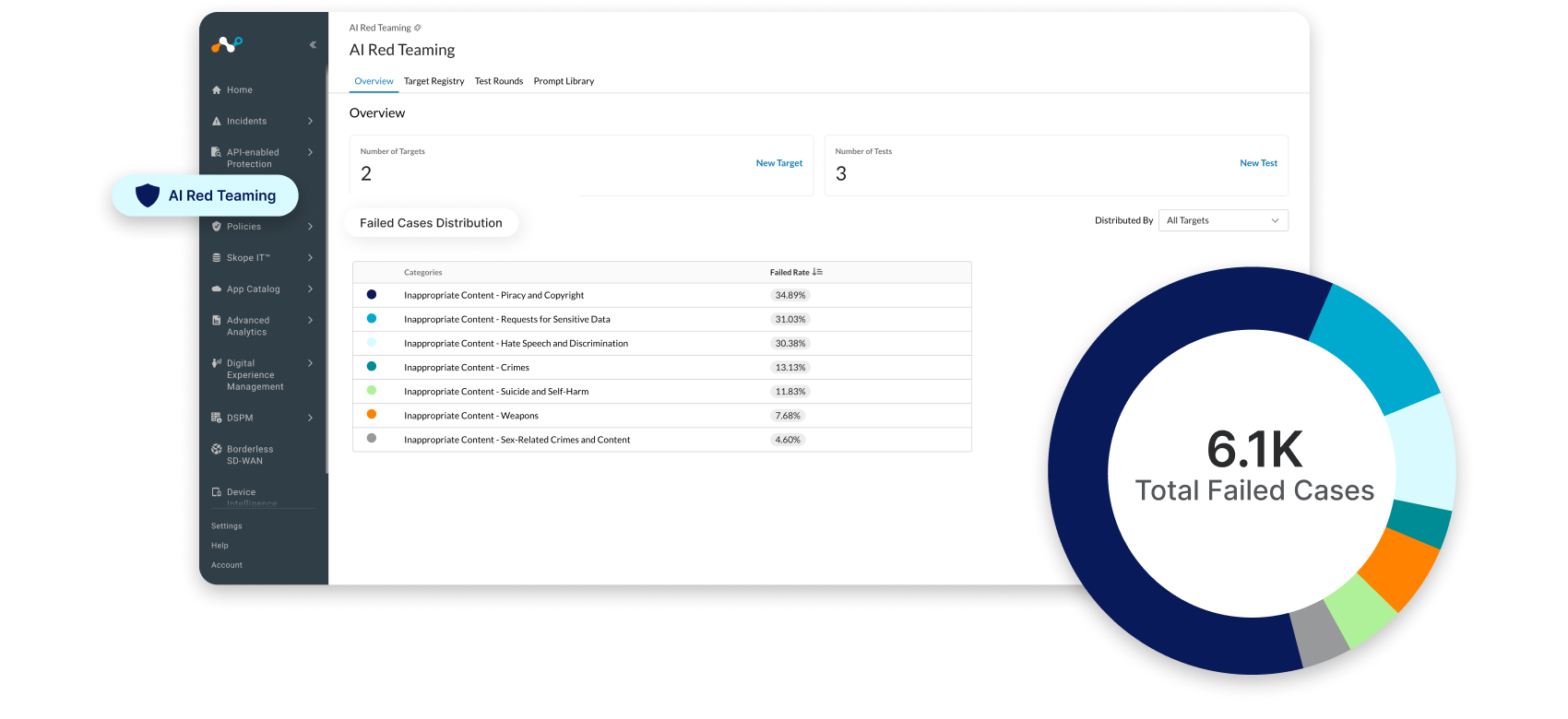
                                AI Red Teaming

                                Proactively identify and address vulnerabilities in private AI deployments. Automate adversarial simulations to find and fix vulnerabilities, to ensure your AI is resilient and production-ready before it reaches your users.

                                Automated vulnerability testing for more resilient AI

                                Moving from SaaS to private AI-powered apps creates a critical security gap. Netskope One AI Red Teaming closes this by automating adversarial simulations and integrating into CI/CD pipelines to help you uncover vulnerabilities. Ensure your AI models are secure, compliant, resilient, and continually tested against advanced threats before attackers strike.

                                Proactive defense for the AI lifecycle
                                features and benefits

                                Harden your private models against sophisticated threats before they go live.

                                Plus Image Plus Image

                                Automated stress testing

                                Continuously test your LLMs using a library of over 18,000 adversarial scenarios and seed prompts. This automated approach replaces slow, manual processes, allowing your security posture to keep pace with rapid enterprise AI development cycles.

                                Plus Image Plus Image

                                Multi-turn attack defense

                                Identify where complex skeleton key and crescendo attacks could bypass your AI security guardrails. Simulate multi-stage conversations to ensure your models maintain context and security throughout an entire session.

                                Plus Image Plus Image

                                Vulnerability discovery

                                Uncover hidden risks across diverse threat vectors, including role-playing prompt injections, jailbreaks, and content generation that violates corporate AI use policies.

                                Plus Image Plus Image

                                Track changing risk assessments

                                Shift model testing from passive observation to active defense by running scheduled red teaming simulations to see the change in risks identified across all tests on the same model.

                                Plus Image Plus Image

                                Build testing into AI development

                                Use APIs to integrate stress tests into CI/CD pipelines, automatically screening for new security vulnerabilities or risks introduced by code changes before every production release.

                                Continuously test your LLMs using a library of over 18,000 adversarial scenarios and seed prompts. This automated approach replaces slow, manual processes, allowing your security posture to keep pace with rapid enterprise AI development cycles.

                                Identify where complex skeleton key and crescendo attacks could bypass your AI security guardrails. Simulate multi-stage conversations to ensure your models maintain context and security throughout an entire session.

                                Uncover hidden risks across diverse threat vectors, including role-playing prompt injections, jailbreaks, and content generation that violates corporate AI use policies.

                                Shift model testing from passive observation to active defense by running scheduled red teaming simulations to see the change in risks identified across all tests on the same model.

                                Use APIs to integrate stress tests into CI/CD pipelines, automatically screening for new security vulnerabilities or risks introduced by code changes before every production release.

                                Netskope One AI Red Teaming use cases

                                Hardening private models
                                Before launching a model in a production environment, use automated simulations to reveal weaknesses. This ensures your private deployments are compliant and resilient against advanced threats.
                                Preventing data leakage
                                Identify and block instances where a model might accidentally reveal internal system prompts or sensitive training data, protecting your intellectual property and ensuring privacy compliance.
                                Protect against evolving threats
                                Test your models against sophisticated jailbreaking techniques where attackers try to force the AI to ignore its rules. Strengthen your defenses to ensure guardrails remain intact under pressure.
                                Accelerate secure AI innovation
                                Ensure your AI cannot be used to generate content that violates safety standards or internal governance policies.
                                Ready to move forward?

                                FAQs

                                What exactly is AI red teaming?

                                AI red teaming is a proactive security tactic which runs simulated attacks to expose hidden weaknesses in AI models and applications before they are deployed. Rather than just verifying if an AI model functions accurately, this approach intentionally attempts to manipulate the system to uncover vulnerabilities such as biased outputs, harmful content generation, or security breaches. Netskope One AI Red Teaming elevates this practice by replacing slow, manual testing with automated adversarial simulations. Using its library of over 18,000 distinct adversarial scenarios, Netskope systematically stress-tests private models to ensure they are safe and resilient before and after reaching production. AI red teaming differs from traditional red teaming because, while they both recreate adversarial tactics, they focus on different attack surfaces:
                                • Traditional red teaming concentrates on conventional IT infrastructure, probing networks, servers, and applications to expose gaps in standard technical defenses.
                                • AI red teaming focuses on the unpredictable behavior of the AI model itself. It probes for non-deterministic vulnerabilities, such as prompt injections, and jailbreak attempts.
                                Netskope One AI Red Teaming includes replication of sophisticated multi-turn attacks (such as "skeleton key" or "crescendo" attacks) that try to trick the model into bypassing its own safety guardrails or leaking sensitive training data. Netskope also integrates these automated stress tests directly into CI/CD pipelines, actively defending against model risks every time code is updated.

                                What are the most common AI attack vectors?

                                The AI attack landscape is rapidly evolving, with cybercriminals actively developing new exploitation techniques to target Large Language Models (LLMs) and agentic architectures. The most common AI attack vectors include:
                                • Prompt injections: Attackers use manipulative linguistic exploits to override an AI system's instructions and alter its intended behavior.
                                • Jailbreaks: These are attempts to circumvent built-in safety guardrails, forcing the AI model to ignore its own safety rules. These attacks can be highly effective, succeeding nearly 20% of the time, often taking less than a minute and only five or six interactions to crack standard safeguards.
                                • Indirect prompt injections: These occur when malicious prompts are secretly embedded within documents or websites; when the AI processes this external content, its behavior is manipulated.
                                • Data extraction attacks: Techniques designed to pull sensitive information and secrets directly from a model's underlying training data.
                                • Multi-turn attacks: Sophisticated, multi-stage conversational exploits, such as "skeleton key" and "crescendo" attacks, where adversaries attempt to trick LLMs by layering interactions to bypass safety guardrails that lack full session context.
                                • Tool poisoning: A threat specifically targeting autonomous, agentic AI, where an AI agent is manipulated or tricked into interacting with a malicious external tool.

                                Is AI red teaming mandatory for compliance?

                                Increasingly, yes. Major regulations now explicitly mandate or strongly encourage red teaming. The EU AI Act includes a requirement for adversarial testing for high-risk AI models. NIST's AI Risk Management Framework also recommends red teaming as a core part of securing AI systems.

                                When organizations build and host their own private AI applications, they take on the full responsibility for securing those models and complying with wider data security and protection regulations such as GDPR and HIMSS.

                                Can I automate AI red teaming, or does it require humans?

                                Yes, AI red teaming can definitely be automated. In fact, Netskope One AI Red Teaming is designed specifically to automate adversarial simulations, effectively replacing slow and unscalable manual testing.

                                It achieves this automation with a library of over 18,000 adversarial scenarios and seed prompts to systematically stress-test your private models against threats such as prompt injections and jailbreaks. You can seamlessly integrate these automated stress tests directly into your CI/CD pipelines via APIs, ensuring that every single code change or model update is automatically screened for vulnerabilities before it ever reaches production.

                                Does red teaming improve AI development cycles?

                                Red teaming significantly improves and accelerates secure AI development by automating the discovery of vulnerabilities and seamlessly embedding security directly into the development pipeline. Here is how it enhances the process:
                                • Speeds up innovation: By replacing slow, manual security reviews with automated adversarial testing, development teams can deploy AI features much faster without compromising on safety.
                                • Seamless CI/CD integration: Red teaming can be integrated directly into your CI/CD pipelines using APIs. This ensures that every single code change or model update is automatically screened for new security risks before it is ever released into a live production environment.
                                • Proactive model hardening: It empowers developers to simulate motivated attacker behaviors, such as complex multi-turn attacks, to actively try and "trick" the model into bypassing guardrails or leaking sensitive data. By finding and fixing these vulnerabilities before the model interacts with a customer or employee, teams avoid the costly process of patching security gaps after they are exposed to the world.
                                • Continuous risk tracking: It shifts model testing from passive observation to an active defense by running scheduled simulations that track how risks change across all tests on the same model. This ensures that rapid model updates never inadvertently introduce new security gaps or increase your risk profile.