Matthew McCormack: How do we help create a pipeline of future cyber leaders, but then also that pyramid? How do we get millions more people into the discipline and just convince them that you don't have to be a com sci or an engineer to do this, right? All you have to be is inquisitive, right? What I want is I want somebody who looks at something and says, "Well, that's interesting. That doesn't make sense." "Let me figure out why," that's the person who would make a good security person. If you are somebody that looks at something and says, "I don't understand why it looks like that, but I'm going to go figure out why," then you're right for this field.
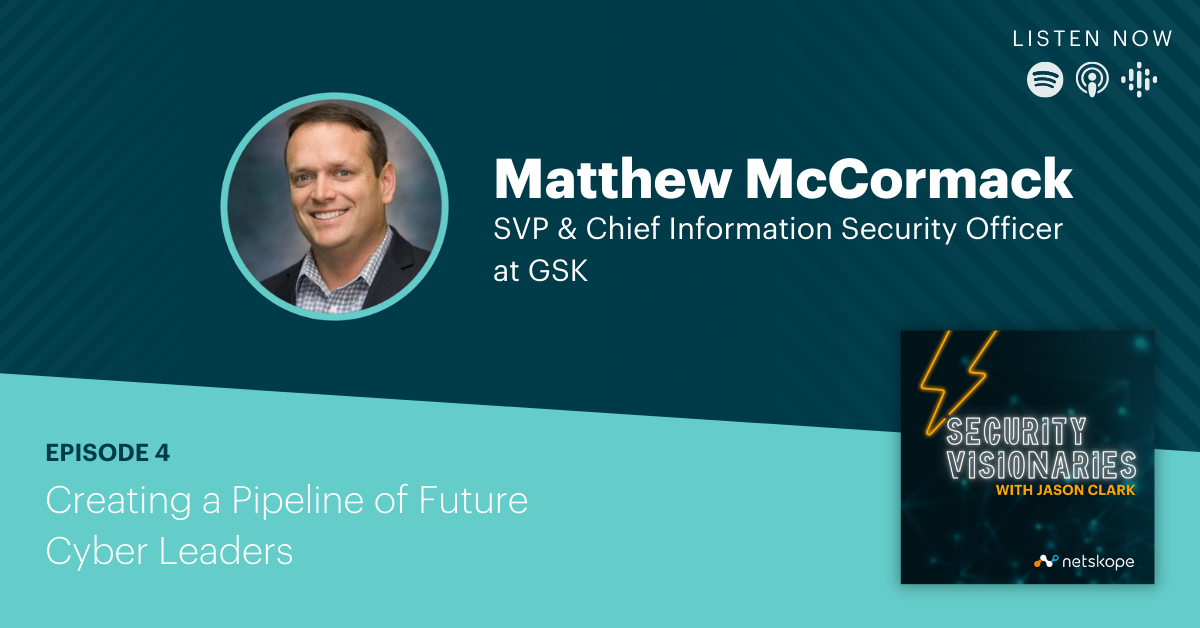
Narrator: Hello and welcome to Security Visionaries hosted by Jason Clark, CISO at Netskope. You just heard from today's guest, Matthew McCormack, senior vice president and chief information security officer at GSK. What happens in a world where the bad guys outnumber the good guys? If you're a modern day CISO, this thought keeps you up at night. Cyber criminals are multiplying at an astounding rate and CISOs are racing to build out teams that can help them stay ahead. A key part of the fight is developing the next generation of security leaders, but how do we, as an industry fill the ranks of tomorrow's cybersecurity forces? Luckily, that's just what today's guest is here to help us figure out. So before we dive into Matthews gameplan, here's a brief word from our sponsor.
Ad roll: The security visionaries podcast is powered by the team at Netskope. Netskope is the sassy leader offering everything you need to provide a fast, data-centric and cloud smart user experience at the speed of business today. Learn more at netskope.com.
Narrator: Without further ado, please enjoy episode four, Security Visionaries with Matthew McCormick, senior vice president and chief information security officer of GSK, and your host, Jason Clark.
Jason Clark: Welcome to security visionaries. I'm your host Jason Clark, CMO and chief strategy officer and chief security officer at Netskope. I'm joined today by my friend and special guests, Matt McCormack. Matt, how are you?
Matthew McCormack: Good. Jason, how are you?
Jason Clark: I am super fantastic, man. Really good to kick off this podcast series with you here. You are our second guest. I was with Emily Heath two weeks ago and that went really, really well. So, as we get started, what was your first job insecurity?
Matthew McCormack: So my first job insecurity, actually ironically, was in the Navy, right? When I was ROTC in college in my senior year of college, they did a physical on me before I joined the Navy and told me that I was red-green colorblind. And if you are familiar with boats at all, red and green are important colors out at sea. It tells you which way the ship is going. And so they basically told me I couldn't fly a plane or drive a ship and so they turned me into a cryptologist which in the '90s cryptology morphed into the early network security. So really wound up in this because of the Navy and because I was colorblind.
Jason Clark: That's an interesting story, right? I think my mind was similar to yours from joining the army, not because of colorblindness, right? But I was flying planes thinking I wanted to be a pilot, and while I was flying, the pilots all around me were professional airline pilots, I had left the Navy, and they said, "Listen, you don't want to be a professional airline pilot. Basically, I'm just driving a bus. Pick a different career." And I'm like, "Oh, wow, okay. You just crushed my dreams."
Matthew McCormack: That's some good advice though.
Jason Clark: It was great advice and I dumped into security. That was it. I was an analyst, right? So it changed my life.
Matthew McCormack: The world has changed, right? Now people are getting into security originally, right? Security originalists, where we all happened into it years ago.
Jason Clark: It was good. I think, Matt, I must say, we've known each other probably 15 years, right? I'd say we've helped be the foundation for this industry, right? We've started from this thing from zero together. It's been pretty cool to see.
Matthew McCormack: I know my first CISO role actually, I was the first CISO at the organization at Defense Intelligence Agency. There hadn't been one before. The idea that we're literally creating some of those first organizations and as scary as it sounds almost 20 years ago, but yes. I remember our first interactions, you were with Websense and Blue Coats back then and I was at the IRS and then everybody was doing their first web proxying and web filtering. 20+ years ago, network security was just packet filtering firewalls, right? And that was it. And then, VPNs and then all the web content filtering popped in and now here we are today.
Jason Clark: Just honestly, we were figuring it out, right? We were just having to invent, as we went and said, "Okay, let's see if this works," right? Which is a lot I think of contributes to a lot of the ways that we still need to do things today, right? And so tell us a little bit about your role at GSK.
Matthew McCormack: As the Chief Information Security Officer, I have all the traditional roles of a CISO, right? Whether it's the cybersecurity network defense, but I also have the GRC function, that governance, risk and compliance which was a global regulated pharmaceutical. There are a significant amount of regulations. And one of the interesting pieces when you're global is it's not just US regulations, right? It's regulations for every company or every country that you manufacture and sell in. And we are in a significant amount of countries. And so when you look at the governance, risk and compliance, its significance, right? As opposed to a previous role with a US tech company, where you're really only generally concerned about a limited amount of countries.
Matthew McCormack: Being with a pharmaceutical that manufactures and sells in almost every country, having to be aware of and pay attention to all these different compliance rules is different, right? Actually it's quite eye opening because you get to see the manner in which different countries approach the privacy of their citizens and how data is kept and maintained. And there's a wide variety, right? I say, as an American, we generally treat the privacy of our citizens toward the bottom of how many other countries do. A lot of countries are very protective of their citizens data. So it was a quite eye opening starting this role several years ago.
Jason Clark: How do you keep up with it at all? That is a lot, right? That's a lot of changing. It looks like it's changing faster than ever it has to me. So how do you stay on top of it?
Matthew McCormack: Well, I mean, for me, look, you have to have a team of people that know how to do it and know how to do it well but also global. You're not going to have a team of people sitting in one spot that's able to manage this global program. When you look at GRC, you have individual people. I'll have several people that are the only person on my team in that country, right? And their job is to maintain that relationship with the local governments and to keep us abreast of all the changes, but there's a lot of significant when you look at China security law, China privacy law, but there's also a lot of privacy discussions going on in India about changing laws over there.
Matthew McCormack: And so when you look at some of these larger countries, any changes in privacy laws can have impact on us globally, right? Because to comply with some of these laws, you may have to make some corporate level changes.
Jason Clark: So when you were at the DIA, you and I were talking a bunch about making this transition away from government and being a CISO in the enterprise. Maybe talk a little bit about how that transition was for you, what's different and also your advice to anybody making that change right now. Because there's definitely people I had seen that had tried and they'd come in a little too hard and it doesn't fit me. What was that like for you and what would you recommend for others?
Matthew McCormack: A router is a router and a person is a person, right? Those things aren't fundamentally different being federal and being commercial. I will say some of the differences, and I don't think anybody would be shocked by any of these, speed, right? The speed with which you can get things done. I know that there's been some changes to allow some more flexibility in the government, but really, the budgeting and the procurement process of the government was not necessarily built around doing things quickly, right? It's basically built around doing things fairly inequitably and not necessarily around being done with speed.
Matthew McCormack: And so for me, one of the bigger changes, and for me, it was 2012 when I went commercial, was my ability to buy and procure what I needed to do, but then also the speed with which in general, not always, but the speed with which I could hire, right? The ability to identify talents and grab that talent very quickly, commercially, was a big difference. Now, on the flipside is, I would say, generally, employees, when you're dealing with employees and some of the actions employees take and as CISOs, we're always having to keep an eye on what we allow employees to do and what we don't allow them to do.
Matthew McCormack: The attitude within the federal space, the government space, people were more comfortable with a command and control-type attitude. So if we say you can't do X, on your computer, people generally said, "Okay, we can't do X," right? Whereas commercially, it's more of a negotiation, right? Especially if you're with a global company, you're going to have unions, worker commissions in Europe. You're going to have different national laws that allow people to do things. There are certain countries that allow some minimal personal use of corporate by law, which you didn't have federally. You could say, "You cannot use your federal computer to do personal work." Boom, end of story, it's done.
Matthew McCormack: But when you have some of these countries that actually have laws that allow that to go on, we have to manage that. So from a personal point of view, some of the rules and requirements on what must be done and what can't be done, sometimes that was a little bit easier on the federal side because it makes the point it, but to make these decisions by edict was a little bit simpler.
Jason Clark: For you, it seems like there's a lot of similarities, right? And then there's some clear differences to me. It just seems very wide, right? Because other than the Army, I have not worked in the federal space.
Matthew McCormack: And the federal space is not all the same, right? So I've been military. I've done intelligence and also spent a number of years with the IRS, so essentially financial. And there's a wide swath of differences between those different areas within the federal space. It's not all ubiquitous. It doesn't all look the exact same, but I will say one of the questions you'd ask, "What advice would I have for somebody transitioning from federal to commercial?" and some of it would be around. Some of the comfort level they had around, as a CISO you make a decision, everybody will go do it. When you're moving into the commercial space is understanding that everything isn't a negotiation or is a negotiation, right?
Matthew McCormack: If there's something that you need to do from a security point of view you're going to have to sit down and make sure you've checked with your privacy officers, with your employment attorneys, within HR, within these different areas. You won't be able to get things done just because you said to do it, right? And understanding that it doesn't mean that you're not a smart person and people don't believe you, it just means that that is the process. Whereas I think federally, we were able to do more of the, "Because I said so." And when you come out into the commercial space, people will not blindly accept what you tell them.
Jason Clark: So just a little bit transition here, what do you believe is the fastest growing risk in cybersecurity, the catch, that people do not realize that CISOs or most security teams or executives do not realize is the fastest growing risk? What's sneaking up on everybody?
Matthew McCormack: I think a lot of people, they're aware now because of some of the stuff, but not understanding the full range and impact is third party. And third party, there's multiple pieces to third party. As companies have grown, they've moved away from all employees, obviously, to very heavy support from contractors or third parties to provide bodies to help you but then also software. And the rise in ransomware, which has affected so many different companies and some very large companies, and specifically when a service provider, somebody that is providing bodies to your company to help you complete a task and traditionally, you're allowing those bodies some manner of access into your company similar to a bad employee, when one of those service providers gets hit with ransomware, really step one is you killing all access for all employees of that company who are accessing your network, killing all remote accesses until the company has determined what the outcome of the ransomware was.
Matthew McCormack: And you realize the impact when all of a sudden 1,500 people can't show up to work on Monday because their company's got hit with ransomware. And you realize the depth of dependency you have on that service provider. And then the second piece to that is the software, right? Everybody knows SolarWinds there's in the press all these things. The idea that you're actually buying and deploying already compromised systems into your own network and it's not like these companies are going to provide us with the source code, so that we can go do our due diligence source code analysis, right? They're not going to do that.
Matthew McCormack: And so because of that, we're really dependent on the product security internal capabilities of these vendors. And so when I say third party, third party around service providers and bodies and then third party around compromised software. You just realize that dependency. At GSK, obviously, a pharmaceutical company, we specialize in making medicines and vaccines and things like that. You don't think about what impact your IT management software could have like SolarWinds, right? You bring SolarWinds in. SolarWinds gets hacked. You have to rip it out, and then all of a sudden, that can shut down a whole company.
Matthew McCormack: And so really understanding that impact of all these third parties and how you try to develop a response plan for what you do when something like this does happen.
Jason Clark: I think you just hit, I think, what is probably, I agree, the biggest. I think the two biggest is really the third party risk, but I'd say it's the fastest growing because of SaaS, right? It is the thing that the business is just lining up with or without IT. And mostly actually without IT in most organizations, they're just going, right? HR, marketing, etcetera and then also the growth of data, right? Data, you are the MC, right? And data is 3x'ing from 57 zettabytes to 107 zettabytes over the next four years. We don't see storage companies stocks, 3x'ing going through the roof, right? Because it's all moving to cloud or mobile. I think it's definitely those two, but double clicking on the third party risk which is at the fastest rate by count, it's definitely SaaS, right? Most companies have over a thousand. What are you seeing organizations do to get involved in that, the CISOs getting over with the business and helping them enabling that versus historically, we've always said, "Hey, no, we have one CRM. Don't go do anything else"?
Matthew McCormack: Anything dot-dot as a service is sometimes code for, "We're going to go around IT," right? And sometimes, look, I understand the reason people do this sometimes because when you go through the process, it takes longer in general, it's more expensive in general, but there's reasons for that, right? Especially in a regulated industry, you have to make sure you're complying. I am seeing a huge trend, especially in direct-to-consumer, right? People wanting to be able to sell directly to you, Jason, which sounds great on the surface and they can go out and find a vendor who will say, "Hey, I'll spin up a portal for you and you can sell your product directly to Jason." "Okay, great, and yes, that that'll drive sales, but do we have a PCI letter, right? Do we have the compliance set up? Are we storing credit cards? Are we storing personal data?" some of these different things.
Matthew McCormack: And so what we're having to do is trying to be proactive and reaching out. As we find some of these capabilities internally, not necessarily just the old days, take out the hammer, smash it and shut it down, but say, "Okay, you know what? If there is a requirement for direct to consumer and you've already built that portal, let's figure out if we can make it legitimate, right? Let's get all the PCI portion done for your direct-to-consumer portal and then let's make sure that other folks within the company going forward are using the one that you just built and not going out and building their own."
Matthew McCormack: So in the past, we probably would have said, "No, this is in violation. We don't do direct to consumer, blah, blah, blah," but now we're having to say, "Look, if you're doing it, statistically there's other people in the company who are either doing it or are going to want to do it, so let's figure out how we get this done." And I'll tell you, a good example and I'm not plugging anybody is when COVID hit here in the US, if you have children, all of a sudden, they popped on Zoom, and Zoom, within GSK, Zoom was not one of the approved collaboration tools. And there was tremendous pressure to allow us to start using that specific tool on our devices when we had not gone through the security due diligence on it. We didn't have a licensing and a privacy agreement with it, all of these things and a lot of pushback from our side on deploying a freeware tool into the environment, but yet, so many people were used to it because they'd all help their children with school and they gotten very comfortable with Zoom and they understood it.
Matthew McCormack: And so sometimes, you know saying no to something while it may make sense from a security point of view, security's in the gray. It's not black and white anymore. Security, you got to live in the gray. And so finding a way while we were not able to necessarily deploy it as quickly as a lot of people would have liked, in the end, we did allow ourselves to add that to the approved collaboration tools and then provide some level of support.
Jason Clark: That's a great example. To that, I get surprised, I'm almost so many companies a day, right? Definitely probably five CISOs a week and obviously many people trying to sell to my security program and listen to vendors, but how many people except the Zoom bots, the bots that come on and say, "Hey," that thing that's just hidden there, translating the whole conversation? Every time I say to the people that are hosting the call, and sometimes it's big companies, I'm just like, "Hey, do you realize that I just looked that company up and they're only 18 employees and they don't have a single person with a security title and their company and we're trusting this whole conversation to be sitting there in the cloud? You know that's probably a compromise, right?"
Jason Clark: And people are like, 'Oh, no, I hadn't thought about that." And sometimes it is security teams and I'm like, "Okay, this is, this is interesting, right?
Matthew McCormack: And I think that one in particular when there was a lot of initial push toward allowing use, allowing that app to be deployed onto our devices, laying out the reason like, "Look, we're not just being jerks to be jerks here, right? We're not just saying no for no reason. We had to lay out the reasons, right? That conversation is kept on commercial servers of another company. If you're discussing patient data or medical device or anything like that, we have no expectation of privacy. That data could be harvested, mined and sold to whoever because we don't have a privacy agreement."
Matthew McCormack: We, within security, have to do a better job sometimes of explaining the reasons. People have gotten smarter about technology and don't just blindly accept, "Well, the security guy said that's bad, so we're not going to do it." They want this. It's just families and kids, right? As my children get older, I need to start explain to them why a little bit more. It's not just a, "No, you can't do that." It's like, "You can't do that because XYZ," or, "Look, when you start driving, you need to start ... This is why you have to go around that corner slow because you can't see this thing over here and there's a blind curve." Same thing, right?
Matthew McCormack: When people are used to a technology, being told that they can't use it in this environment, they want to know why. And I think that's a legitimate question, right? It doesn't mean that they're questioning whether we know what we're doing as security professionals. It just means that there's a level of knowledge that they have, and because of that, they have some questions. And so we need to do a better job from the security side of being that explainer in chief.
Jason Clark: Well, there's two parts there, that's really important. So there's one which is translating this to real risks that I want to double click on. And then the second one we'll come to is, and you've made the statement that was published, it was that in the end where all CISOs are salesman which is true. And so I want to hit both of those around there's risk changing, it's happening fast. I actually say that we're in this upside down world of security where everything we protected is now out and now our security controls have to follow those users and those data everywhere they go and we still have to protect the old, right?
Jason Clark: So it's like enable the new, protect the old, but in this new model, one of the things that you talked about the past is frameworks, but are the frameworks really there and up to date to truly understand what my risk is in this new world versus let's say more threat modeling and actually thinking about the risk per each stage and what my control is and moving that to real time? How do you feel we are as an industry in that thinking and what suggestions do you have?
Matthew McCormack: Are the frameworks there? Yes. Are they as up to date as we need them? No. Right? I think we've all been very reliant on the goodness frameworks for a number of years. As you talked about at the beginning, as the world is turning dot-dot as a service and things like that, those frameworks have struggled to keep pace, right? But it doesn't mean that they're not still good foundational. But I think for us, your ability to grade how well you're doing and if you're actually delivering on the commitment you're making to your board, you have to have some kind of framework, right?
Matthew McCormack: We got our ICF, our internal control framework, and as most people, we use NIST as a baseline, but then we customize and there's reasons to do that. If you look at your internal audit capability, you want your framework matching up with theirs, so that if they're identifying an issue, it maps into yours. And if you're looking at your privacy organization, if you're looking at some of these different, your overall compliance team, not just your security compliance, but the folks that are responsible for us, your HIPAA, your Sarbanes-Oxley, all these other national compliance standards and GDPR, right? There's so many compliance and frameworks out there.
Matthew McCormack: You could fall down a black hole of perpetually trying to make the perfect framework. And I think for us, we decided NIST is our framework and we will do a small amount of customization because of our unique industry and draw the line there. I do you think you will forever be updating because when you're in 130 countries, there's always new frameworks and new standards, and new things like that that you'll just never be able to catch up on. We do try to review our framework annually, make changes, but I do think frameworks are great, frameworks are important. Threat modeling is very important as well and trying to go through ...
Matthew McCormack: If you got 130 factories, not all 130 factories are at the same level of importance. Maybe one makes your highest selling and highest revenue-producing product. Maybe another one is just packaging the cardboard that you need to put that product in. Both are important, but which one is the most critical, right? Can you get cardboard from somebody else? Most likely. Can somebody else make that specific medicine for you? Less likely. So your threat modeling, you have to go through and we are in a constant state of that, not just for our manufacturing facilities, but also our data stores and our data repositories, right? Where do we allow them to be replicated? Who owns them? Are they in the cloud? Are they not in the cloud?
Matthew McCormack: Maybe it makes economic sense to put something in the cloud and make it some sort of SaaS model. However, the risk of taking that data outside of your environment and putting it into the cloud outweighs the economics. We are in a constant state of threat modeling and risk return, right? For us, is the risk of doing that worth the return and I'll tell you, that is why and it's a topic, is within any good security organization, something everybody deals with, but from hiring, don't always go look for computer science people for your security organization, right? If you're doing this type of threat modeling, you better find yourself an accountant, right? You better find yourself somebody that understands money.
Matthew McCormack: And when you're looking at your insurance policy, your cyber insurance policies, computer science people are not the best people to be evaluating your insurance risk levels. And so when you look at your security organization, when you're doing threat modeling, don't just blindly accept that you're going to have people internally that know how to do that. Either you're going to have some really boutique specialist people and we're lucky to have a couple of really smart people to help us with that or go out and get it. Because if you try to do some of that threat modeling with people that are not specialists in that, your priorities for that year are going to be pretty messed up.
Jason Clark: Honestly, we hit sales, right? We said, "Oh, well, you need to be salesman," right? Well, I don't think no computer science majors aren't necessarily going to be your best salesman either, right? So I think depending on your domain and depending on what you're trying to grow helps nurture that talent gap that we have. What I'd say is I've had tremendous success actually getting kids out of high school. So with a Security Advisor Alliance, I go to high schools and middle schools and we're teaching them, "Hey, this is cyber." And they're all like, "Oh, I thought it was like rocket science. I didn't realize it was that easy. I didn't realize I had to be a guy in the basement with no lights on and just sliding pizzas under the door," right?
Jason Clark: And you'll see groups of girls almost always beating the guys in a capture the flag event. And they're like, "Oh, wow, I didn't even know this was an option for me, right? I'm good at this." And so I've been recruiting out of high school and it's not more like ... College isn't for everybody right away, right? I went into the Army instead of going to college at first. I actually didn't get my degree until I was 25. And the only reason I got my degree was they said, "Hey, we want to make you a CISO, but we can't unless you have your degree." And so what's your view on the places that you go and have you been grabbing kids out of high school at all, and also just in general, what's your view on things that other security and IT leaders can do for this talent gap?
Matthew McCormack: 100% right. So yeah, I speak it at high schools and it blows my mind. I just actually ... A goddaughter of mine, I did an interview with her because her high school has a cybersecurity program and she actually was doing a program where she has to code, but then she also has to pull down some products and look at them and evaluate the risk. And it blew my mind that they were doing that in their junior year of high school. I was really wowed, but then also like, "Thank God," right? Because to your point, the amount, whoever you talk to, whether it's three, five or seven, right? The million, 3, 5, 7 million people gap that we have in the cyberspace, expecting that we're going to be able to wait for these people to graduate university before they can enter the field is crazy, right?
Matthew McCormack: There's just too much demand. And also depending on that discipline, like I said, I'm with you. You don't fundamentally need that university degree. I taught you for years at a local community college and they had an associate's degree in cybersecurity where it was several years ago, but they were literally teaching these people how to use, I'm going to date myself, NetWitness and ArcSight and some of these tools, right? They were teaching them how to use them. And when I was still in the government at that point, I was hiring those people left and right because you can literally put them right in your sock.
Matthew McCormack: And so I think the idea that there's so many pieces to cybersecurity and then I'm not saying you want us operating on you, but it's become very much like medicine, right? The same way not all doctors are doctors, right? Some doctor is good at joints, some doctor is good at dermatology. You have all these different specialists who are good at their different things. Security has become that, right? You have your pen testers, you have your training specialists. If you're in a company the size of ours, you need program and project managers who can manage these multimillion dollar projects.
Matthew McCormack: So when I look at my team of 300-400 people, you have all different backgrounds, all different color stripes and I will say some of the best security people are psychology people. And when I talk at colleges, I routinely have people saying, "Oh, I'm studying psychology or sociology, but I'm really interested in cybersecurity." "Great because big portion of cybersecurity is what the user does." And people that understand how to influence users, when you're trying to get users to not click on a phishing, I can't just send an email saying, "Don't be dumb and click this link," I'm going to have to figure out how to influence people and those are psychology background people. And so there's all different types.
Jason Clark: I know a couple of CISOs that got a degree in psychology, right? Some really good CISOs and they actually started as psychologists and then made the transition. They don't talk about that too much, but that's one of the secrets to their success. In a way, I think it's all about being different, right? Being unique. Don't just follow the main road that everybody else has done. What can you bring to the table that nobody else has?
Matthew McCormack: E na verdade é uma das minhas irritações e, obviamente, não sou reitor de universidade e não pretendo ser um. Uma das minhas irritações são as universidades que colocam seus programas de segurança cibernética em suas escolas de engenharia ou ciências da computação. Esse é 100% o lugar errado para colocar isso, certo? A segurança cibernética não é uma disciplina da ciência da computação e nem sequer é uma disciplina da engenharia. Sim, sou engenheiro. Sim, eu cresci assim. E isso influenciou como me tornei um CISO? Sim, com certeza e tenho 100 colegas que não são engenheiros, certo? É um negócio, certo? A segurança cibernética é uma disciplina de risco empresarial. E quando você olha para uma escola de negócios, "Ei, você vai ter uma aula de risco, uma aula de seguros, uma aula de finanças, uma aula de psicologia, uma aula de comportamento organizacional", quando fiz meu MBA , as aulas que fiz na escola de administração estavam infinitamente mais relacionadas ao que faço no dia a dia do que as aulas que fiz na escola de engenharia. E então me mata quando vejo universidades colocarem sua ciência da computação ou seus programas de segurança em suas escolas de ciências da computação ou de engenharia. 100% no lugar errado.
Jason Clark: Eu concordo. O MBA, para mim, teve um impacto significativo na maneira como eu via minha organização, eu mesmo, minha função. Honestamente, conseguir meu bacharelado foi insignificante para mim, certo? Realmente não mudou minha vida, a não ser que consegui a caixa de seleção que desejo, mas fazer meu MBA mudou meu pensamento. Então isso foi significativo. Se voltarmos, você mencionou algo sobre as diferentes funções se tivesse que mudar de carreira e assumir um cargo de gerente, por qualquer motivo, em que domínio você gostaria de estar? Qual é o seu domínio favorito em segurança no qual você gostaria de operar nesse nível?
Matthew McCormack: Treinamento, certo? Porque eu acho que, para mim, é uma das áreas absolutamente mais críticas, né? 100%, porque ainda é 90% do usuário, certo? O que o indivíduo faz que expõe? Gastamos milhões e milhões e milhões em ferramentas para impedir alguém de fazer alguma coisa e então olho para a percentagem do meu orçamento, isso é formação e é minúsculo, mas é assim que as coisas são. E há uma tendência na indústria de treinamento em segurança que está tentando se tornar mais interativa, mais atual e arrancada das manchetes. Ainda é muito difícil. Mas direi que uma das áreas que ainda está no espaço da segurança cibernética, que ainda está tão aberta para um pensamento diferente da próxima geração, é o treinamento, certo? Porque é assim que você interage com as pessoas.
Jason Clark: Isso está certo. E você pode medir isso. Você pode medir as diferenças nas mudanças, certo? Adorei essa resposta, Matt, porque vou te contar, fazendo muitas entrevistas, faço essa pergunta o tempo todo. Como você sabe, contratei mais de 50 CISOs em minha carreira, certo? Já tenho 30 trabalhando para mim e tenho 10 aqui na Netskope, mas também faço muitas entrevistas para CISOs para CIOs em nome deles, certo? Três CIOs estão me pedindo para participar de seu processo de entrevistas que estão em empresas diferentes no momento, apenas do ponto de vista de amizade. E então eu diria que entrevistei centenas de CISOs neste momento e sempre fiz esta pergunta: você é o primeiro CISO que respondeu ao treinamento.
Matthew McCormack: Provavelmente porque sou um péssimo programador. Provavelmente é por isso. Você nunca iria querer que eu codificasse nada para você.
Jason Clark: Geralmente é [inaudível 00:37:07] ou: "Oh, quero estar perto do negócio" e, mais comumente, é: "Quero ser o arquiteto. Quero brincar com a tecnologia", ou adoro o SOC. Eu adoro lutar a luta, certo?" Mas de vez em quando, você encontra uma pessoa que simplesmente diz: “Eu adoro RI” e eu digo: “Ah, há algo errado com isso. Lá se vai sua vida. Você está bem em nunca ter férias e trabalhar todas as sextas à noite. Isso é legal." Isso é realmente único, Matt. Acho que isso é importante e acho que é qualquer pessoa que esteja ouvindo. Na verdade, isso é algo para se pensar. Você pode fazer muito com treinamento. Há muitas oportunidades aí, especialmente pensando em inventar tecnologia. E eu sei que você e eu estamos treinando uma empresa que deseja fazer algo neste espaço. Portanto, deveríamos passar mais algum tempo falando sobre isso.
Jason Clark: Seguindo em frente, mais um tempinho aqui, algumas perguntas rápidas para você, certo? Se você pudesse fazer algo diferente em sua carreira ou voltando às suas últimas funções de CISO, o que faria de diferente?
Matthew McCormack: Honestamente, acho que retrospectiva é ótima, certo? Acho que esperava que o SaaS ... Não pensei que viria tão rápido. Achei que teria um pouco mais de tempo para preparar minha infraestrutura para ponto-ponto como serviço. Chegou mais rápido do que eu pensava.
Jason Clark: Isso é comum, certo? Na verdade o que é engraçado é que você sabe que o Netskope está nesse espaço, certo? E assim geramos relatórios para as pessoas. Chegamos e as pessoas pensam que têm cerca de 100 SaaS e então, quando mostramos a elas, elas têm 1.000 ou 2.000 e mostramos a elas essa contagem de tráfego e que seu tráfego de SaaS é mais da metade do tráfego do que seu tráfego da web. E você simplesmente ouve isso: "Oh, uau." E a próxima frase diz: "Isso aconteceu rápido", certo? Está certo. É por isso que falamos sobre você dizer que o risco de terceiros é o risco que mais cresce. E acho que isso é impulsionado pelo SaaS ou pela tecnologia incorporada, como você disse, no exemplo da SolarWinds. Então, outro golpe rápido, certo? Como é a aposentadoria para você?
Matthew McCormack: Não tenho ideia. Acho que não estou nem perto disso, certo? Fiquei muito tempo no governo. Eu tenho que continuar trabalhando. Acho que, para mim, o que realmente gosto de fazer fora das peças operacionais do dia a dia de um CISO é ser mentor de muitos CISOs, dar palestras em universidades e frequentar escolas de ensino médio. Acho que apenas defesa de direitos e, para mim, não se trata de defesa de direitos: “É assim que você protege as redes. É por isso que o PlayStation do seu filho está em risco." Defesa de apenas encorajar as pessoas a entrar na disciplina. Nossa, Jason, se você olhar para trás, na UMA, é literalmente cego, mas uma sorte cega e estúpida, que caímos no que eu acho que acabou de ser abençoado, certo?
Matthew McCormack: Se você tivesse me dito em 97, quando comecei a fazer isso, que a segurança cibernética se transformaria na indústria que é, eu nunca teria acreditado em você. É apenas um aspecto da sorte cega e estúpida. Mas agora, precisamos de mais e CISOs, obviamente, certo? Porque existem milhões de empresas, não existem milhões de CISOs. Como podemos ajudar a criar um pipeline de futuros líderes cibernéticos, mas também essa pirâmide? Como podemos atrair milhões de pessoas a mais para a disciplina e simplesmente convencê-las de que você não precisa ser um cientista da ciência ou um engenheiro para fazer isso, certo? Tudo que você precisa é ser curioso, certo?
Matthew McCormack: O que eu quero é alguém que olhe para alguma coisa e diga: “Bem, isso é interessante. Isso não faz sentido. Deixe-me descobrir o porquê." Essa é a pessoa que daria um bom segurança. Se você é alguém que olha para algo e diz: “Não entendo por que parece assim, mas vou descobrir o porquê”, então você está certo para esta área, certo? Então, como podemos atrair mais pessoas? Quando eu terminar as operações, quando estiver pronto para desligar meu telefone nos fins de semana e fazer coisas assim, imagino que vou gastar muito tempo tentando convencer ou educar os mais jovens a entrarem no mundo. disciplina.
Jason Clark: Eu adoro isso. Na verdade, obviamente, você já está começando, está fazendo isso agora, certo? Você simplesmente vai fazer mais. Acho que você falou sobre o espaço e como nos inserimos nele. Sinceramente, pensei em deixar a segurança em 2000, certo? Sempre que o vírus ILOVEYOU acontecia, eu pensava: “Já resolvemos isso”. Eu disse: “É AV. Temos filtros de spam, certo?" Eu literalmente estava começando a ficar um pouco entediado e comecei a receber meu CCIE. Passei no escrito. Eu disse: “Oh, a voz é o futuro, certo? Voz sobre IP pode ser minha carreira." Eu literalmente estava preocupado com a possibilidade de haver um beco sem saída em termos de segurança e então o mundo inteiro mudar, certo?
Matthew McCormack: Bem, veja agora pós-COVID, quando as empresas passarem de 2% remotos para 98% remotos no decorrer de um mês, e aqui estamos nós, por mais louco que pareça, vamos acabar pressionando dois anos de COVID e emprego remoto. Isso mudou fundamentalmente o mundo, obviamente. Basta olhar para o valor de mercado das empresas que fornecem ferramentas de colaboração online, certo? Através do teto. Então, o que você faz quando não tem pessoas nos escritórios? E não se trata apenas de “Como posso proteger suas transações?” Agora você volta ao treinamento deles. Como você os treina quando eles não estão vindo para o escritório? Como você faz com que eles façam ... É mais complicado entregar seu laptop quando você sai quando não está no escritório.
Matthew McCormack: De repente, a segurança sofreu outra curva e a indústria mudou, indo direto ao ponto, sobre "Tudo bem, o vírus ILOVEYOU foi lançado. Sim, resolvemos isso. Temos AV. O que vem a seguir?" Deus, se a cada ano nossa indústria não mudar, certo? O celular mudou isso. Cloud mudou isso. Agora, o emprego remoto mudou isso. E haverá outra mudança em dois anos. Acho que uma das razões pelas quais permanecemos em segurança é que a cada ano é algo diferente.
Jason Clark: As últimas três perguntas aqui, mas são respostas rápidas, são respostas de 15, 20 segundos, certo? Três perguntas. Então, a primeira é: qual talento ou habilidade que não está no seu currículo?
Matthew McCormack: Isso não está no meu currículo. Quer dizer que sim, mas não coloco no currículo?
Jason Clark: Isso você tem, pode ser um hobby, certo?
Matthew McCormack: Sim, adoro construir, certo? Quer se trate de um muro de contenção. Quando o COVID apareceu, construí uma casa na árvore para meus filhos e parei de colocar luz e água também, mas fora isso, provavelmente é essencialmente uma casinha.
Jason Clark: Isso é muito legal. Tudo bem, segundo, se você não estivesse na área de redes e segurança, se não estivesse fazendo o que está fazendo, em que outro setor você estaria?
Matthew McCormack: Na verdade, na escola, eu era engenheiro industrial, que projetava fábricas, pesquisa operacional e estatística. Adoro isso porque é pegar coisas não estruturadas e limpá-las em nossa sala de cirurgia. Poof, é isso que você... Adoro entrar nas fábricas e ver como você pode modernizar as máquinas, movimentar todas as coisas. Isso foi fascinante para mim, mas a Marinha disse: "Poof, você seria um criptologista melhor", e aqui estou, mas eu realmente gostaria ou gostei significativamente do design e das estatísticas da fábrica.
Jason Clark: Parece que você sabe como contar para seus filhos, certo? Você pode começar a observá-los e já poderá ver os talentos e habilidades. Então eu tenho meu filho de quatro anos, ele é o construtor, né? Ele é o único que está construindo esses conjuntos de LEGO enormes, aos quatro anos, e sozinho, simplesmente se concentrava neles e construía coisas no quintal.
Matthew McCormack: Eu também tenho um que é do mesmo jeito. É engraçado que desde muito jovem você possa ver exatamente algumas dessas mesmas características, que meus pais me disseram: "Sim, certo?" E então sim, é interessante também. Eu sei desde os 13 anos, mas eu sabia desde que ele era jovem que ele seria engenheiro. Eu simplesmente sabia.
Jason Clark: O mesmo, certo? Mecânico, prático, algum tipo de engenheiro também. Meu outro é quase um cientista. Ele quer misturar produtos químicos e outras coisas, certo? E então a última pergunta rápida é um conselho importante se alguém ligar para você e for um CISO pela primeira vez.
Matthew McCormack: E este é um conselho que dou, assim como você, orgulho-me do fato de ter ajudado a desenvolver muitas pessoas que estão em funções de CISO agora. E então uma das peças que sempre dou a eles é: "Você está no seu trabalho porque é inteligente. As pessoas com quem você está reunido naquela sala estão trabalhando porque são inteligentes. Você não é a pessoa mais inteligente da sala. Aceite conselhos de outras pessoas na sala. E a segurança é uma disciplina colaborativa, certo? Você precisará trabalhar com o CTO e o CIO e o CFO e o conselheiro geral e todas essas diferentes disciplinas.
Matthew McCormack: Então aprenda a falar a língua deles, certo? Aprenda a falar advogado. Aprenda a escrever um business case porque se você vai pedir milhões de dólares por uma iniciativa, o CFO vai querer saber qual é o seu retorno. Entenda que todos com quem você vai interagir, todos os seus colegas, estão em seus empregos porque eles também são muito inteligentes. Então comece sabendo que você é uma entre muitas pessoas inteligentes, você não é a única pessoa inteligente."
Jason Clark: Adorei. Acho que é um bom conselho. Certa vez, em minha primeira reunião do conselho aos 26 anos como CISO, entrei e estava nervoso. Eu estava tremendo. E o presidente desta empresa disse: “Filho, venha aqui”, e disse: “Escute, você é o especialista aqui, certo? Eles são caras espertos, sim, mas fazem parte dos conselhos, mas não conhecem o ciberespaço como você conhece o ciberespaço. Você é o especialista. Seja dono de suas coisas, certo?" E então ele se virou e disse: "E tenho outra coisa para você." E ele disse: "Aqui estão duas fotos de Johnnie Blue." E ele disse: “Ele será seu amigo. Nós vamos voltar. Você começará em 15 minutos." Eu estava tipo, "Ok, funcionou." E, a propósito, nunca tive isso na minha vida antes.
Matthew McCormack: E acho que todos nós temos histórias. E o que descobri é que normalmente tenho uma situação semelhante, de quando estava no IRS, onde tentava defender uma nova iniciativa cibernética, e o chefe da unidade de negócios com 26.000 pessoas, e ele disse: "Ei, " comecei a discussão com "Filho", e o que descobri em minha carreira é que sempre que alguém inicia uma discussão com "Filho", geralmente será seguido por algum conselho, certo? Diz algo que você não sabe atualmente. Então eu definitivamente ouvi isso. Sempre que alguém começa, é isso. Acontece menos agora que fiquei mais velho. Mas sempre que alguém começava algo com “Filho”, eu sabia que o que viria a seguir era algo que eu deveria ouvir.
Jason Clark: Exatamente. Desde que você era criança, certo? Bem, de qualquer forma, estamos sem tempo, mas Matt, isso foi incrível. Muito obrigado. Isso foi divertido. Muitos insights excelentes, eu acho, para todos lá fora e eles conheceram você ainda melhor. Vamos fazer isso de novo e definitivamente voltar e falar mais sobre as coisas que podemos fazer juntos pela indústria.
Matthew McCormack: Parece bom. Obrigado, Jasão. Eu realmente aprecio. Foi muito divertido.
Rolo de anúncios:O podcast dos visionários da segurança é desenvolvido pela equipe da Netskope. Procurando a plataforma de segurança em nuvem certa para possibilitar sua jornada de transformação digital? O Netskope Security Cloud ajuda você a conectar usuários com segurança e rapidez diretamente à Internet, de qualquer dispositivo a qualquer aplicativo. Saiba mais em Netskope.
Narrador: Obrigado por ouvir os Visionários de Segurança. Reserve um momento para avaliar e comentar o programa e compartilhe-o com alguém que você conhece e que possa gostar dele. Fique ligado nos episódios que serão lançados a cada duas semanas e nos vemos no próximo.

























)