Evento de Lanzamiento: Seguridad IA inteligente. Control total de los datos. Reserve su plaza
Hankyu Hanshin Properties Corp., a core comprehensive real estate developer within the Hankyu Hanshin Holdings Group, is pursuing its digital transformation vision, “DX Vision,” to shape the future of urban development. As the company accelerates its cloud migration through various digital transformation initiatives, it adopted Netskope to build a Zero Trust foundation that balances both security and user convenience. With enhanced visibility and control over cloud services, the elimination of reliance on VPN, and improved remote‑work performance, the company has strengthened its security posture while modernizing workstyles—thereby accelerating the realization of its “DX Vision.”
For more than a century, the Hankyu Hanshin Holdings Group has contributed to the creation of vibrant communities and attractive railway-line areas. As a core company within the group, Hankyu Hanshin Properties is a comprehensive real estate developer engaged in a wide range of projects, including its “Geo” condominium brand, residential development, office buildings, commercial facilities, and large-scale urban development. In the Osaka Umeda area, which aims to be an international exchange hub, the company is steadily advancing multiple projects such as the Umekita Phase 2 Development and the Shibata 1-chome Project. Leveraging the expertise cultivated through railway-line development, the company is also expanding beyond the Tokyo metropolitan area into overseas markets, particularly in Asia.
Hankyu Hanshin Properties is pursuing its “DX Vision,” a digital transformation initiative designed to leverage digital technologies and continue delivering “services and experiences that customers choose first” for the next 100 years. Kuniharu Seike, Manager of the Core IT Management Group and the DX Planning and Promotion Group within the Corporate Planning Division’s DX Promotion Department, explains:
“The DX Promotion Department works alongside each business unit to drive business DX, operational DX, and value DX. These initiatives extend beyond just our company—they apply to all real estate–related group companies as well. Within that structure, the Core IT Management Group is responsible for our internal information systems.”
From the standpoint of operational DX, the company needed to modernize workstyles by achieving both strong security and high user convenience. The key to enabling this transformation was Netskope, which provides the foundation for implementing Zero Trust.
Our existing remote access solution authenticated through servers at domestic data centers, which caused latency due to traffic backhauling for overseas offices, even within Japan, remote-work connections would sometimes become unstable.
Leveraging cloud services is essential for advancing digital transformation. Reflecting on past challenges, Mitsuru Ishigami of the Corporate Planning Division’s DX Promotion Department, Core IT Management Group, explains that as the company shifted to the cloud, they needed “more flexible controls—not just allowing or blocking access, but managing actions such as viewing, uploading, downloading, and posting,” and that “traditional filtering solutions simply couldn’t meet these requirements.”
From a security perspective, the company primarily uses Box as its standard storage service. However, because real estate projects often involve collaboration with external partners, different storage services are sometimes preferred depending on the project. Ishigami notes that “we couldn’t simply block those services, so as a workaround—while maintaining our security policies—our department would download files on behalf of employees and store them in Box,” although “as the number of requests grew, the operational burden became significant.”
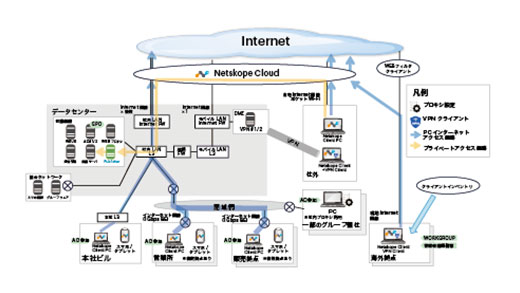
Managing shadow IT and moving away from a VPN with known vulnerabilities also became critical themes for strengthening security. Additionally, their existing remote access environment had performance issues. Assistant Manager Shoichi Matsukawa explains that “our existing remote access solution authenticated through servers at domestic data centers, which caused latency due to traffic backhauling for overseas offices,” and adds that “even within Japan, remote-work connections would sometimes become unstable.”
In 2023, the company began evaluating Zero Trust solutions to enable secure and convenient cloud service usage while resolving remote access challenges. Ishigami recalls that after consulting with Marubeni IT Solutions—a long-time business partner—they were introduced to Netskope and that “visiting a company already using Netskope and hearing their direct experience gave us confidence that Netskope could address our issues.”
When comparing different solutions, Ishigami highlights Netskope’s advantages, stating that “Netskope integrates CASB, SWG, and ZTNA into a unified platform, whereas competing products often required more complex architectures.” He also emphasizes that “Netskope’s granular control of cloud service permissions, its advanced blocking categories, and the ability to manage generative AI services were major strengths,” adding that “these categories are continuously updated, allowing us to keep pace with the latest cloud services.”
Kuniharu Seike further stresses that “for secure and reliable remote work, the ability to use CASB for cloud service visibility together with a VPN‑less environment was a major advantage.”
With Netskope, when a user performs a high‑risk action in a SaaS application, a warning pop‑up can appear directly on their screen. Instead of uniformly prohibiting actions, it explains why something is risky and steers users toward safer behavior.
The rollout of Netskope began in July 2025. After a phased release starting in September, deployment to roughly 1,000 users was completed by October. With Netskope in place, Speee’s security operations underwent a significant transformation—most notably in how the company guides user behavior.
Under traditional security measures, it was common to completely block certain actions or functions in order to avoid risk. “As a result, the network would sometimes come to a halt, causing operational disruptions,” Matsumoto recalls.
“With Netskope, when a user performs a high‑risk action in a SaaS application, a warning pop‑up can appear directly on their screen. Instead of uniformly prohibiting actions, it explains why something is risky and steers users toward safer behavior,” says Matsumoto.
In practice, the system has already detected incidents that could be considered near‑misses. One example involved a user potentially handling business data on a personal account while using a generative AI service. “This could have led to a serious data‑leak incident,” Matsumoto explains. “Because we detected it in advance, we were able to directly advise the user and guide them toward recommended AI tools. Netskope made it possible to take the right action at the right time.”
In this way, Netskope functions as a foundation that preserves user freedom while clearly defining the boundaries of unacceptable risk—ensuring governance is maintained without compromising productivity.
Netskope’s granular SaaS visibility and guided controls are unmatched, enabling strong governance without impacting performance.
In addition to the security benefits described above, one of the clearest impacts of implementing Netskope has been the improvement in network access. By optimizing traffic routes through Netskope’s SWG capabilities, the company achieved approximately 30% improvement in latency based on actual measurements. “In our internal surveys, employees consistently reported that connections felt smoother and overall speed had improved. User satisfaction clearly increased,” says Matsumoto.
At the same time, the company has been able to phase out its on‑premises VPN appliances, leading to a significant reduction in annual facility‑related costs. With the burden of operating and maintaining VPN equipment lifted, the IT department can now devote more time to higher‑value initiatives.
These achievements were highly praised by company leadership, and Matsumoto—who led the project—was awarded the company‑wide MVP recognition.
Looking ahead, Speee aims to further strengthen its zero‑trust network environment while maintaining user autonomy and freedom. “By deepening the integration between Netskope and our existing security tools—such as EDR, EPP, and SIEM—we hope to unify our fragmented security measures and enhance our defensive posture as a whole,” Matsumoto explains.
As AI agents become increasingly embedded across internal operations, autonomously exchanging and processing data, Netskope will continue to play an essential role in enabling the coexistence of advanced AI utilization and strong security.