For more than a century, the Hankyu Hanshin Holdings Group has contributed to the creation of vibrant communities and attractive railway-line areas. As a core company within the group, Hankyu Hanshin Properties is a comprehensive real estate developer engaged in a wide range of projects, including its “Geo” condominium brand, residential development, office buildings, commercial facilities, and large-scale urban development. In the Osaka Umeda area, which aims to be an international exchange hub, the company is steadily advancing multiple projects such as the Umekita Phase 2 Development and the Shibata 1-chome Project. Leveraging the expertise cultivated through railway-line development, the company is also expanding beyond the Tokyo metropolitan area into overseas markets, particularly in Asia.

Hankyu Hanshin Properties is pursuing its “DX Vision,” a digital transformation initiative designed to leverage digital technologies and continue delivering “services and experiences that customers choose first” for the next 100 years. Kuniharu Seike, Manager of the Core IT Management Group and the DX Planning and Promotion Group within the Corporate Planning Division’s DX Promotion Department, explains:
“The DX Promotion Department works alongside each business unit to drive business DX, operational DX, and value DX. These initiatives extend beyond just our company—they apply to all real estate–related group companies as well. Within that structure, the Core IT Management Group is responsible for our internal information systems.”
From the standpoint of operational DX, the company needed to modernize workstyles by achieving both strong security and high user convenience. The key to enabling this transformation was Netskope, which provides the foundation for implementing Zero Trust.
Our existing remote access solution authenticated through servers at domestic data centers, which caused latency due to traffic backhauling for overseas offices, even within Japan, remote-work connections would sometimes become unstable.

Leveraging cloud services is essential for advancing digital transformation. Reflecting on past challenges, Mitsuru Ishigami of the Corporate Planning Division’s DX Promotion Department, Core IT Management Group, explains that as the company shifted to the cloud, they needed “more flexible controls—not just allowing or blocking access, but managing actions such as viewing, uploading, downloading, and posting,” and that “traditional filtering solutions simply couldn’t meet these requirements.”

From a security perspective, the company primarily uses Box as its standard storage service. However, because real estate projects often involve collaboration with external partners, different storage services are sometimes preferred depending on the project. Ishigami notes that “we couldn’t simply block those services, so as a workaround—while maintaining our security policies—our department would download files on behalf of employees and store them in Box,” although “as the number of requests grew, the operational burden became significant.”
Managing shadow IT and moving away from a VPN with known vulnerabilities also became critical themes for strengthening security. Additionally, their existing remote access environment had performance issues. Assistant Manager Shoichi Matsukawa explains that “our existing remote access solution authenticated through servers at domestic data centers, which caused latency due to traffic backhauling for overseas offices,” and adds that “even within Japan, remote-work connections would sometimes become unstable.”
In 2023, the company began evaluating Zero Trust solutions to enable secure and convenient cloud service usage while resolving remote access challenges. Ishigami recalls that after consulting with Marubeni IT Solutions—a long-time business partner—they were introduced to Netskope and that “visiting a company already using Netskope and hearing their direct experience gave us confidence that Netskope could address our issues.”
When comparing different solutions, Ishigami highlights Netskope’s advantages, stating that “Netskope integrates CASB, SWG, and ZTNA into a unified platform, whereas competing products often required more complex architectures.” He also emphasizes that “Netskope’s granular control of cloud service permissions, its advanced blocking categories, and the ability to manage generative AI services were major strengths,” adding that “these categories are continuously updated, allowing us to keep pace with the latest cloud services.”
Kuniharu Seike further stresses that “for secure and reliable remote work, the ability to use CASB for cloud service visibility together with a VPN‑less environment was a major advantage.”
For secure and reliable remote work, the ability to use CASB for cloud service visibility together with a VPN‑less environment was a major advantage.

The company conducted a Proof of Concept (PoC) of Netskope over a three‑month period starting in September 2024. Mitsuru Ishigami explains that they resolved issues one by one during the PoC, saying that “whenever an application failed to run, we worked with Marubeni IT Solutions to adjust the Netskope configuration until the problem was cleared.”
Based on the PoC results, the company began building the environment—starting with the client inventory—in March 2025, followed by full company‑wide deployment in August 2025. During this process, they encountered challenges that had not surfaced during the PoC phase.

Kuniharu Seike explains that “as the number of deployed PCs increased during the company‑wide rollout, network traffic spiked—especially on Monday mornings—due to WORKGROUP updates and other scheduled data downloads. After consulting Marubeni IT Solutions, we changed network routing for non‑essential traffic to avoid bottlenecks. We are grateful to Marubeni IT Solutions for partnering with us as a single team throughout Netskope’s deployment and operations.”
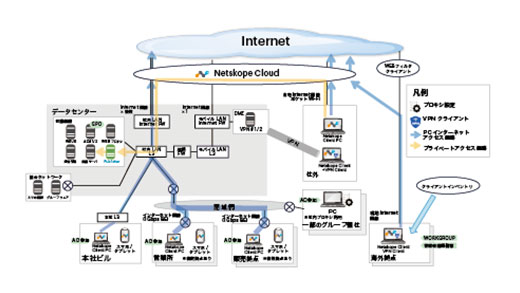
Netskope enables a Zero Trust architecture by installing an agent on each device, ensuring that all traffic is routed through Netskope by default. Users can work in a consistently secure environment without needing to perform any special operations. With ZTNA enabling the elimination of VPN and local breakout enabling direct internet access, performance has noticeably improved for both domestic and international mobile environments. As a result, users have expressed positive feedback on the enhanced experience.
Plans to manage shadow IT with even greater granularity, including differences between free and paid accounts, intend to review and rationalize cloud services to make more effective use of them.

With Netskope’s CASB, the company can now flexibly control major cloud services and ensure their secure use. By configuring restrictions on actions such as posting, employees are allowed to view popular social media platforms and YouTube, improving overall convenience. Mitsuru Ishigami notes that the team “plans to manage shadow IT with even greater granularity, including differences between free and paid accounts,” and that they “intend to review and rationalize cloud services to make more effective use of them.”
The company also developed an automated request system that allows users to submit unblock requests. Shoichi Matsukawa explains that many requests involved cloud services that could not be permitted, and that “by clearly explaining why certain services cannot be allowed, we believe we are helping to deter the use of shadow IT.”

By assigning fixed IP addresses to corporate smartphones through Netskope, the company can now enable services that were previously blocked due to legacy IP restrictions. Kuniharu Seike adds that they learned from “feedback shared by other companies using fixed IPs through information exchanges in the Netskope user community.”
Looking to the future, Seike says that the company intends to “apply the knowledge gained from deploying and managing Netskope to expand it across real estate‑related group companies, strengthening overall security and improving convenience.”
The Zero Trust platform built with Netskope will continue to balance security and usability, accelerating the realization of Hankyu Hanshin Properties’ Digital Transformation Vision.