














Get the report: How to Achieve CIO-CEO Alignment in the Era of AI
A strategic guide to implementing Zero Trust across seven pillars for complete data protection and operational resilience.
The U.S. Department of Defense Zero Trust Capability Execution Roadmap provides a strategic framework for modern security. It is based on the DoD’s Zero Trust Reference Architecture, part of the DoD’s strategy to implement ZT principles into all its digital resources and operations.
The Zero Trust Architecture rests on seven pillars that interconnect and support one another, with each pillar consisting of core capabilities and supporting activities. The central pillar and ultimate goal of any ZT strategy is the protection of organizational Data. The other pillars relate to users, devices, workloads, networks, visibility and analytics, and automation and orchestration.
The DoD zero trust roadmap is built on a highly detailed, seven-pillar reference architecture that mandates a complete reframing of security capabilities . Organizations find this struggle because their existing, non-unified security product stacks cannot easily be mapped to the required hundreds of granular activities and two distinct maturity levels (target and advanced) defined within each pillar. If security teams are forced to manually manage complex, multi-vendor controls against a single, detailed framework, it makes centralized orchestration and protection of organizational data highly difficult.
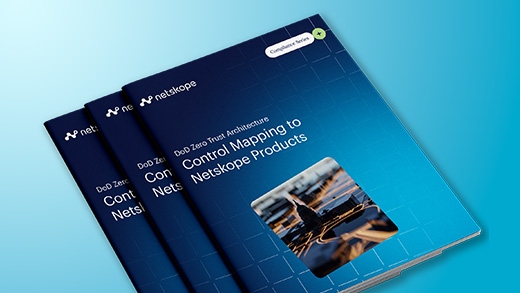
Here’s a brief overview of how Netskope provides a comprehensive platform that directly maps to the seven pillars of the DoD zero trust architecture and the target-level and advanced capabilities of the DoD Zero Trust Roadmap.
Download the DoD zero trust capability mapping guide for a detailed, pillar-by-pillar explanation of Netskope’s controls. Connect with the Netskope team immediately for demo or specific questions regarding Zero Trust implementation.