JDSC operates under the mission of “UPGRADE JAPAN—Upgrading Japan.” Backed by the knowledge base of the University of Tokyo, the company collaborates with client enterprises through a three part approach that integrates AI/Data Science × Business Transformation × Implementation into Operations and Systems. This enables JDSC to holistically support problem solving and value creation for individual companies as well as entire industries.
To drive transformations in business models and organizational culture, JDSC follows through from conceptualization and roadmap development to prototype creation and operational implementation. By forming alliances with major corporations across various industries in consortium-style initiatives, the company promotes industrial transformation. This unique contribution model has become a key strength driving JDSC’s rapid growth.

In JDSC’s co-creation business model, handling client data is common, making security the foundation of trust. “Many of our customers are large enterprises, and the security standards they expect are extremely high. Implementing advanced security products was essential to meet those expectations,” says Keisuke Hashimoto, Technical Co Founder at JDSC. He continues:
“As our business expands and our workforce grows, risks inevitably increase. Cyberattacks are becoming more sophisticated, and even well intentioned employees may fall into unexpected pitfalls. To protect the data and employees that form the core of our business, it was critical to strengthen our defenses against threats. Any information leak could be fatal for the company.”
With cyberattacks on the rise, it is essential to view growth and security as inseparable. In 2022, JDSC began selecting security solutions to address these escalating threats.
We needed a single solution that could cover the stringent security requirements of large enterprises while keeping operational overhead low. Another key point was that Netskope uses an agent installed on each device, which made deployment much easier compared to competing products.

After evaluating multiple products, the company selected Netskope as its SSE (Security Service Edge) platform. Mika Yamazaki, IT Systems Administrator at JDSC, explains the reasoning behind the decision, “because our operations team is small, we needed a single solution that could cover the stringent security requirements of large enterprises while keeping operational overhead low. Another key point was that Netskope uses an agent installed on each device, which made deployment much easier compared to competing products. In practice, we simply used automated tools to install the agent as part of our device provisioning process, so it required virtually no manual effort.”

In February 2022, to prevent information leakage, the company deployed CASB (Cloud Access Security Broker) to visualize and control cloud service usage, as well as SWG (Secure Web Gateway) to protect the organization and users from risky websites and malicious content. “We employ many data scientists and engineers, and at the time, the selection of cloud services was largely left to individual discretion. Meanwhile, our security team struggled to balance control and convenience. By using CASB, we were able to visualize shadow IT and ensure safety while still enabling the necessary cloud services. SWG also strengthens our defenses against internet-based threats,” Yamazaki adds.
By communicating Netskope’s capabilities for identifying and defending against shadow IT, we were able to foster awareness among employees and create an environment where non‑approved cloud services are no longer used.

Netskope enables the application of unified security policies both inside and outside the organization by routing all traffic through the Netskope cloud. In operating CASB, a key challenge was balancing the cloud services that data scientists and engineers wanted to use with the need to maintain security. “With Netskope, we can manage how traffic is forwarded from endpoints to the Netskope cloud and specify which traffic should be excluded (bypassed). What matters most is ensuring that users can keep the Netskope agent turned on at all times. To prevent users from disabling the agent for convenience, we grant bypass permissions where appropriate,” explains Yamazaki.

The company also requires employees to submit requests when they want to use new cloud services. “When determining whether a service should be approved or rejected, we rely not only on our own research but also on the cloud risk ratings provided by the Netskope App Catalog (formerly CCI). If a service is deemed non‑approved, we make sure to present alternatives,” says Yoshiaki Sato, Head of Group IT & Security.
Hashimoto reflects on the impact of deploying CASB,“By communicating Netskope’s capabilities for identifying and defending against shadow IT, we were able to foster awareness among employees and create an environment where non‑approved cloud services are no longer used.”
The introduction of SWG has also prevented attempts to access inappropriate content before incidents could occur. Sato adds that internal surveys have included positive feedback such as, “We appreciate that JDSC has adopted Netskope and built a sophisticated security framework.”
With our workforce expanding rapidly, we plan to leverage Netskope’s capabilities to detect data exfiltration from cloud storage and identify suspicious behavior.

Following the deployment of CASB and SWG, the company moved to the next step, implementing Zero Trust. “Many of our data scientists and engineers frequently work from home or remotely. We also opened a Kansai office and added more team members. To provide a secure and seamless remote work environment—whether outside the office or across locations—we needed a Zero Trust architecture that ensures consistent security beyond network boundaries,” says Hashimoto.
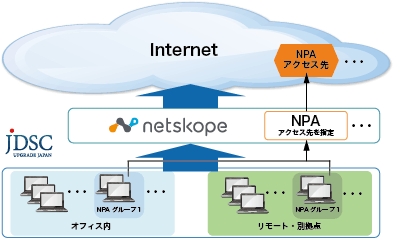
The company selected Netskope Private Access (NPA), a Zero Trust–based remote access solution. Unlike traditional on premises VPNs, NPA delivers application level authentication through the cloud, eliminating the need for appliance maintenance or updates and reducing vulnerabilities.

NPA also enabled the company to meet customer requirements. “Netskope assigns virtual IPs by default, but some customers required us to connect from a fixed IP so they could verify the source of inbound traffic. At first, we built our own proxy to route traffic and provide a fixed IP. With NPA, we can meet this requirement simply through configuration,” explains Hashimoto.
A proof of concept for NPA began in December 2025, and full deployment started in February 2026. “We’ve already received multiple requests from project teams wanting to use NPA. I expect the primary use cases will be accessing customer environments and test environments,” Yamazaki notes.
Looking ahead, Sato describes the company’s next steps in strengthening security, “with our workforce expanding rapidly, we plan to leverage Netskope’s capabilities to detect data exfiltration from cloud storage and identify suspicious behavior. We are also evaluating a rollout of Netskope to our group companies.”
Yamazaki adds that strengthening internal defenses remains a priority. “By using Netskope’s real-time protection—monitoring and controlling traffic between users and the web—we are building detection mechanisms to identify unusual actions, such as large file downloads by individuals planning to leave the company.”
Security must be approached from both the administrative and user perspectives. “It’s important not only for administrators to request certain behaviors but also for users themselves to want to adopt secure tools—like when users proactively ask to use NPA. This mindset is essential for strengthening security. We also expect ongoing feature enhancements from Netskope that reduce operational burdens,” says Hashimoto.
With AI and data science driving industrial transformation, JDSC relies on the Netskope security platform to strengthen customer trust while enabling both security and convenience in remote work—ultimately supporting the company’s co creation efforts.