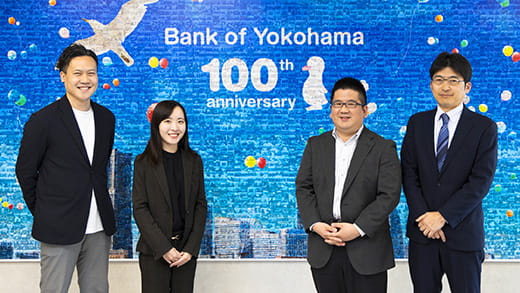
As one of Japan’s largest regional banks, Bank of Yokohama works hand in hand with local communities and customers, primarily in Kanagawa Prefecture. In response to the expanding use of AI, the rise in cyberattacks, and the adoption of hybrid work, the bank has transformed its intranet (hereinafter “Intra”) from a data center-centric model to a cloud-based zero-trust architecture. To achieve Zero Trust, the bank adopted Netskope’s SASE. The deciding factor was that it met all of the bank’s security requirements. The new intranet, which also aligns with the direction of the “Guidelines on Cybersecurity in the Financial Sector,” has attracted significant interest from other regional banks.
Founded in 1920, Bank of Yokohama has fulfilled its responsibilities as a regional financial institution for over 100 years, primarily serving Kanagawa Prefecture. As the core of the Yokohama Financial Group, it collaborates with group companies to provide comprehensive financial solutions. In 2022, the group established its long-term vision as “a solution company chosen as a partner deeply rooted in the community and walking alongside it.” To realize this vision, a mid-term management plan launched in April 2025. The three core themes are “Growth,” “Empowerment,” and “Sustainability.”
Hisao Ishikawa, General Manager of the IT Solutions Department at Bank of Yokohama, explains “Empowerment,” which serves as the driving force behind the plan. “Under Empowerment, we are actively investing in human capital to develop the talent needed to fulfill our role as a ‘Solution Company.’ We are also focusing on creating an environment where every employee can maximize their potential by leveraging business reforms and digital technologies such as generative AI. From an IT perspective, the key points are improving productivity and strengthening governance.”
Bank of Yokohama has many client relationship managers who conduct business off-site, and to accommodate diverse work styles, the bank has continued remote work even after the pandemic and introduced a hybrid work model. Junpei Yoshino, Leader of the IT Solutions Department at Bank of Yokohama, reflects on the challenges of the existing intranet, which combined VDI (Virtual Desktop Infrastructure) with thin clients.
“It took a long time to boot up the PC, and performance was slow. Additionally, since it was managed in an on-premises data center, there were challenges regarding business continuity in the event of disasters or outages. Furthermore, we needed to expand the use of AI and address the growing threat of cyberattacks. In 2023, we launched an intranet renewal initiative to address these challenges.”
The decisive factor in our adoption decision, based on the PoC results, was whether the solution could meet the bank’s security requirements. Netskope was the only solution that met all of them.
The intranet renewal initiative aimed to move away from a data center-centric model. “To meet the demands of improving business performance and leveraging AI, there were limits to scaling up within a centralized data center model,” said Tomotsugu Miura, Assistant Leader of the IT Solutions Department, adding:
“For the new intranet, which needed to achieve both improved productivity and strengthened governance, we required a Zero Trust approach—one that is cloud-based rather than an on-premises perimeter model—to create a secure working environment both inside and outside the company. It also became a key component of the cybersecurity measures defined in the ‘Guidelines on Cybersecurity in the Financial Sector’ issued by the Financial Services Agency.”
To implement Zero Trust, Bank of Yokohama narrowed down its SASE product options and conducted a PoC (Proof of Concept). “The decisive factor in our adoption decision, based on the PoC results, was whether the solution could meet the bank’s security requirements. Netskope was the only solution that met all of them,” said Yoshino.
In addition to security requirements, Bank of Yokohama decided to implement Netskope in March 2024 based on a comprehensive evaluation that included SASE functionality, ease of operation via an integrated console, and cost. Led by the Security Management Office (now the Security Management Department), the bank compiled a list of security risks, defined requirements based on those risks, and mapped them to Netskope’s features.
We were able to visualize shadow IT using CASB (Cloud Access Security Broker). Additionally, since we can control specific actions such as data viewing and downloading, we are able to operate the system with employee convenience in mind.
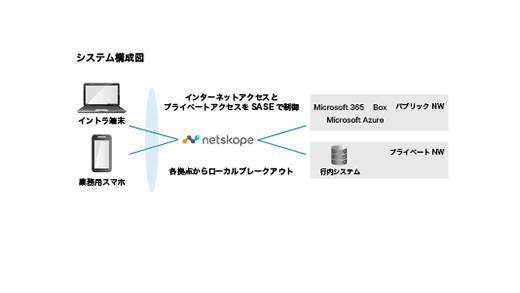
In the new intranet, which uses Netskope as its security foundation, agents installed on endpoints (FAT terminals, tablets) ensure that all communications are routed through the internet to the SASE, thereby enabling a zero-trust environment. In April 2025, we began a pilot operation of the new intranet, and starting in May 2025, we sequentially distributed approximately 15,000 devices to head offices and branches.
For the company-wide rollout of the new intranet, we assigned ambassadors for each region in addition to the IT managers in each department to serve as information liaisons.
“The ambassadors serve as a point of contact for the intranet environment utilizing Netskope. “We also set up an online support desk via Microsoft Teams, but I believe the presence of ambassadors who could be consulted face-to-face provided a sense of reassurance. We also invited instructors from Netskope to explain the background of the intranet overhaul, security risks, and countermeasures using Netskope to IT managers and ambassadors,” says Reina Koyama of the IT Solutions Department at Bank of Yokohama.
Operating the new intranet environment also requires individualized support when communicating with clients such as government agencies. “While unauthorized cloud services are generally blocked, we collaborate with the Security Management Office to make adjustments—such as changing settings or adding whitelists—as needed, ensuring we respond quickly to employee requests,” says Ms. Koyama.
In response to the expanding use of AI and the increase in cyberattacks, building an intranet that supports financial operations is a common challenge for regional banks. Through our efforts to build this new intranet, we hope to contribute to solving the challenges faced by regional financial institutions across Japan.
Security in the cloud-based work environment has been significantly strengthened through Netskope’s SASE-based Zero Trust architecture. “We were able to visualize shadow IT using CASB (Cloud Access Security Broker). Additionally, since we can control specific actions such as data viewing and downloading, we are able to operate the system with employee convenience in mind,” says Miura.
Netskope’s SSL inspection feature decrypts and inspects encrypted traffic to prevent malware infiltration and the leakage of confidential information. Furthermore, when using Box as an external file-sharing tool, the DLP (Data Loss Prevention) feature helps mitigate the risk of sensitive data leaks.
Miura elaborates on its application: “By using DLP, the moment an employee stores a file in Box, it is automatically labeled as ‘containing confidential information.’ This allows us to optimize operations by implementing more rigorous user checks based on the file’s sensitivity level. The labeling process takes just a few seconds. This processing speed was also a key factor in our decision to adopt Netskope.”
Thanks to local breakout—where users access the internet directly from remote locations—PC boot times have been reduced from over ten minutes to less than a minute, and web conferences are now comfortable and smooth. Additionally, while we previously used smartphone tethering to launch VPN software and access thin clients, now as long as we’re connected to Wi-Fi, we can work in a secure environment from anywhere.
Regarding the future, “We plan to leverage AI to enhance user behavior analysis and other capabilities. Security updates are necessary as times change. We intend to continue leveraging Netskope to the fullest extent possible,” said Miura. Yoshino added, “Under a zero-trust framework, we will move away from vulnerable VPNs and optimize network connections. We also plan to roll out the Netskope-based intranet across the entire group to strengthen security.”
The zero-trust solution based on Netskope’s SASE, implemented by The Bank of Yokohama, is attracting attention from other regional banks. Ishikawa commented on the social significance of this initiative: “In response to the expanding use of AI and the increase in cyberattacks, building an intranet that supports financial operations is a common challenge for regional banks. Through our efforts to build this new intranet, we hope to contribute to solving the challenges faced by regional financial institutions across Japan.”
The Yokohama Financial Group aims to be “an indispensable financial group for the region.” Netskope’s Zero Trust solution will support the challenges and growth of Bank of Yokohama, the core of this group.