Today, approximately 30,000 domestic employees of the PERSOL Group use cloud services safely and efficiently, enhancing productivity in a secure and reliable environment.
Human resources are the source of corporate vitality. As labor shortages grow into a major social challenge, the importance of the HR business is rising daily. With the goal of creating “better work opportunities for one million people by 2030,” PERSOL is evolving into a technology-driven HR services company through DX initiatives. As part of this transformation, the company actively leverages generative AI to improve customer and employee experiences while driving new value creation.
To achieve this vision, business expansion and productivity improvements are essential. To enhance flexible working styles while avoiding top risks associated with handling sensitive data, the company turned to Zero Trust. Masato Ida, General Manager of the Secure Network Office, Secure Access Infrastructure Department, Group IT Headquarters, explains the background.

“At our company, we encourage employees to proactively choose a work style that fits them best, and remote work has become established since the COVID-19 pandemic. However, this also brought new challenges—namely, the limitations of perimeter-based security relying on firewalls, and the growing need to support users’ increasing use of cloud services. In 2020, we began exploring Zero Trust to ensure security regardless of location.”
The first step in the company’s Zero Trust project was to gain buy-in from business divisions. “With Zero Trust, we would be shifting from on-premises proxies to cloud proxies, meaning a major change in our network environment. We needed to explain the significance and process changes to each division,” says Yuki Haneishi, Lead Consultant of the Secure Network Office. He continues, “We also collected requests from the business divisions regarding security and usability. We compiled those, added key priorities for the project, and created a detailed comparison table with about 400 evaluation items.”
We built a Netskope portal, developed usage guidelines and Q&A documents, and held study sessions for security staff at group companies to explore how to leverage Netskope effectively together.

Based on that comparison, the company conducted a detailed evaluation of Zero Trust products and, in October 2022, decided to adopt the cloud-based security platform Netskope. In addition to core functions such as cloud proxy and URL filtering, three main points became decisive, Haneishi explains.
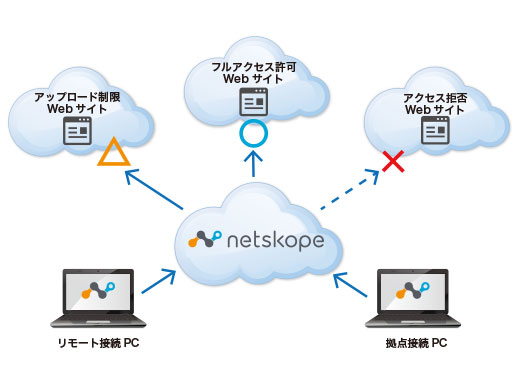
“The first was source IP fixation, since some client contracts require assurance that access originates from the PERSOL environment. The second was operation-level control, which allows viewing while blocking uploads and meets user requirements. The third was HTTPS decryption, which provides full visibility into user-to-website communications. In addition, expandability through CASB (Cloud Access Security Broker), ZTNA (Zero Trust Network Access), and cloud firewall functions was also a major advantage.”

The Netskope deployment primarily focused on migrating from the existing proxy. With Netskope’s support, the company implemented risk-mitigation measures such as parallel operation with the legacy proxy and a small-scale phased rollout, achieving a smooth transition with zero downtime.
Naoto Okawa, Senior Consultant of the Secure Network Office, recalls, “We built a Netskope portal, developed usage guidelines and Q&A documents, and held study sessions for security staff at group companies to explore how to leverage Netskope effectively together.”
Netskope allows unified management of all internet-bound communications—not only through browsers but also all traffic from PCs accessing the internet.

By the end of 2023, Netskope had been fully deployed across the PERSOL Group, and use began in 2024. As of May 2025, approximately 30,000 domestic employees are utilizing it. “We gradually installed the Netskope client on all company-issued PCs, completing the rollout without affecting performance,” says Okawa.
Since the PoC in October 2022, Netskope has operated stably. Users have even reported improved connection quality. “With the expansion of remote work, network traffic had become concentrated in our on-prem data centers, causing congestion. By routing essential traffic such as email and cloud service communication through Netskope, we successfully reduced traffic inside the data center,” explains Haneishi.

Along with improved usability, operational workloads were also reduced. “Because control is possible at the operation level, users can access necessary cloud services instantly without extra effort. Meanwhile, the IT and security departments have significantly reduced workloads related to security reviews,” Haneishi adds.
From a security standpoint, Okawa highlights the importance of leveraging the cloud firewall. “Netskope allows unified management of all internet-bound communications—not only through browsers but also all traffic from PCs accessing the internet. By September 2025, all 30,000 domestic group employees using Netskope will be fully covered.”
With this project, we’ve built a Zero Trust foundation that supports our group’s businesses. The key is that all internet-bound communications are centralized and visible in logs, allowing us to develop various initiatives.

As cloud usage expands, countermeasures against shadow IT are increasingly crucial to prevent data leaks.“By using CASB, we can visualize communications at the application level, clearly identifying shadow IT usage. The scoring function for shadow IT risks also provides criteria for approving or rejecting services, making user alignment easier through data-backed discussions,” explains Okawa.
He adds that the company is developing dashboards to visualize Netskope data. “By sharing information among IT and security teams, we can accelerate and improve incident response and security measures. Utilizing Netskope to continuously enhance security operations is a key theme for us.”

Looking ahead, Ida says, “With this project, we’ve built a Zero Trust foundation that supports our group’s businesses. The key is that all internet-bound communications are centralized and visible in logs, allowing us to develop various initiatives. Going forward, we look forward to leveraging Netskope’s AI capabilities, such as UEBA (User and Entity Behavior Analytics), which detects behavioral anomalies through machine learning.”
Guided by the vision of “Work and Smile,” PERSOL Group’s Zero Trust foundation built on Netskope continues to support both the group’s growth and its mission to help solve social challenges.