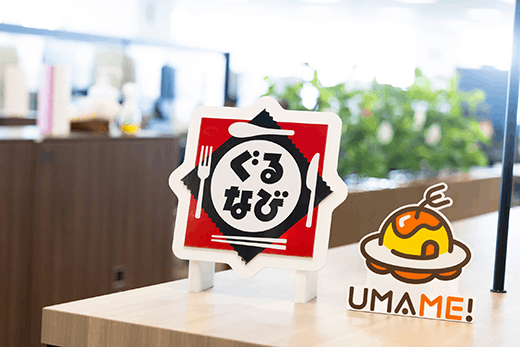
Gurunavi’s restaurant information platform first launched in 1996 during the early days of the internet. Guided by its founding mission to “preserve and nurture Japan’s food culture,” the company grew significantly with support from users and partner restaurants. In October 2023, the site was renamed “Rakuten Gurunavi” to deepen collaboration with the Rakuten Group. Gurunavi continues expanding its services as a “restaurant digital transformation best partner,” introducing solutions such as FineOrder, a mobile ordering system that addresses labor shortages, and UMAME!, an AI powered restaurant discovery app.

In 2021, Gurunavi declared its purpose, “Connecting people through food and fulfilling them.” To advance this mission, one of the company’s transformation pillars became creating an environment where diverse talent can demonstrate their strengths, maximizing performance for both individuals and the organization. As part of this transformation, hybrid work emerged as a key initiative. Gurunavi aimed to achieve zero trust, enabling employees to securely access cloud services anytime and anywhere.
By promoting understanding of the importance of cloud visibility and control, standardizing workarounds, and offering ongoing support, we successfully maintained comprehensive visibility and control without impacting developer productivity.

Gurunavi’s first initiative was visualizing and governing cloud service usage. The company prioritizes cloud technologies to maintain business agility and respond quickly to market changes. According to Yuji Tsushima, Deputy Section Manager, Infrastructure Service Section, System Development Department, System Development Division, the company faced challenges with its existing environment.
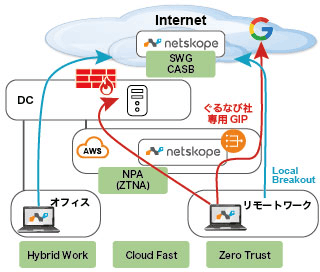
“As cloud services expanded, the legacy on-premises proxy servers lacked sufficient capabilities to address shadow IT. Network traffic within the data center grew congested, accelerating the need for local breakout to enable remote workers to access the internet directly. When the proxy hardware neared end-of-life, we began evaluating solutions in late 2019 that could visualize and control cloud usage while enabling local breakout.”

In spring 2020, Netskope was selected as the SASE platform capable of meeting these requirements. A key factor was its real‑time visibility and control for Windows, along with advanced CASB functionality that competing solutions at the time could not deliver at the same level for Mac devices.
Throughout deployment, development teams submitted improvement requests regarding errors related to various cloud services. “By promoting understanding of the importance of cloud visibility and control, standardizing workarounds, and offering ongoing support, we successfully maintained comprehensive visibility and control without impacting developer productivity.”
The fact that Netskope was more cost-effective than our managed VPN service also supported approval at the executive level.

Gurunavi then advanced toward zero trust by eliminating its VPN. Remote work had become standard during the pandemic, and hybrid work remained essential afterward. Achieving this required consistent application of security policies both inside and outside the office.
Regarding the selection of zero trust solutions, Tsushima explains, “We selected Netskope due to its strong compatibility with our existing cloud visibility and governance features, and because integrated management of security tools was advantageous. The fact that Netskope was more cost-effective than our managed VPN service also supported approval at the executive level.”

In fall 2024, Gurunavi conducted a Proof of Concept (PoC) for Netskope Private Access (NPA). The goal was to ensure NPA could meet the same requirements as the VPN. “We redesigned access rules to shift from IP-based firewalling to user-based control. Because Netskope assigns virtual IPs, we also implemented measures to avoid rare conflicts between user IP addresses and virtual IPs.”
TOKYO ELECTRON DEVICE LIMITED (TED), which had supported Netskope operations since the initial rollout, provided technical support for the PoC. Tsushima notes, “TED’s dedicated engineer provided thorough support during the PoC. Even after going live, we continue receiving monthly analysis and advice based on the latest Netskope technologies.”
After a two month PoC, Gurunavi began a phased rollout of NPA in November 2024 and completed company wide migration in November 2025.
By establishing a system in which all communication—whether inside or outside the company—is uniformly inspected through Netskope, we were able to eliminate the concern that security might become weaker during remote work.

Regarding the impact of introducing Zero Trust from the perspective of hybrid work, Tsushima explains, “By establishing a system in which all communication—whether inside or outside the company—is uniformly inspected through Netskope, we were able to eliminate the concern that security might become weaker during remote work.”
Governance over cloud service usage, which had been a long-standing challenge, was also successfully established. “By visualizing all cloud services used within the company through Netskope, we can identify shadow IT and immediately block or control high risk applications. In addition, our Security Management Office utilizes the cloud service risk assessments provided by Netskope’s App Catalog (formerly CCI) to determine whether to approve or reject each cloud service. Furthermore, TED analyzes Netskope logs and provides reports on the usage trends and behavior related to non approved services.”

Local breakout has also improved communication performance for remote work environments, including eliminating delays in web conferences and shortening the time required for transferring large files. Network congestion in the data center has been resolved, reducing the need for costly circuit upgrades. In addition, by introducing NPA and eliminating the VPN, Gurunavi not only removed associated vulnerabilities but also achieved approximately 40% cost reduction by canceling the managed VPN service. Netskope Client, installed on user devices, now updates automatically, reducing to nearly zero the operational workload previously required for VPN client software version management.
Regarding future plans, Tsushima continues, “One of our key initiatives moving forward is reducing the high cost WAN circuits at each office and transitioning to a simple network architecture centered on ‘Netskope × high quality internet connectivity.’ This approach will optimize traffic, improve communication stability, and further reduce costs. We also plan to introduce Netskope to devices other than PCs, applying the same security policies to realize secure hybrid work environments regardless of device type. We also have high expectations for Netskope’s AI enhanced services and the further advancement of our operations.”
Gurunavi continues expanding the possibilities of the food industry, and the realization of zero trust through Netskope’s SASE platform will contribute to the development of the restaurant sector as the company pursues ongoing challenges and growth.